Bitcoin Remains Calm Amid Iran Escalation – Market Awaits TradFi
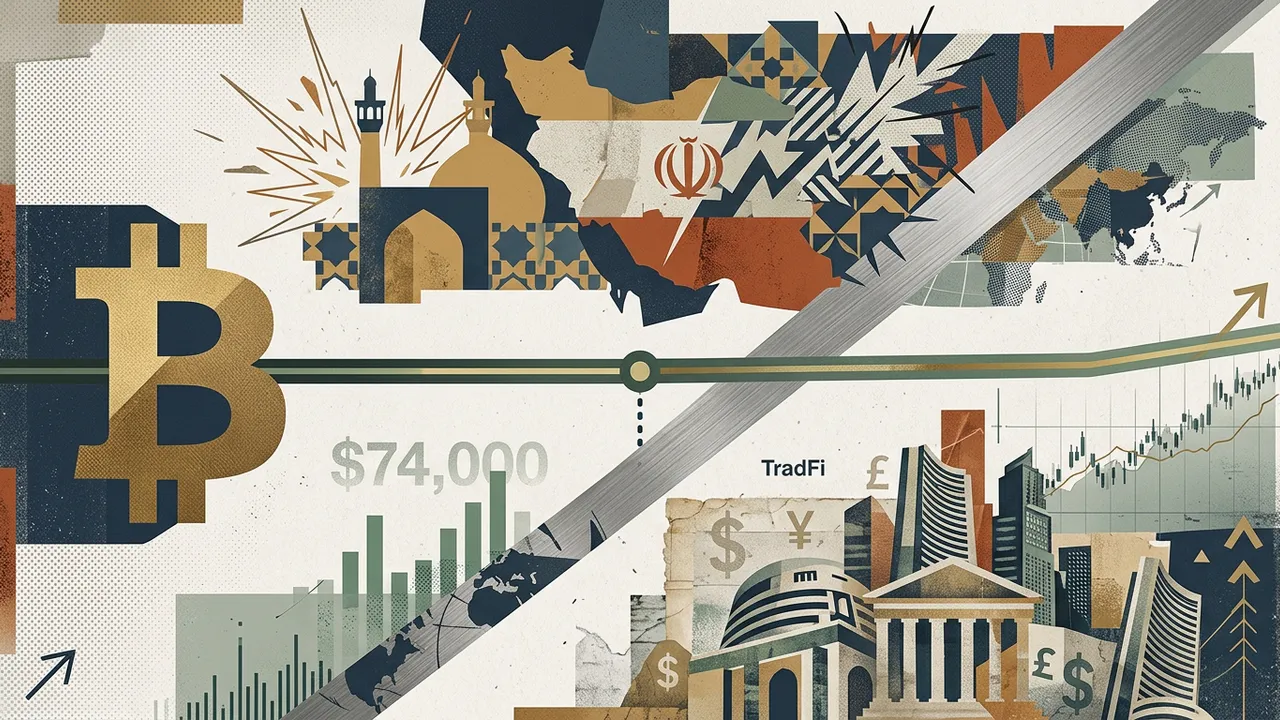
Despite geopolitical turbulence in the Middle East, Bitcoin shows relative stability. Analysts see potential for a rise to $74,000, while the reaction of traditional markets becomes the decisive factor.
Bitcoin Demonstrates Resilience During Geopolitical Crisis
While the world watches developments in the Middle East, the Bitcoin market reveals a remarkable characteristic: The world's largest cryptocurrency is showing increasing immunity to short-term geopolitical shocks. After a brief decline, Bitcoin quickly recovered and settled in the range around $67,000 – behavior that raises questions about the market's increasing maturity while simultaneously highlighting its dependence on traditional financial markets.
Recent events in Iran and the associated market reaction offer valuable insights into Bitcoin's changing role as a potential safe haven and its integration into the global financial system.
The Facts
Following airstrikes by the United States and Israel on Iranian targets, the Bitcoin price initially fell to around $63,000 [1]. However, the subsequent recovery was swift: Within less than 24 hours, Bitcoin gained approximately $5,000 and temporarily reached $68,200 [1]. By the weekend, the price stabilized in the range of $66,500 to $67,000 [1][2].
The background to the market movements were reports of the death of Iran's Supreme Leader Ayatollah Ali Khamenei. According to Reuters, Iran's Supreme National Security Council stated that Khamenei was killed in his office on Saturday [1]. U.S. President Donald Trump described Khamenei on his Truth Social platform as "one of the most vicious people in history" and declared that his death was justice for the people of Iran and worldwide [1].
The volatility led to significant liquidations: According to CoinGlass data, approximately 100,000 traders were liquidated in the past 24 hours, with a total volume of $450 million. Long and short positions were roughly equally affected [1]. The broader crypto market also benefited from the recovery: Among the top 10, Solana rose the most with nearly ten percent, while LayerZero (ZRO) was the biggest winner with approximately 22 percent [1].
Analysts are now closely watching the reaction of traditional financial markets. U.S. stock market futures were down 0.65 percent over the weekend [2]. Crypto analyst Michaël van de Poppe described the initial reaction as "positive," but warned: "There is uncertainty about how the U.S. markets will open tomorrow" [2]. He pointed to the 21-day average at $67,627 as an important level for a potential recovery rally [2].
Trader BitBull was optimistic and predicted: "Bitcoin looks good in the short term. I think a rally towards the $73,000 to $74,000 level could happen" [2]. Crypto analyst Ash Crypto articulated the situation precisely: "If this conflict shows signs of resolution before the stock market opens on Monday, I think Bitcoin can hold its gains and rise further. However, if the bombings continue, the market will be quite volatile" [1].
Additional uncertainty arises from the situation in the Strait of Hormuz. Iran announced it would close this important oil transport route, leading to concerns about rising oil prices and associated inflationary effects [2]. The Kobeissi Letter referenced analyses by JPMorgan, according to which the U.S. Consumer Price Index (CPI) could jump to 5 percent – a level last reached in March 2023, when the Federal Reserve was aggressively raising interest rates [2].
Analysis & Context
The market reaction to the Iran crisis reveals several significant developments in the Bitcoin ecosystem. First, it's notable that while Bitcoin reacted volatilely, it did not experience extreme panic selling. The rapid decline to $63,000 and subsequent recovery suggest that many investors had already "priced in" geopolitical instability – a thesis supported by several analysts [2].
Particularly revealing is the dependence on traditional financial markets. The fact that the weekend prevented TradFi markets from reacting in real-time created a vacuum in which Bitcoin initially acted independently. The fact that analysts are now eagerly awaiting the opening of U.S. stock markets underscores an important reality: Bitcoin may be decentralized, but its price is closely linked to the global financial system. The CME gap at $65,880, which van de Poppe pointed out, could well still be filled if traditional markets react negatively.
Historically, Bitcoin has reacted differently to geopolitical crises. During the 2014 Crimea annexation and at the beginning of the 2022 Ukraine war, there was short-term volatility in each case, followed by recoveries. However, by 2022, Bitcoin was already much more integrated into institutional portfolios, which strengthened its correlation with risk assets. The current situation shows an intermediate stage: Bitcoin reacts to geopolitical events but recovers quickly when immediate panic subsides.
The potential oil price crisis from a closure of the Strait of Hormuz could paradoxically work both positively and negatively for Bitcoin. Rising inflation could increase Bitcoin's attractiveness as an inflation hedge, but would simultaneously force the Federal Reserve toward tighter monetary policy – traditionally negative for risk assets. This dual dynamic makes short-term predictions particularly difficult.
Technical analysis points to a critical level: Breaking through the 21-day average at approximately $67,600 could indeed pave the way for a rally toward $73,000 to $74,000, as several analysts predict. At the same time, the CME gap to the downside remains a risk that should not be ignored. The massive liquidation of $450 million also shows that the market remains highly leveraged, which could lead to additional volatility with further geopolitical developments.
Conclusion
• Bitcoin demonstrates increasing maturity through rapid recovery after geopolitical shock, but remains closely linked to traditional markets – the reaction of U.S. stock markets will be decisive for further price development
• Analysts see short-term potential for a rally to $73,000 to $74,000, provided the 21-day average at $67,600 is sustainably exceeded and no further military escalation occurs
• The potential oil price crisis from a closure of the Strait of Hormuz could lead to an inflation increase, which could benefit Bitcoin in the medium term but would likely be burdened in the short term by more restrictive monetary policy
• The high number of liquidations ($450 million) shows that the market remains highly leveraged – investors should expect continued volatility until more clarity exists about the geopolitical situation
• Market observers speak of a "pricing in" of geopolitical risks, suggesting that Bitcoin investors are increasingly able to distinguish between short-term shocks and fundamental threats
Sources
AI-Assisted Content
This article was created with AI assistance. All facts are sourced from verified news outlets.