Bitcoin's $60K Breakdown: Correction or Structural Shift?
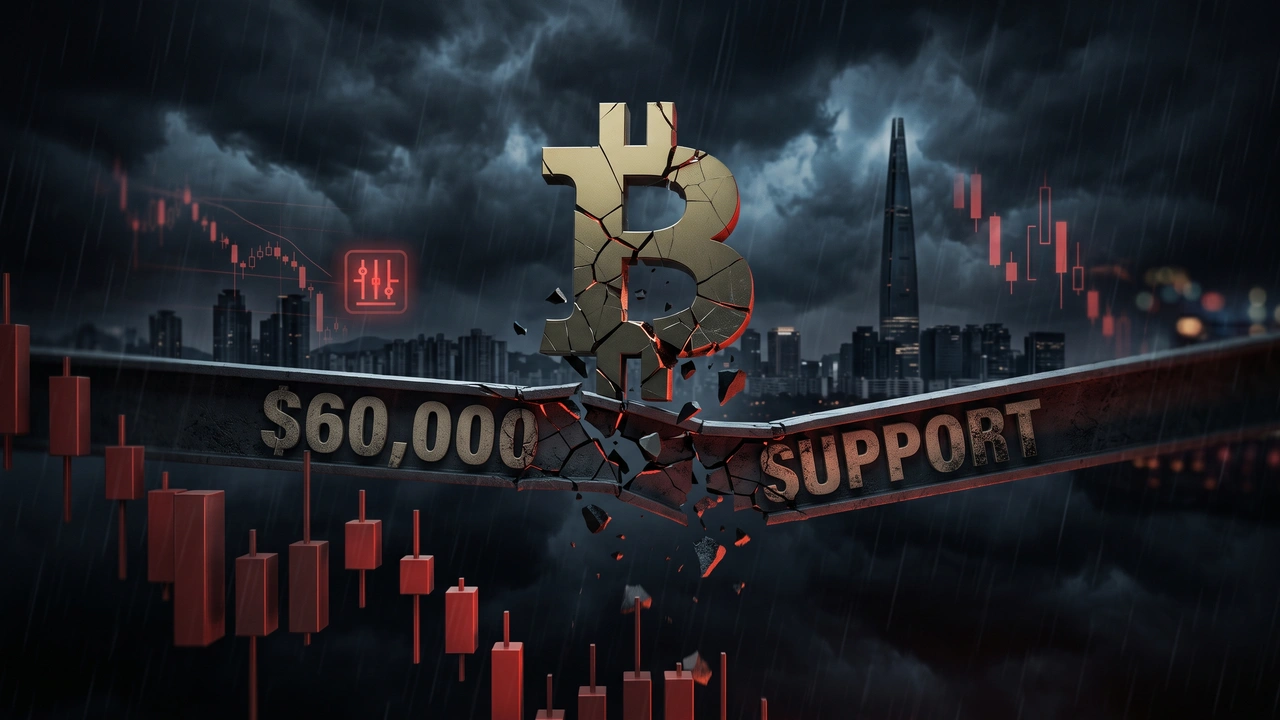
Bitcoin posted its first daily close beneath $60,000 since September 2024, while altcoins like Dogecoin collapsed to multi-year lows - raising urgent questions about whether this correction has further to run or is nearing exhaustion.
Key Takeaways
- Bitcoin's first daily close beneath $60,000 since September 2024 has turned a former support level into active resistance, raising the technical cost of any recovery.
- The Fed's inflation outlook - with its 2026 forecast revised from 2.7% to 3.6% - removes the near-term rate-cut catalyst that had underpinned much of the crypto bull case.
- Asian equity market instability, including an 8% crash triggering South Korean circuit-breakers, is amplifying risk-off flows that hit Bitcoin alongside tech stocks.
- The 200-week moving average near $62,243 is the critical reclaim target for bulls - a confirmed weekly close above it would significantly strengthen the recovery argument.
- Altcoins like Dogecoin are absorbing losses far exceeding Bitcoin's drawdown, a classic late-correction pattern that historically precedes - but does not guarantee - broader market stabilization.
Bitcoin's $60K Breakdown: Correction or Structural Shift?
The number $60,000 has quietly transformed from a floor into a ceiling. That psychological and technical inversion - from support to resistance - may be the most consequential development in Bitcoin's near-term price story, and it arrived alongside a broader deterioration in global risk appetite that is making the path back upward considerably steeper than many bulls anticipated.
The current downturn is not isolated to Bitcoin. Across the crypto landscape, the damage is deepening, with lower-cap assets bearing the heaviest losses. The question now is whether this is a routine bull-market shakeout or something with more structural weight behind it.
The Facts
For the first time since the third quarter of 2024, Bitcoin sealed a daily candle below $60,000 - a threshold that had previously served as durable support throughout much of the preceding cycle [2]. The breach is not merely symbolic. Once a major level flips from support to resistance, bulls must fight harder to reclaim it, and each failed attempt reinforces selling pressure from traders who bought near that zone and are now looking to exit at breakeven.
The immediate backdrop is a tech-driven rout in Asian equity markets. South Korean exchanges activated circuit-breakers after an 8% single-session collapse, part of a pattern of sustained losses across the region that has fed directly into risk-off sentiment in crypto [2]. US markets proved more resilient - the S&P 500 and the Dow Jones both held in positive territory - but that divergence offers limited comfort when Bitcoin tends to track global rather than purely domestic equity sentiment [2].
Macroeconomic fundamentals are adding a second layer of headwind. The Federal Reserve's preferred inflation benchmark, the Personal Consumption Expenditures index, recorded its steepest year-on-year climb since mid-2023 [2]. Trading firm QCP Capital highlighted the significance, noting that core PCE is currently tracking around 3.30% and headline PCE near 3.82% - both running well above the Fed's stated target [2]. More striking still, the Fed's own inflation projection for 2026 has been revised sharply upward, from 2.7% to 3.6%, leading QCP to argue that inflation - not economic growth - has become the primary constraint on monetary policy [2]. For Bitcoin and other risk assets, this means rate cuts remain a distant prospect, removing a catalyst that many market participants had been pricing in.
The tech sector's deterioration deserves separate attention. Market commentator The Kobeissi Letter pointed out that numerous major technology companies are already down more than 50% from their record highs, with crypto exchange Coinbase leading that grim roster at -69% below its peak [2]. Strategy - formerly MicroStrategy and the world's largest corporate holder of Bitcoin - has also seen notable pressure, with its Bitcoin-linked instrument STRC logging a significant decline [2]. These are not peripheral data points. When the companies most closely associated with the crypto narrative are themselves in deep drawdown territory, it compounds the difficulty of maintaining bullish conviction.
The altcoin market is absorbing even sharper losses. Dogecoin has slipped out of the top ten by market capitalization and touched a fresh annual low [1]. A rally earlier in the month - tied in part to speculation around a SpaceX IPO - failed to hold, and DOGE has since surrendered roughly 36% from its prior monthly high near $0.118 [1]. The memecoin's underperformance illustrates a pattern familiar from previous corrections: when Bitcoin comes under pressure, speculative assets on the periphery tend to amplify the move downward.
On the technical side, the 200-week simple moving average sits at approximately $62,243 - a level that has historically served as a long-cycle anchor during bear phases [2]. Analyst Michaël Van de Poppe flagged a potential bullish divergence forming on the daily chart while also stressing that any recovery thesis depends entirely on Bitcoin closing back above that moving average [2]. As he noted, "the markets need to bounce back upwards in order to close above the 200-Week MA" - a concise framing of the bull case, but one that remains unconfirmed.
Analysis & Context
The 200-week moving average has an almost mythological status in Bitcoin cycle analysis, and for good reason. During the 2018-2019 bear market and again during the 2022 collapse, this indicator roughly traced the floor of maximum drawdown. Bitcoin briefly pierced it in both cycles before recovering - each time providing a violent but ultimately profitable entry for long-term holders. The current test is structurally different from those episodes, however, because Bitcoin is approaching this trendline from a position of still-elevated prices rather than after a 70%-plus collapse. That means the 200-week SMA retains its significance as a psychological anchor without carrying the same historical guarantee of being a capitulation bottom.
The more instructive parallel may be the pattern recognition around inflation-driven corrections specifically. When the Fed's hands are tied by persistent price pressure - as QCP Capital's analysis implies they currently are - Bitcoin's traditional macro tailwind of anticipated liquidity expansion simply disappears. Rate cuts were a significant part of the bullish narrative entering 2025 and 2026. With the Fed's own forecast now embedding higher inflation through the forecast horizon, that narrative needs to be revised. Investors who built positions on the assumption of a rate-cut cycle arriving within months may be repricing those positions, and that unwinding can be both painful and prolonged. The key risk is not a single sharp drop but a grinding, multi-month consolidation that exhausts late-cycle participants.
Sources
AI-Assisted Content
This article was created with AI assistance. All facts are sourced from verified news outlets.