Bitcoin's $76K Rejection: Relief Rally or Bear Trap in Disguise?
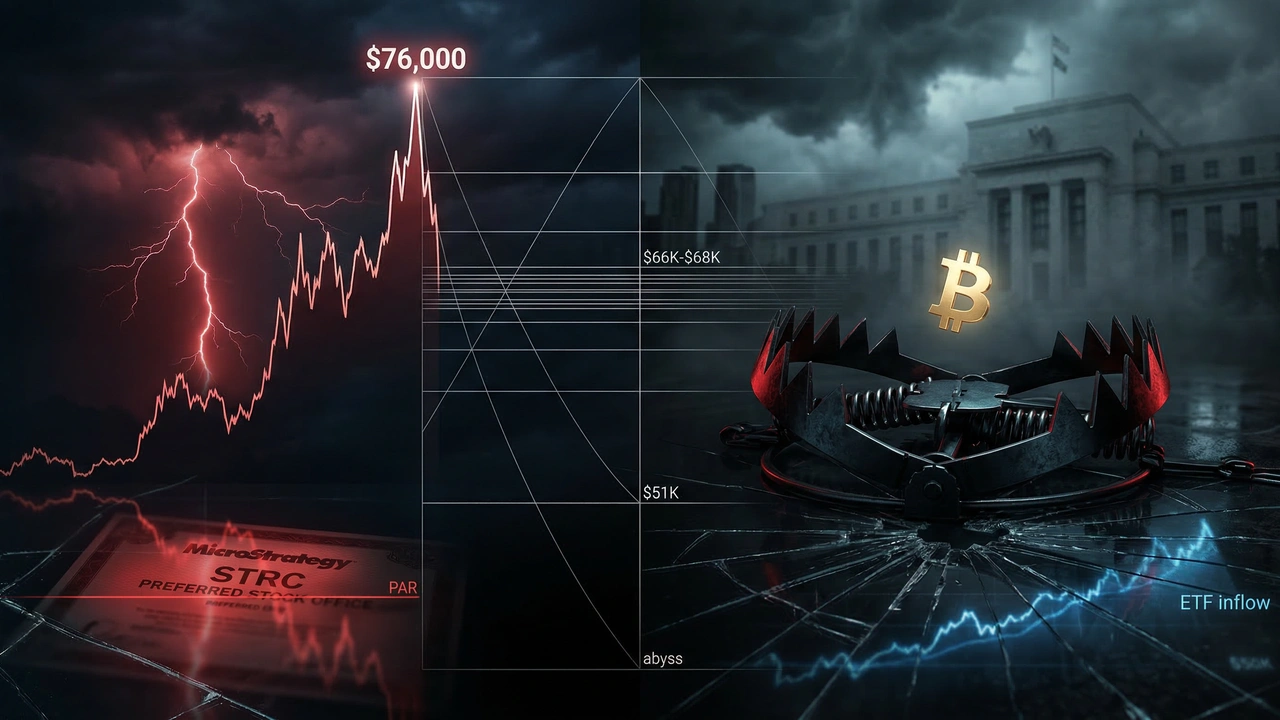
Bitcoin briefly touched six-week highs near $76,000 before retreating, as Strategy's halted BTC accumulation and persistent macro uncertainty raise serious questions about whether the relief rally has legs.
Key Takeaways
- Bitcoin's rejection at $76,000 aligns with the upper boundary of a bear flag pattern, raising the risk of a pullback toward $66,000–$68,000, with more extreme downside targets near $51,000 if the pattern fully breaks down [3].
- Strategy's pause in STRC-funded Bitcoin accumulation is a historically reliable short-term bearish signal — previous STRC dips below $100 par value preceded BTC price declines of 25–40% [3].
- The Federal Reserve interest rate decision (March 18) and Bank of Japan policy meeting (March 19) represent major near-term volatility catalysts; hawkish outcomes from either could accelerate selling pressure across crypto markets [1].
- ETF inflows and easing oil prices provide a constructive backdrop, but these tailwinds appear insufficient to override the heavier technical and institutional demand concerns currently facing the market [1][2].
- Multiple experienced traders warn against misreading the current bounce as a confirmed bear market bottom — patience and disciplined position sizing remain the most prudent approach until higher time frame reversal signals emerge [2].
Bitcoin's $76K Rejection: Relief Rally or Bear Trap in Disguise?
Bitcoin briefly reclaimed $76,000 this week — a level that sparked cautious optimism across the market — only to retreat sharply, leaving traders caught between competing narratives. On one side, ETF inflows, stabilizing oil prices, and a recovering stock market suggest the worst may be behind us. On the other, a convergence of technical warning signs, Strategy's sudden pause in BTC accumulation, and an unresolved macro environment paint a far more sobering picture. The question isn't just whether Bitcoin bounced — it's whether anyone should trust it.
The stakes heading into the remainder of the week are unusually high. A Federal Reserve interest rate decision, Bank of Japan policy announcement, and fresh US economic data all loom on the calendar, creating a perfect storm of potential volatility triggers that could determine Bitcoin's directional bias for weeks to come.
The Facts
Bitcoin surged to a six-week high of $76,000 before running into heavy resistance and retreating to approximately $74,000 during Tuesday's Wall Street session [2]. The move appeared to energize bulls momentarily, but skepticism mounted quickly. Technical analyst Roman noted on X that there is "still nothing on higher time frames that suggests the bear market has bottomed — no divergences, no volume at lows, no reversal pattern" [2]. Fellow trader Jelle reinforced this view, pointing out that every previous Bitcoin bear market has resolved below the 0.618 Fibonacci retracement level, typically after "months of boring sideways price action" [2].
Adding significant weight to the bearish case, MicroStrategy parent company Strategy has paused its Bitcoin accumulation via its STRC preferred stock instrument after the vehicle dropped below its $100 par value — the critical threshold required for the firm's at-the-market issuance model to function efficiently [3]. Before the pause, Strategy had been in aggressive accumulation mode, purchasing 22,337 BTC in the week ending March 15 and another 17,994 BTC the week prior, with STRC-linked capital funding a substantial portion of those purchases [3]. In total, Strategy added over 40,000 BTC across two weeks — roughly six times the total Bitcoin mined over the same period [3].
Historically, this kind of pause has been a bearish signal. When STRC last dipped below par in January, Bitcoin subsequently fell nearly 40% over the following three weeks [3]. A comparable dip in November 2024 preceded a roughly 25% BTC decline [3]. With Bitcoin currently bumping against the upper boundary of what analysts describe as a bear flag pattern near $76,000, a confirmed breakdown could target the $66,000–$68,000 range — with more extreme scenarios projecting a slide toward $51,000 [3].
Not all signals point down, however. The BTC-ECHO model portfolio, which tracks a systematic multi-asset crypto strategy, noted that ETF inflows continue to support demand, market sentiment has shifted from fearful to neutral compared to the prior week, and the portfolio itself recovered to nearly $93,000 in total value — a gain of roughly 4% [1]. Macro conditions also provided modest relief, with WTI crude oil staying below $100 per barrel and US equities staging a quiet rebound [2]. Meanwhile, gold's struggle to hold $5,000 per ounce support has prompted at least one analyst, James Easton, to call for Bitcoin's "outperformance of the decade" relative to the precious metal [2].
Analysis & Context
What we are witnessing is a classic mid-cycle tension between narrative and data. The bullish narrative is emotionally compelling: ETF adoption is maturing, institutional players like Strategy have been buying at scale, and macro headwinds are easing at the margins. But the data underneath that narrative is more complicated. Strategy's STRC funding mechanism shutting down is not a minor footnote — it removes what had been one of the most consistent and sizable sources of BTC demand in recent weeks. When a buyer responsible for purchasing six times the Bitcoin mining output over a two-week period steps back, the market must find alternative demand to fill that gap. History suggests it rarely does so smoothly.
The technical picture is equally ambiguous but leans cautious. Bitcoin holding above its 20-day EMA is mildly constructive [1], but the failure at $76,000 — precisely at the upper edge of the bear flag — is precisely the kind of rejection that confirms resistance rather than absorbs it. The 0.618 Fibonacci retracement argument raised by trader Jelle deserves serious attention. Looking back at the 2018, 2020, and 2022 bear market cycles, Bitcoin consistently found its ultimate bottom below that retracement level, often after extended periods of choppy, directionless price action that exhausted both bulls and bears alike. If that pattern holds, the current $74,000–$76,000 range may represent noise rather than a definitive bottom.
The Fed decision on March 18 is the most immediate wildcard. An unchanged rate policy would likely support risk assets and could give Bitcoin a brief lift, but any hint of prolonged restrictive monetary policy — or hawkish forward guidance from Powell — would almost certainly renew selling pressure across the crypto market. The Bank of Japan's decision on March 19 adds another layer of complexity, as any surprise rate hike from Tokyo would tighten global liquidity conditions and historically weighs on speculative assets. Investors who remain positioned in the market through these events should do so with eyes wide open to the downside scenarios.
Sources
AI-Assisted Content
This article was created with AI assistance. All facts are sourced from verified news outlets.