Bitcoin's $80K Battle: Rally Meets Geopolitical Turbulence
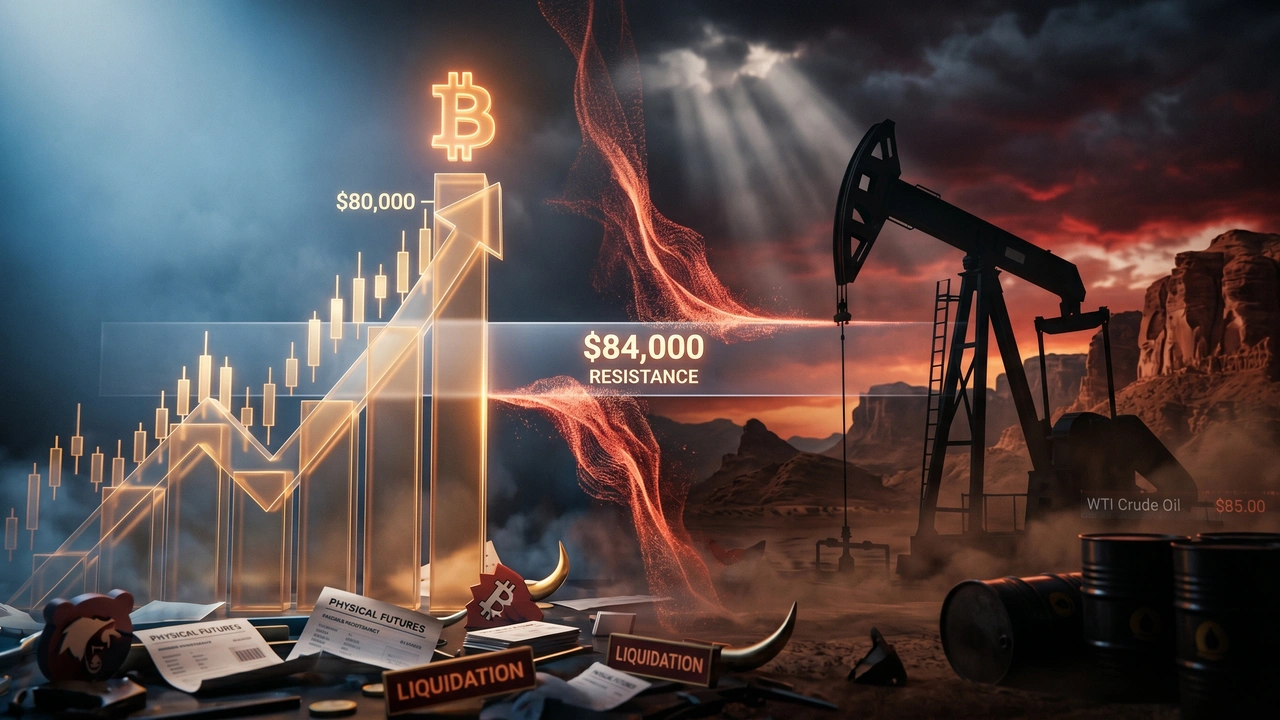
Bitcoin surged past $80,000 on fresh buying momentum and massive short liquidations, but Iran-linked geopolitical shocks injected renewed volatility into what analysts are calling a 'disbelief rally' with a clear path toward $84,000 and beyond.
Key Takeaways
- Bitcoin's push above $80,000 was driven by unusually large buy-volume spikes on Binance totaling roughly $2 billion across two hourly candles, reflecting aggressive momentum-chasing rather than patient accumulation - a dynamic that can reverse quickly if momentum fades [1].
- The CME gap at $84,000 is the single most important near-term technical level to watch: clearing it would potentially unleash over $2.85 billion in forced short liquidations, while failure to reach it could set up a retest of support near $76,500 [1][2].
- Geopolitical risk from Iran-linked oil market disruption has re-entered the equation and could override technical setups in the short term - traders should monitor macro headlines alongside chart levels [2].
- This is being characterized as a "disbelief rally" by analysts, a historically significant pattern that often precedes sustained recoveries but is also marked by sharp pullbacks that shake out weak hands before the next leg higher [1].
- Short-term holders are near breakeven, and a confirmed daily close above $81,500 would be a meaningful structural signal - without it, the risk of a retest lower remains very much on the table [2].
Bitcoin's $80K Battle: Rally and Risk Collide at a Critical Inflection Point
Bitcoin is staging one of its most psychologically charged recoveries in months, clawing back above $80,000 on the back of explosive buy-side volume and a cascade of short liquidations. But just as bulls appeared ready to seize control, fresh geopolitical turbulence from the Middle East reminded markets that macro forces never take a day off. What is unfolding right now is not a simple price recovery story - it is a high-stakes collision between technical momentum, speculative positioning, and global risk sentiment.
The result is a Bitcoin market that is simultaneously compelling and precarious. Resistance levels are stacking up, sentiment is cautious despite the price action, and the next few days could determine whether this rally graduates into something sustainable or falters under the weight of external pressures.
The Facts
Bitcoin registered daily gains of approximately 1.6% on Monday, with the BTC/USD pair pushing as high as $80,610 - its highest level since January 31 [1]. The broader crypto market reflected the move, with total global market capitalization climbing 1.6% toward $2.65 trillion [1]. Ether gained roughly 2% to trade around $2,367, XRP added nearly 2% to sit just above $1.41, and Dogecoin led the top ten with a 3.5% advance [1].
The rally was supercharged by aggressive buying activity on Binance, where Bitcoin's taker buy volume registered two consecutive large hourly spikes of approximately $1.19 billion and $792 million respectively, according to CryptoQuant analyst Amr Taha [1]. Taha noted that this type of volume concentration near a major breakout level suggests traders were not waiting for a pullback but actively chasing confirmation as price moved higher [1]. Across the broader market, short liquidations totaled $452 million in a 24-hour period, a figure that underscores the intensity of bullish pressure [1].
However, the session was far from clean. Reports that Iran had struck a petroleum facility in the United Arab Emirates sent oil markets sharply higher, with WTI crude surging over 5% past $105 per barrel and Brent crude hitting $119 per barrel [2]. US equities came under pressure, and Bitcoin experienced sharp whipsaw price action around the $80,000 level as risk appetite deteriorated [2]. Trading firm QCP Capital described the Iran situation as "fluid" and warned that market pricing of de-escalation "could change quickly" [2].
Analysts are now converging on a specific technical target: the CME futures gap at $84,000, formed in early February. Trader Daan Crypto Trades noted that Bitcoin was "on its way to close the previous large gap from $84K" and advised marking those levels as potential magnets and local reversal zones [1]. According to liquidation data from CoinGlass, a confirmed break above $84,000 would trigger over $2.85 billion in leveraged short liquidations across all exchanges - a figure that could amplify upside momentum considerably [1].
On the cost-basis front, CryptoQuant contributor Crazzyblockk highlighted that a confirmed daily close above $81,500 would flip that level from resistance to support and open the path toward the $87,000-$92,000 range. Failure to hold, however, risks a retest of the "new money realized price" near $76,500 [2]. MN Capital founder Michael van de Poppe identified the $86,000-$88,000 zone as the next meaningful resistance cluster following any sustained break above $79,000 [1].
Analysis & Context
What makes this rally particularly interesting is the psychological dynamic it reflects. Crypto analyst Matthew Hyland called it a "disbelief rally" - a pattern deeply familiar to veteran Bitcoin observers [1]. Disbelief rallies occur when price recovers sharply after a period of capitulation or despair, catching the maximum number of participants off-side. Those who shorted the breakdown or liquidated long positions near the lows are now forced to either cover at a loss or watch the market move away from them. This is precisely the mechanism behind the $452 million in short liquidations already recorded [1]. The phenomenon is not new to Bitcoin. The 2020 recovery from the March COVID crash followed an almost identical psychological arc - a violent drop, widespread calls for further downside, followed by a relentless grind higher that wrong-footed the majority before eventually reaching new all-time highs.
The CME gap at $84,000 deserves serious attention as both a near-term magnet and a potential volatility trigger. CME gaps have historically acted as strong gravitational targets for Bitcoin price, and the concentration of over $2.85 billion in short liquidations above that level creates a genuine feedback loop scenario [1]. If buyers can push through $84,000, the resulting forced covering could accelerate the move dramatically. The danger, of course, is that the geopolitical backdrop has introduced a variable that technical analysis cannot fully price in. A significant escalation in Middle East tensions - particularly one that drives oil materially higher and triggers sustained equity market selling - would likely pressure Bitcoin alongside other risk assets, at least in the short term. The correlation between Bitcoin and equities has remained elevated through 2024 and into 2025, meaning macro shocks cannot be dismissed as irrelevant. Short-term holders are approaching breakeven on their unrealized losses [2], which means a meaningful percentage of recent buyers are neither panicking nor celebrating. That group represents potential selling pressure if prices stall, but also a resolved holder base if Bitcoin continues to recover. Long-term holders, meanwhile, remain comfortable despite average unrealized losses of approximately 27% [2], which historically signals a cohort unlikely to add significant selling pressure at current levels.
Sources
AI-Assisted Content
This article was created with AI assistance. All facts are sourced from verified news outlets.