Bitcoin's Dual Threat: Address Poisoning and the Quantum Clock
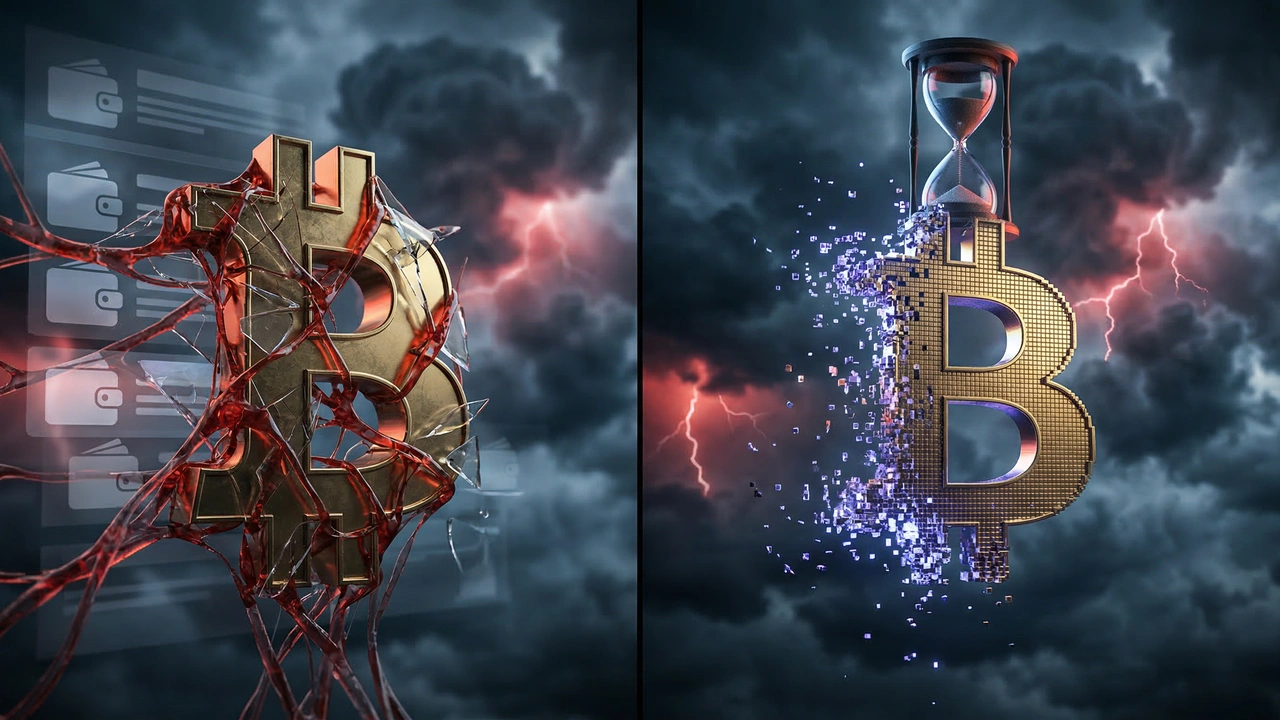
From sophisticated wallet-history exploits flooding Ethereum to existential quantum computing warnings targeting Bitcoin's cryptographic foundations, the crypto security landscape faces a two-front crisis that demands urgent attention from every market participant.
Key Takeaways
- Address poisoning is now industrialized: The Fusaka upgrade's cheap transactions enabled a 612% surge in dust transfer attacks on Ethereum — never copy-paste addresses from transaction history, especially for large transfers; always verify the complete address string [1].
- Quantum risk carries a measurable market price: Edwards estimates a current 20% "quantum discount" on Bitcoin's fair value, rising sharply through 2028 without a credible technical response — investors should monitor quantum computing developments as a macro-level Bitcoin variable [2].
- Bitcoin's upgrade speed is itself the vulnerability: The decentralized governance structure that makes Bitcoin resistant to capture also makes rapid security migrations exceptionally difficult — the community needs to begin serious consensus-building on post-quantum cryptography now, not after Q-Day is imminent [2].
- Low-cost attacks at scale change the threat calculus: Both address poisoning and quantum computing share the same underlying dynamic — as attack costs fall and potential rewards remain enormous, even low success rates generate massive criminal returns [1][2].
- Practical protection is available today: Use hardware wallets, maintain named address books, enable address highlighting tools, and treat every unexpected warning prompt as meaningful — these habits cost nothing but can prevent irreversible losses [1].
Bitcoin Faces a Two-Front Security War — And Time Is Running Short
The crypto security landscape is confronting two distinct but equally serious threats simultaneously. On one front, a low-tech but devastatingly effective scam is exploiting human habit to drain wallets across Ethereum. On another, a long-debated existential risk — quantum computing — is being framed not as a distant theoretical concern but as a present-tense market force already discounting Bitcoin's value. Together, these threats paint a picture of an ecosystem where both users and developers face mounting pressure to act decisively.
What connects these threats is not their technical complexity, but their shared exploitation of complacency. Whether it is a user who trusts their transaction history a fraction too much, or a developer community that moves too slowly on protocol upgrades, the vulnerabilities being targeted are fundamentally human in nature.
The Facts
Etherscan has issued warnings about a surging wave of address poisoning attacks on Ethereum, triggered in part by the case of a single user who received more than 89 warning notifications after conducting just two stablecoin transfers [1]. The mechanics are straightforward but insidious: attackers send tiny or worthless transactions to a target wallet, embedding a near-identical fake address into the user's transaction history. When the victim later copies an address from that history — as many routinely do — they inadvertently send funds directly to the attacker [1].
Etherscan identifies three primary variants of the attack: lookalike wallet addresses, fake token names, and zero-value transfers designed to mimic legitimate activity [1]. The attack requires no code exploit — it targets attention and habit rather than software vulnerabilities, making it particularly dangerous for newcomers who typically verify only the first and last few characters of an address [1].
The scale is alarming. A study published in mid-2025 documented approximately 270 million attack attempts targeting 17 million victims across Ethereum and BNB Chain between July 2022 and June 2024, with confirmed losses totaling at least $83.8 million [1]. The problem has accelerated sharply following Ethereum's Fusaka upgrade in December 2025, which made transactions significantly cheaper. In the 90 days following the upgrade, daily transaction volume rose roughly 30 percent, new address creation jumped 78 percent, and dust transfers in USDT under $0.01 surged by a staggering 612 percent [1]. USDC and DAI saw comparable dust transfer increases of 473 and 470 percent respectively [1].
On the Bitcoin side, fund manager Charles Edwards has renewed his quantum computing warning with striking directness: "If these problems are not solved, we believe the value of Bitcoin will fall to zero" [2]. Edwards centers his analysis on the concept of "Q-Day" — the moment when sufficiently powerful quantum computers become capable of breaking Bitcoin's current cryptographic protections, potentially enabling attackers to compromise wallets with exposed public keys and liquidate holdings at scale [2].
Edwards argues this risk is already being priced into the market. He contends that Bitcoin's underwhelming price performance in 2025, despite broadly favorable macroeconomic conditions, reflects an emerging "quantum discount" — which he currently estimates at approximately 20 percent of Bitcoin's fair value [2]. His model projects this discount rising to 38 percent by 2027 and 58 percent by 2028 if no credible technical solution emerges [2]. He further warns that between 20 and 30 percent of Bitcoin's total supply could be vulnerable, including coins associated with lost wallets and historically exposed public keys [2]. As a potential mitigation, Edwards floats the idea of a "Dead Man's Switch" — freezing unmigrated coins after a defined transition period — while acknowledging this would represent a fundamental philosophical rupture with Bitcoin's core principle of absolute ownership [2].
Analysis & Context
Address poisoning is not a new attack vector, but its industrial-scale automation represents a genuine escalation. The Fusaka upgrade's unintended consequence — dramatically cheaper dust transactions — has effectively handed attackers a cost-efficient delivery mechanism for mass poisoning campaigns. This is a recurring pattern in blockchain history: every improvement in throughput or cost efficiency that benefits legitimate users simultaneously lowers the barrier for bad actors. The lesson here is not that Ethereum should avoid scaling upgrades, but that block explorers, wallet interfaces, and user education must evolve in lockstep with network improvements. The practical defenses remain simple — maintain an address whitelist, verify full addresses character by character on large transfers, and treat transaction history as a reference point, never as a trusted source for copy-pasting [1].
The quantum computing debate requires more nuanced unpacking. Edwards' most compelling argument is not the technical one — it is the governance one. Bitcoin's consensus process, while a strength in terms of security and decentralization, makes rapid protocol-level changes structurally difficult. Developers, node operators, miners, exchanges, and wallet providers must all align — a process Edwards realistically estimates at two years minimum [2]. That timeline, mapped against accelerating progress in quantum hardware from major technology firms, creates a shrinking window. The philosophical dilemma around potentially freezing Satoshi-era coins is real and unresolved. It pits Bitcoin's foundational property rights against the network's systemic survival — a debate the community has never been forced to resolve under genuine time pressure. The fact that Edwards frames 2026 as a critical milestone year for meaningful progress suggests the next 12 to 18 months will be defining for how seriously this threat is taken at the protocol level.
It is worth noting that not all analysts share Edwards' urgency — a CoinShares researcher has publicly expressed a more relaxed view on the quantum timeline [2]. But the divergence of expert opinion itself underscores the risk: if the community remains divided on the severity, coordinated action becomes harder to mobilize precisely when it may be most needed.
Sources
- [1]btc-echo.de
- [2]btc-echo.de
AI-Assisted Content
This article was created with AI assistance. All facts are sourced from verified news outlets.