Bitcoin's Floor in Focus: On-Chain Data and Miner Stress Converge
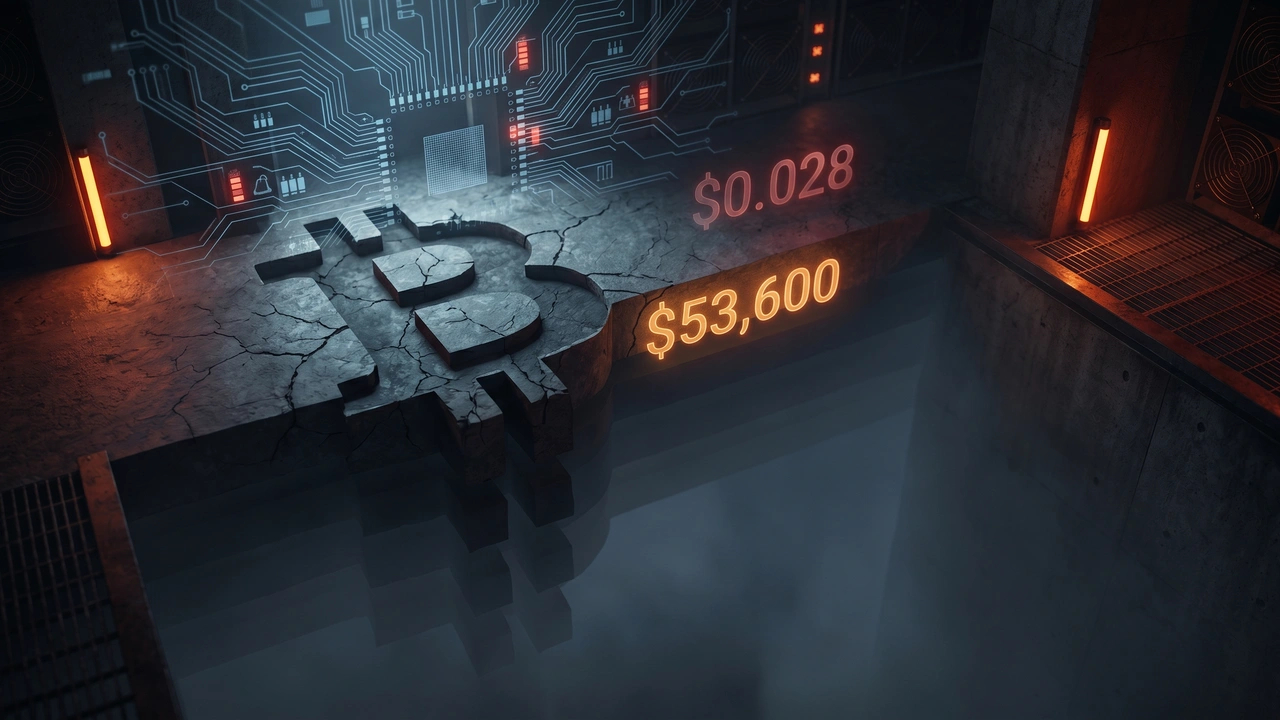
CryptoQuant places Bitcoin's structural price floor near $53,600, while miner revenues hit record lows - two separate stress signals pointing toward the same uncomfortable question about how much further BTC can fall before true capitulation sets in.
Key Takeaways
- Bitcoin's Realized Price at $53,600 represents a historically significant valuation floor, but reaching it would require a further drop of roughly 13% from current levels around $62,000 - and nothing in the data makes that move inevitable.
- Realized losses over the past 30 days total approximately 187,000 BTC, far below the 1.2 million BTC recorded at the 2022 market bottom, suggesting true capitulation has not yet occurred.
- Weekly Bitcoin demand contracted by an estimated 652,000 BTC - the steepest single-week drop since early 2022 - confirming that the demand recovery needed to sustain a bull market is not yet visible in on-chain data.
- Miner revenue per terahash has compressed sharply, and net miner positions have been negative since early May, creating persistent background sell pressure - though institutional spot flows now substantially exceed miner output in scale.
- A regime shift toward a renewed bull market requires demand recovery, not just price stabilization near a cost-basis floor; until that signal emerges, the risk of further downside cannot be dismissed.
Bitcoin's Floor in Focus: On-Chain Data and Miner Stress Converge
Two distinct corners of the Bitcoin market are flashing the same cautionary signal simultaneously. On-chain analysts at CryptoQuant have pinpointed a critical valuation threshold that has historically marked the bottom of major bear cycles, while mining economics have deteriorated sharply enough to incentivize operators to offload holdings. Taken together, these converging pressures frame one of the more consequential stress tests Bitcoin has faced since the FTX collapse of late 2022.
The core question is not whether Bitcoin is in trouble - it clearly faces headwinds. The more precise question is whether the market is approaching a zone where buyers historically overwhelm sellers, or whether the current weakness is a prelude to something deeper.
The Facts
CryptoQuant's head of research, Julio Moreno, published an analysis Wednesday centering on Bitcoin's Realized Price - the aggregate cost basis across every coin that has changed hands on-chain. That figure currently sits at $53,600, roughly 9% below where Bitcoin traded when it recently dipped toward $59,000. BTC has since bounced back to approximately $62,000, but Moreno argues the Realized Price remains the most meaningful valuation anchor in the market. [1]
Historically, major bear markets have carved their bottoms at or slightly beneath that on-chain cost basis level. The FTX-driven collapse of November 2022 briefly pierced it before prices reversed - a brief, violent undershoot followed by recovery. Moreno is careful to frame this not as a forecast but as a zone worth watching: "Historically, that is a level that would confirm a bottom," he wrote, adding that current demand weakness makes reaching that level a genuine possibility. [1]
The demand picture is indeed deteriorating. CryptoQuant's composite measure of Bitcoin demand - blending perpetual futures activity with apparent spot buying - dropped by roughly 652,000 BTC in a single week, the sharpest weekly contraction since January 2022. The slide below $60,000 appears to have acted as a trigger, accelerating spot selling while simultaneously forcing out leveraged long positions. [1] Yet realized losses have not reached the magnitude historically associated with full capitulation. Over the past 30 days, holders booked losses equivalent to about 187,000 BTC - significant, but far short of the 400,000 BTC realized when BTC first broke $60,000 in February 2026, and a fraction of the 1.2 million BTC in realized losses recorded at the November 2022 market bottom. [1] Moreno interprets this gap as evidence that a substantial cohort of holders remains in profit near $59,000 and has not yet reached the psychological threshold that triggers panic or forced selling.
On the mining side, profitability has cratered in parallel. The daily revenue generated per terahash per second of computing power dropped to $0.028 on Tuesday, down from $0.039 just a month prior - a decline of roughly 28% in four weeks. [2] In practical terms, an Antminer S21 XP Hydro running at $0.07 per kilowatt-hour now generates an estimated monthly gross profit of $137, compared with $192 the previous month. [2] Charles Edwards of Capriole Investments estimates the all-in production cost for Bitcoin - incorporating depreciation and equipment amortization - at approximately $62,650, with the bare-minimum electricity breakeven near $50,120. [2] That places current prices uncomfortably close to the upper bound of that cost range for many operations.
The margin squeeze is already showing up in miner behavior. The 14-day average net position change for coins held in miner and mining pool wallets turned negative in early May and has stayed there. [2] Whether those liquidations serve to cover operating costs, repay debt, or fund pivots into artificial intelligence infrastructure - a sector Bernstein analysts describe as constrained primarily by power access rather than hardware availability - the market effect is the same: incremental sell pressure from an industry that collectively controls over $110 billion in Bitcoin. [2] Hashrate concentration adds another layer of concern; Foundry USA, AntPool, and F2Pool now jointly account for 59% of total network hashrate, up markedly from the roughly 44% the top three pools controlled in 2022. [2]
Analysis & Context
The historical parallel worth examining closely is not 2022 but 2019 and 2023 - two periods when Bitcoin traded beneath its estimated all-in production cost for stretches exceeding six months each, per Capriole Investments data. [2] In both cases, the market eventually cleared, but not before testing investor patience well beyond what most participants expected. The lesson is not that miner pain automatically triggers a price collapse, but that compressed margins can sustain background selling pressure for longer than the typical market narrative allows. Bitcoin does not simply recover because miners are stressed - it recovers when demand absorbs that supply.
That is precisely where the CryptoQuant and Cointelegraph narratives converge on the same structural problem. Miner selling is, in aggregate, increasingly dwarfed by institutional spot flows - and Cointelegraph's sourcing makes that point explicitly. [2] The real governor of Bitcoin's next directional move is not whether a mid-sized mining operation flips off its rigs, but whether the macro environment gives institutional buyers enough confidence to step up. The realized-loss data suggests that moment has not arrived: capitulation, historically, looks like a sudden, violent spike in loss-taking, not the slow bleed currently visible in the numbers. The absence of that spike means the market may be in a prolonged consolidation phase rather than at a definitive bottom - which is both reassuring and frustrating depending on your time horizon.
Sources
AI-Assisted Content
This article was created with AI assistance. All facts are sourced from verified news outlets.