Bitcoin's Geopolitical Stress Test: Resilience or False Calm?
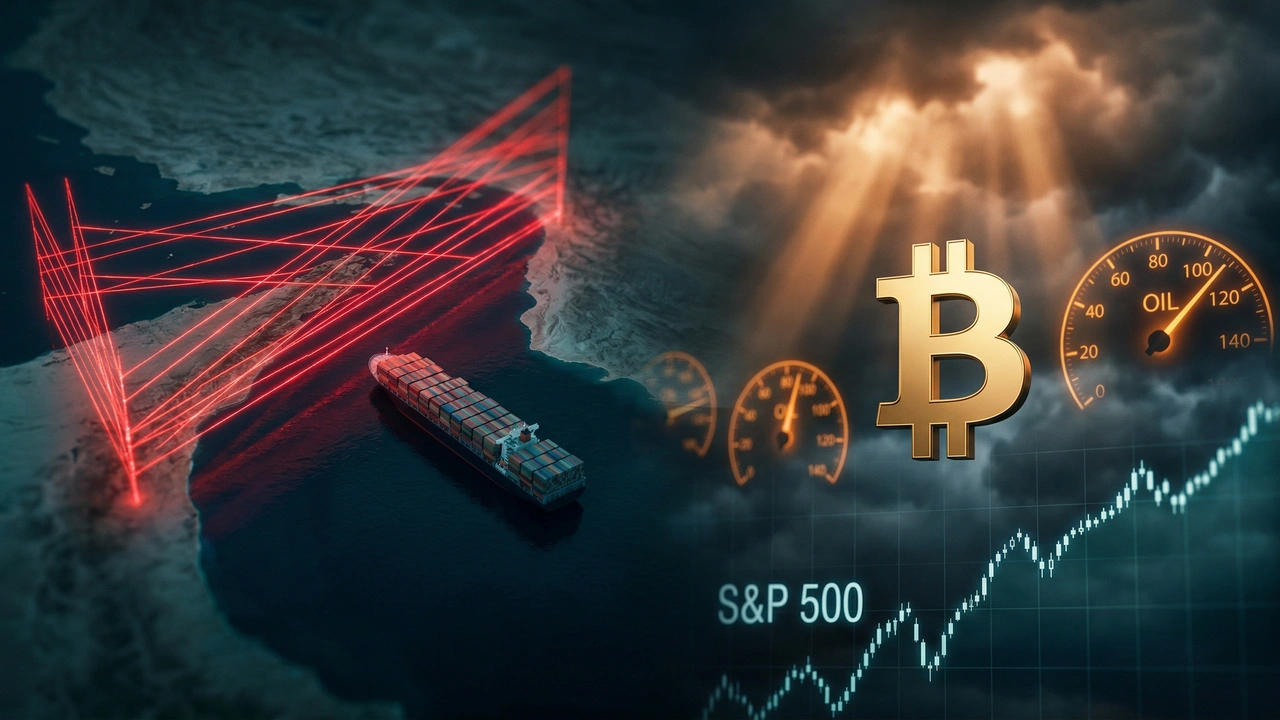
As the US blockade of the Strait of Hormuz reshapes global energy markets and rattles risk assets, Bitcoin is displaying an unusual composure — but analysts warn the calm may be short-lived if the Iran conflict deepens further.
Key Takeaways
-
Bitcoin's calm is structurally grounded but conditional: The asset's relative outperformance during the Iran escalation reflects reduced leverage and whale selling prior to the event — not a permanent decoupling from macro risk. If geopolitical stress deepens materially, BTC will not be immune.
-
The China factor is the most underpriced risk in the market: QCP Capital's analysis highlights that enforcing the Hormuz blockade against Chinese vessels could trigger an escalation that current asset prices are entirely unprepared for — making this the key variable to monitor in the coming days and weeks.
-
Gold's weakness during a geopolitical shock is a macro signal: The fact that inflation fears are suppressing gold — traditionally the ultimate safe haven — while Bitcoin holds firm reveals a complex rate-expectations dynamic that could shift quickly if central banks are forced to respond to energy-driven inflation.
-
Technical patterns suggest near-term caution: The Bart Simpson reversal risk and the daily bear flag pattern are both warning signals that the current $72,500 bounce may not be sustainable. The $70,500 level is the critical line in the sand; losing it could mean a full reversal of the ceasefire rally.
-
The $59,000–$61,000 zone is the level to watch for longer-term opportunity: Experienced traders are not chasing this bounce — they are waiting for price to reach the extremes of the current range before taking action, which suggests disciplined investors should avoid FOMO at mid-range levels.
Bitcoin's Geopolitical Stress Test: Resilience or False Calm?
When the United States formally imposed a naval blockade on Iranian ports this week, the financial world braced for chaos. Oil surged past $100 per barrel, geopolitical uncertainty spiked, and every risk asset on the planet was put to the test. Bitcoin, historically treated as a speculative plaything that sells off first and asks questions later, did something unexpected: it held its ground — and then climbed. That behavior deserves serious scrutiny, because it either signals a genuine maturation of Bitcoin as an asset class, or it represents the calm before a far more turbulent storm.
The distinction matters enormously. Understanding why Bitcoin is behaving the way it is right now — and whether that behavior is structurally sound or fragile — is essential for anyone watching the market through a macro lens. The picture that emerges from the latest data and expert commentary is one of cautious resilience layered over a deeply uncertain foundation.
The Facts
Bitcoin reversed early losses and climbed to $72,530 on Bitstamp following the Wall Street open on Monday, mirroring a broader relief rally across US equities [1]. Both the S&P 500 and Nasdaq Composite Index turned positive on the day, as markets processed the nuance within the US blockade announcement: vessels traveling to and from non-Iranian ports would not be impeded [1]. That clarification — essentially narrowing the scope of the blockade's immediate market disruption — gave traders enough breathing room to step back from the panic button.
WTI crude oil nevertheless remained elevated, hovering around $102 per barrel after briefly retesting the psychologically significant $100 level at the open of futures trading [1]. Trading firm QCP Capital pointed to China as a critical and underappreciated variable in the escalation equation. Since Iranian crude flows predominantly eastward toward Beijing, any effective enforcement of the blockade would directly threaten Chinese energy supply chains [1]. QCP noted that intercepting Chinese vessels in international waters carries the risk of a materially larger geopolitical escalation — one that markets are decidedly not priced for [1]. Their assessment: "Rhetoric escalates, reality softens" — a familiar geopolitical playbook that markets are currently leaning on.
On the crypto-specific side, CoinShares analyst James Butterfill offered a structural explanation for Bitcoin's relative outperformance. He noted that Bitcoin had already shed much of its speculative excess before the Iran shock materialized — whales had trimmed positions, leverage had come down, and BTC's valuation relative to gold had become more attractive [2]. New inflows into crypto investment products added further support [2]. Notably, gold — typically the go-to safe haven in geopolitical crises — actually weakened during this period, as rising oil prices stoked inflation fears and dampened expectations for near-term rate cuts, making the non-yielding metal less attractive in a higher real-rate environment [2].
Yet the technical picture is far from bullish. Trader Jelle flagged the risk of a classic "Bart Simpson" failed breakout pattern forming on the BTC chart — a sharp pump that reverses almost entirely, potentially dragging price back to erase gains made during the earlier ceasefire rally [1]. He identified $70,500 as a critical support level, warning that losing it could trigger a full retracement [1]. Trader CrypNuevo was equally cautious, advising followers that Bitcoin is currently stuck in a mid-range no-man's land and flagging the $59,000–$61,000 zone as a more compelling entry point for swing longs [1].
Analysis & Context
What makes this moment particularly instructive is the inversion of the traditional risk-asset hierarchy. In past geopolitical shocks — the 2019 US-Iran tensions following the killing of Qasem Soleimani, the early days of the Russia-Ukraine war in 2022 — Bitcoin's reaction was almost reflexively negative. It sold off alongside equities before eventually recovering. This time, the pattern is different, and Butterfill's structural argument is compelling: when speculative excess has already been wrung out of a market, it becomes far more resilient to external shocks. The 2022 crypto collapse essentially reset Bitcoin's risk profile, and the asset enters this crisis in a leaner, less leveraged state than it has been in years.
However, the QCP Capital warning about China should not be dismissed. The Strait of Hormuz scenario is not a contained bilateral dispute — it sits at the intersection of US-Iran conflict, global energy supply, and the ongoing US-China geopolitical competition. If enforcement of the blockade leads to direct confrontation with Chinese shipping, the market's current "rhetoric will soften" assumption would be obliterated overnight. In that scenario, Butterfill's warning of macroeconomic stress and heightened volatility becomes the base case, not the tail risk [2]. A stagflationary environment — weak growth, persistent inflation, no rate cuts — would be genuinely hostile territory for Bitcoin, which still correlates strongly with broader risk appetite during acute stress events [2].
The technical signals reinforce the need for caution. The Bart Simpson pattern that Jelle is tracking has a well-documented history in Bitcoin markets — it represents a failure to sustain a breakout, often seen when a price surge is driven by sentiment rather than sustained buying pressure. Combined with the bear flag pattern on daily timeframes that was already in play before this week's bounce [1], the short-term risk-reward for new long positions at current levels looks asymmetric in the wrong direction. Bitcoin's geopolitical resilience is real, but it is being tested against a backdrop where the macro environment could deteriorate rapidly and without much warning.
Sources
AI-Assisted Content
This article was created with AI assistance. All facts are sourced from verified news outlets.