Bitcoin's Mainstream Battle: Censored on Netflix, Poised to Power AI Commerce
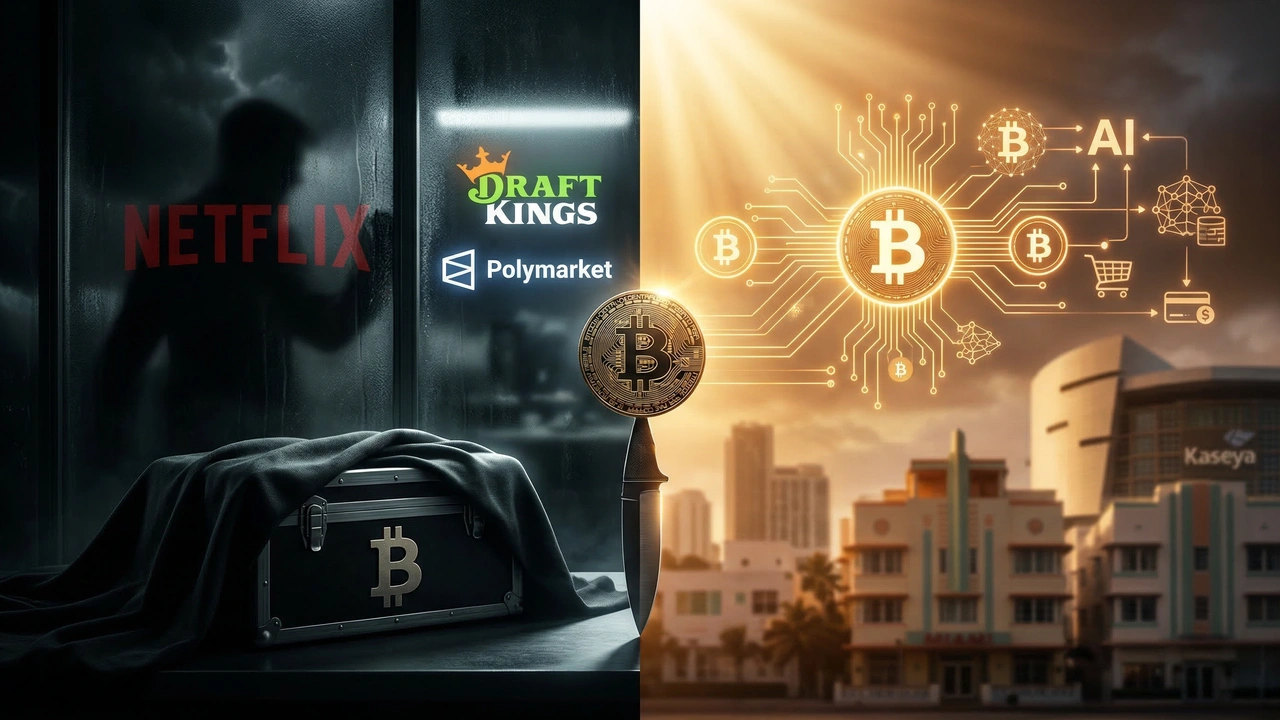
A Netflix sponsorship ban and a landmark opportunity in AI-driven payments reveal the contradictory reality facing Bitcoin in 2025: simultaneously marginalized by legacy media gatekeepers and positioned to become the backbone of tomorrow's automated economy.
Key Takeaways
- Netflix's last-minute ban on Bitcoin sponsorship branding — while approving gambling platforms and insurance companies — exposes a pattern of selective, opaque enforcement that Bitcoin businesses must anticipate and plan around when pursuing mainstream media partnerships [1].
- The inconsistency between Netflix's treatment of Bitcoin and its treatment of clearly speculative platforms like Polymarket and DraftKings undermines any claim of principled policy and should be challenged publicly and persistently by the Bitcoin industry [1].
- The AI agent commerce space represents a rare greenfield opportunity where Bitcoin's open, competitive payment infrastructure is technically competitive with — and in some ways ahead of — corporate alternatives like stablecoin platforms [2].
- The stablecoin threat is structural, not just competitive: when one company owns the agent platform, the currency, and the merchant rails, Bitcoin's principles of openness and censorship resistance become the differentiating argument — but only if bitcoiners make that case actively [2].
- Bitcoin's mainstream integration requires a two-track strategy: fighting for visibility and fair treatment in legacy media and cultural venues, while simultaneously building the next-generation payment infrastructure that will make those legacy gatekeepers less relevant over time.
Bitcoin Fights Two Battles at Once: Censorship Today, Commerce Revolution Tomorrow
Bitcoin's path to mainstream integration has never been a straight line, and two developments from late 2025 crystallize that reality with striking clarity. On one front, a major streaming platform quietly banned Bitcoin branding from a professional boxer's fight trunks just days before his biggest career moment — revealing that institutional resistance to Bitcoin's visibility remains alive and well even as spot ETFs attract billions from BlackRock and Fidelity. On another front, a compelling case is being made that Bitcoin is uniquely positioned to become the default payment rail for an entirely new category of commerce: AI agent-driven transactions. Together, these stories tell a single, urgent truth — Bitcoin's integration into the mainstream is neither guaranteed nor linear, and the decisions made right now will shape its trajectory for decades.
The Facts
The censorship incident unfolded in the lead-up to the Jake Paul vs. Anthony Joshua boxing event, streamed exclusively by Netflix on December 19, 2025, at Miami's Kaseya Center, with estimated viewership between 20 million and 100 million [1]. Welterweight fighter Justin Cardona had secured sponsorship agreements with Bitcoin mining firm Sazmining and Bitcoin lending platform LEDN as early as mid-October, with logos submitted and approved well before the October 31 deadline. Invoices were paid, trunks were embroidered, and Cardona even promoted the partnership publicly on social media — all without any objection from the broadcaster [1].
That silence ended abruptly. On December 12, one week before fight night, promoter Most Valuable Promotions notified Cardona's team that Netflix had conducted a "secondary review" and was banning all Bitcoin-related content — from the trunks themselves to press conferences and weigh-ins. The stated reason was simply "Prohibited per our policy," with no elaboration provided [1]. Cardona was forced to replace his custom-embroidered gear at his own expense. Sazmining CEO Kent Halliburton pointed out the glaring inconsistency: betting platforms Polymarket and DraftKings, both of which involve speculative financial activity, appeared prominently throughout the broadcast without issue. An insurance company backing Cardona also cleared approval without friction. Netflix's own written guidelines list Bitcoin nowhere by name — lumping potentially offending financial content under "speculative financial products" alongside payday loans and pyramid schemes, while categorizing financial services as merely "restricted" and subject to case-by-case review [1]. "It's unbelievable that Bitcoin and Bitcoin companies continue to be censored," Halliburton stated, calling the reversal "incoherent" given the selective enforcement on display [1].
Meanwhile, a separate but thematically connected argument is being made about Bitcoin's next great opportunity. In a piece authored by developer Matt Corallo, published via Spiral's Substack and cited in Bitcoin Magazine, the rapid rise of AI agents is framed as a historic opening for Bitcoin payments [2]. The core argument: traditional payment infrastructure — credit cards, merchant checkout flows, captcha-heavy websites — is fundamentally incompatible with the automated, bot-driven commerce that AI agents require. Every major payments player is scrambling to establish standards, from Visa's "Intelligent Commerce" initiative to OpenAI and Stripe's Agentic Commerce Protocol and Coinbase's crypto-focused x402 extension [2]. But crucially, no single company yet dominates both the agent and merchant sides of this emerging marketplace.
Bitcoin, Corallo argues, is already technically ahead of the curve. Lightning Network transactions have surpassed one billion dollars in monthly volume, and Square has enabled Lightning for in-person merchants [2]. Unlike stablecoins — where a single company like Coinbase can simultaneously own the platform (Base), earn interest on the currency's float (USDC), and effectively lock in both merchants and users — Bitcoin operates on open, competitive rails where no operator can extract rents once dominance is achieved [2]. The call to action is direct: bitcoiners need to actively deploy agents, equip them with wallets, and drive real purchasing activity to create the merchant adoption flywheel.
Analysis & Context
The Netflix incident is infuriating precisely because it is so familiar. Bitcoin has faced this kind of quiet, inconsistent exclusion from mainstream platforms for years — not through explicit, defensible policy, but through vague categorizations applied selectively. The pattern echoes the "Operation Choke Point" era, when U.S. regulators pressured banks to de-risk industries they disfavored, Bitcoin among them, without transparent rulemaking. Netflix's behavior follows the same playbook: no explicit ban, just undefined discretion wielded at the last moment. What makes this episode particularly notable in 2026's context is the sheer absurdity of the double standard. Bitcoin now underpins a $2 trillion asset class with regulated ETF products from the world's largest asset managers, while the platforms that openly facilitate real-money gambling on elections and sports get prime broadcast placement without question [1]. The message being sent to Bitcoin businesses is not that they are disreputable — it is that they are politically inconvenient.
The AI payments opportunity, by contrast, represents something genuinely new in Bitcoin's history: a competitive field where Bitcoin is not playing catch-up to entrenched incumbents but is instead one of the most technically prepared contenders at the starting line. Bitcoin has spent years building the payment infrastructure — Lightning, open-source wallets, non-custodial processor networks — that AI agents will need. The risk, as Corallo rightly identifies, is complacency. Stablecoins are the path of least resistance for most developers, and the corporate interests behind them are well-funded and aggressive. If Bitcoin advocates do not actively build merchant integrations, deploy agent wallets, and generate real transaction volume now, the window will close. History suggests that whoever establishes network effects in a new payment paradigm tends to hold them for a very long time.
Read together, these two developments expose Bitcoin's central tension in the mainstream integration era: legacy gatekeepers still hold significant power to suppress Bitcoin's visibility in high-profile cultural moments, while the genuinely open frontier of AI commerce offers a bypass route that could render those gatekeepers increasingly irrelevant. Bitcoin does not need Netflix's permission to become the payment layer for a trillion-dollar AI economy.
Sources
AI-Assisted Content
This article was created with AI assistance. All facts are sourced from verified news outlets.