Bitcoin's Next Bull Run Requires a Painful Altcoin Reckoning First
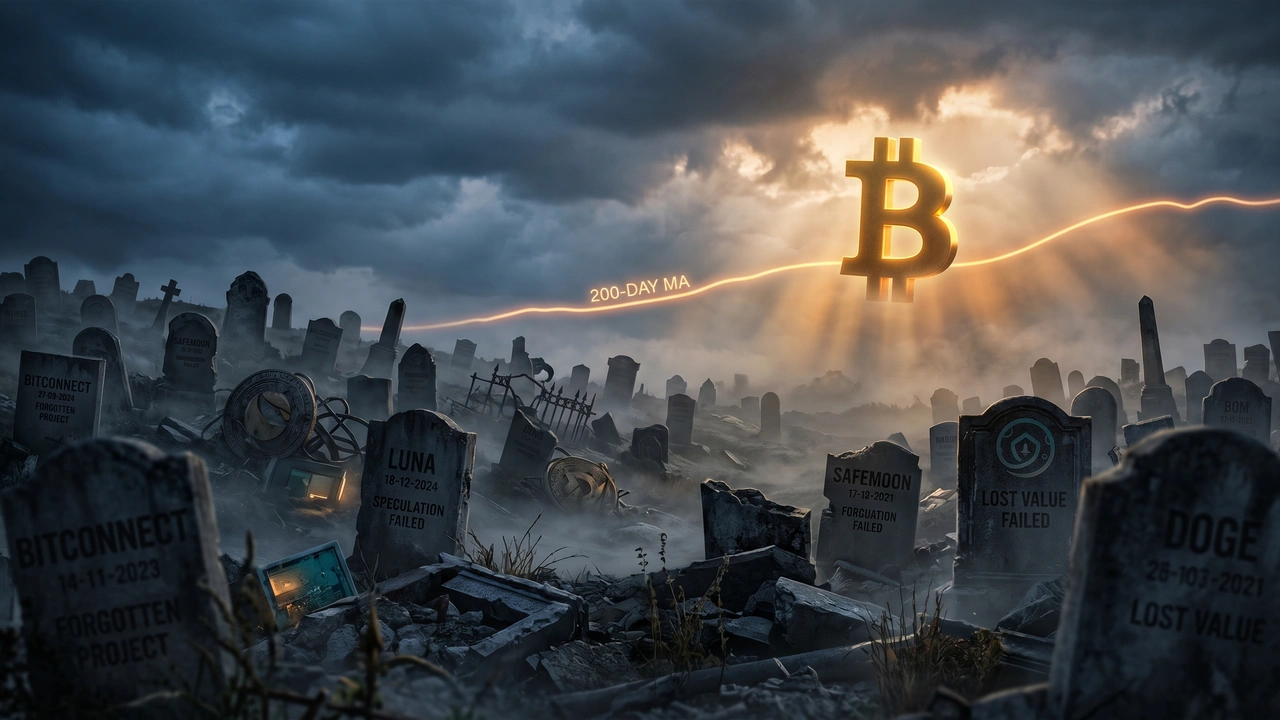
As Bitcoin climbs back above $81,000 and options markets price in $115,000 targets by year-end, veteran analysts warn the broader crypto market still needs a deep cleansing before any sustainable rally can take hold.
Key Takeaways
- Bitcoin's recovery above $81,000 is technically significant but not yet confirmed as a bull market signal - the $82,300 200-day moving average and the $88,880 resistance zone are the real tests [1]
- The $6 billion in December options open interest reflects mixed conviction: $1.85 billion in bullish bets above $115,000 is offset by a 9% put premium showing professional traders remain cautious about downside [2]
- Bitcoin dominance above 67% (excluding stablecoins) signals capital consolidation into BTC rather than risk-on rotation into altcoins - a pattern more consistent with late bear market dynamics than early bull market expansion [1]
- Multiple respected voices including Ben Cowen and Arthur Hayes argue that a genuine altcoin massacre - wiping out thousands of speculative tokens - is a prerequisite for the next sustainable bull cycle, not an optional side event [1]
- The options skew and technical resistance levels together suggest the current rally should be treated as a potential relief bounce until Bitcoin reclaims and holds key levels, rather than assumed to be the start of a new parabolic advance [1][2]
Bitcoin's Next Bull Run Requires a Painful Altcoin Reckoning First
Bitcoin is flashing signs of life again, breaching $81,000 for the first time since late January and stoking fresh optimism across the market. Options traders are already eyeing $115,000 by Christmas. But a growing chorus of seasoned analysts is urging caution - not because Bitcoin lacks strength, but because the broader crypto ecosystem is still carrying years of speculative deadweight that has yet to be properly flushed out. The path to a genuine bull market, they argue, runs straight through a graveyard of failed altcoins.
This tension between near-term price excitement and structural market cleanup defines the moment Bitcoin finds itself in right now. Understanding both sides of that equation is essential for anyone trying to read where this market is actually headed.
The Facts
Bitcoin recently pushed back above $81,000 for the first time since late January, representing a 33% recovery from its yearly low of $60,130 recorded on February 6 [2]. Despite that meaningful bounce, technical analysts are treating the move with measured skepticism. The critical threshold to watch is the 200-day moving average sitting around $82,300 - a level Bitcoin must convincingly clear to validate the recovery [1]. Beyond that, analysts identify the $88,880 zone as the key area BTC needs to reclaim and hold as support. Failure to do so could open the door to a pullback toward the $58,000 to $62,000 range [1].
In the options market, Bitcoin's December 25 expiry is drawing significant attention. Roughly $6 billion in open interest is tied to that date, with Deribit holding a 92% market share at $5.5 billion [2]. Bulls have stacked $1.85 billion in call options targeting $115,000 or higher, a figure that might initially read as exuberant confidence. However, context matters here - many of these instruments serve as hedges or components of neutral strategies rather than pure directional bets [2]. On the bearish side, $1 billion in put options are targeting $55,000 or lower, meaning extreme positioning exists on both ends of the spectrum [2]. The options skew metric tells a more nuanced story: put options are currently trading at a 9% premium over equivalent calls, signaling that professional traders retain a meaningful degree of concern about downside risk despite the recent rally [2].
While price action grabs headlines, analyst Ben Cowen of Into The Cryptoverse is focused on a deeper structural issue. Cowen argues that a true, sustainable crypto bull market cannot emerge until thousands of speculative low-quality tokens are wiped out [1]. He notes that Bitcoin dominance - excluding stablecoins - has already climbed above 67%, a sign that capital is consolidating into Bitcoin rather than rotating into riskier assets [1]. This pattern, Cowen says, reflects a market in cleanup mode, not expansion mode.
Cowen is far from alone in this view. Arthur Hayes stated at Consensus Miami 2026 that 99% of altcoins could go to zero, with only a handful of projects surviving due to genuine liquidity flows [1]. That echoes predictions made years earlier by Cardano founder Charles Hoskinson and Ethereum co-founder Vitalik Buterin during the ICO era, when both estimated over 90% of projects would ultimately fail [1]. Ripple CEO Brad Garlinghouse went even further in 2019, predicting 99% of all cryptocurrencies would eventually disappear [1].
Analysis & Context
The current setup has strong parallels to the 2018 to 2020 period following the ICO bubble. Bitcoin dominance surged during that extended bear market as capital fled speculative tokens and either parked in BTC or exited crypto entirely. The altcoin graveyard from that era is vast - thousands of projects that raised millions and quietly disappeared. Yet many market participants treated each relief rally as the start of a new cycle, only to see further drawdowns. The lesson from that period is that Bitcoin dominance expansion is often a symptom of contraction, not a precursor to broad-based gains.
The options market data deserves particular attention because it reveals a split personality in the current market. Retail sentiment leans optimistic - the $115,000 call options make for exciting headlines. But the 9% put premium among professional traders tells a different story. Institutional and sophisticated traders are paying extra to protect against downside, which is a meaningful signal that the smart money is not yet fully convinced this rally has legs. A call option targeting $120,000 on December 25 costs roughly $2,202 for one Bitcoin's worth of exposure - cheap lottery-ticket pricing that reflects genuine uncertainty rather than conviction [2]. When professionals hedge aggressively while retail bets big on extreme upside, the market typically resolves in a humbling direction before finding its true footing.
The broader narrative connecting these two data points is this: Bitcoin is demonstrating relative strength while the altcoin complex remains structurally impaired. The market is in a transitional phase where Bitcoin's recovery is real but fragile, and the gravitational pull of thousands of underperforming tokens continues to drag on overall market sentiment and liquidity. History suggests that the most durable Bitcoin bull markets - 2020 to 2021 being the clearest example - tend to follow extended periods where Bitcoin dominance has already made a sustained climb. That groundwork may still be in the process of being laid.
Sources
AI-Assisted Content
This article was created with AI assistance. All facts are sourced from verified news outlets.