Bitcoin's Security Frontier: Quantum Threats and DeFi Hacks Redefine Risk
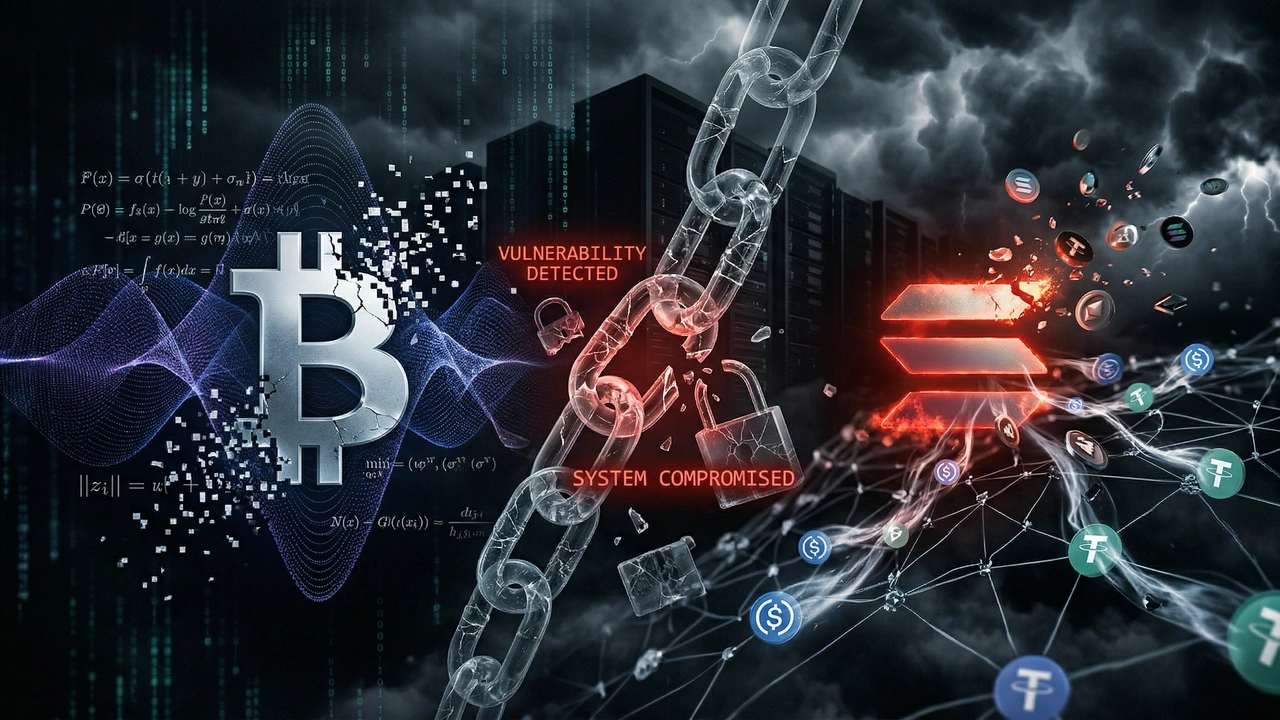
A $200 million exploit on Solana's Drift protocol and a landmark Google quantum computing paper arrive simultaneously, forcing a serious reckoning with the vulnerabilities embedded across the entire crypto ecosystem — including Bitcoin itself.
Key Takeaways
- The Drift exploit confirms that DeFi protocol risk remains acute: A $200 million hack on one of Solana's flagship platforms is not an anomaly — it is part of a persistent pattern that investors in DeFi-native tokens and protocols must price into their risk models [1].
- Quantum computing timelines are compressing, but Bitcoin is not in immediate danger: Google's research moves the theoretical goalposts, but practical quantum attacks on Bitcoin remain years away at minimum — the real urgency is for developers and the broader community to accelerate work on quantum-resistant standards [2].
- The Satoshi address question is Bitcoin's most politically sensitive quantum dilemma: Whether to freeze dormant early Bitcoin addresses represents a governance challenge with no clean answer — any solution requires a level of consensus that would test the network's social fabric [2].
- DeFi hacks of this scale invite regulatory scrutiny: Large exploits consistently trigger renewed calls for oversight of decentralized finance platforms, which could reshape the operating environment for protocols across all chains, including Solana [1].
- Security diversification matters: The simultaneous emergence of both protocol-layer and cryptographic-layer threats underscores why robust security practices — from choosing audited, battle-tested platforms to using quantum-aware wallet strategies — are not optional for serious participants in the crypto space.
When Security Fails: Crypto's Twin Threat Problem Comes Into Focus
Two major security stories have collided this week to create an uncomfortable truth for the broader crypto industry: the threats to digital asset security are not theoretical, and they are not limited to any single layer of the ecosystem. Whether it is a sophisticated protocol exploit draining hundreds of millions from a live trading platform, or a peer-reviewed paper suggesting that quantum computers could crack Bitcoin's cryptographic foundations sooner than anyone expected, the message is the same — the industry's security assumptions deserve urgent and serious scrutiny.
For Bitcoin investors and DeFi participants alike, this moment demands more than passing attention. It demands context, clear thinking, and an honest assessment of what these developments actually mean.
The Facts
The decentralized finance ecosystem built on Solana suffered a severe blow when Drift, one of the network's most prominent perpetual trading platforms, was targeted in a large-scale exploit. Initial estimates placed the value of stolen assets at a minimum of $200 million [1]. The attack unfolded rapidly, and the Drift team moved quickly to halt all deposits and withdrawals in an effort to contain further losses, acknowledging on X that they were observing "unusual activity" on the protocol and urging users not to deposit funds during the investigation [1].
The fallout was immediate and measurable. The DRIFT token collapsed in value within hours of the incident becoming public, and broader confidence in Solana's DeFi ecosystem visibly eroded [1]. Solana itself dropped 6.24 percent within a 24-hour window, sliding below the $80 mark [1]. Adding to user anxiety, funds already deposited on the platform became temporarily inaccessible, leaving investors in a state of uncertainty with no clear timeline for resolution. Investigators noted that portions of the stolen assets were converted into stablecoins and bridged across multiple networks — a classic obfuscation technique used to complicate recovery and tracing efforts [1].
On a separate but thematically resonant front, a new research paper from Google has reignited debate over the long-term security of Bitcoin's cryptographic architecture. The paper suggests that a meaningful quantum attack on Bitcoin could be executed with fewer than 500,000 physical qubits — roughly twenty times fewer than previous estimates had suggested [2]. The most alarming scenario outlined is what researchers call an "on-spend attack," in which a quantum computer reconstructs a private key from an exposed public key while a transaction is still sitting in the mempool. Under the conditions described, this process could theoretically complete in nine to twelve minutes — a window that overlaps uncomfortably with Bitcoin's average ten-minute block interval [2].
Binance founder Changpeng Zhao (CZ) weighed in publicly, striking a measured tone. He argued that cryptographic systems, including Bitcoin, would simply need to migrate to quantum-resistant algorithms — a solvable engineering problem, in his view, though one he acknowledged would be more complex for Bitcoin given its decentralized structure [2]. CZ did, however, raise a genuinely thorny question: what happens to old Bitcoin addresses, particularly those belonging to Satoshi Nakamoto? He suggested that preemptively freezing those addresses might be the prudent course, a view that Bitcoin researcher Christopher Bendiksen publicly disputed [2].
Analysis & Context
The Drift hack is a painful but familiar chapter in DeFi's ongoing security chronicle. Since the ecosystem began scaling in earnest around 2020, major protocol exploits have surfaced with troubling regularity — from the Poly Network breach to the Wormhole and Ronin hacks, each carrying nine-figure price tags. What these incidents share is not just financial damage, but an erosion of the foundational promise that decentralized protocols are inherently more secure than their centralized counterparts. They are not — they are differently vulnerable. Smart contract logic, oracle dependencies, and cross-chain bridge mechanics each introduce attack surfaces that sophisticated actors continue to probe relentlessly. The Drift incident is a reminder that Solana's high-throughput architecture, while impressive in performance terms, does not confer immunity from the same class of vulnerabilities that have plagued Ethereum-based DeFi.
The quantum computing question is a different beast entirely — less immediate, but potentially more consequential. It is important to put the Google paper in proper perspective: no quantum computer today comes close to the qubit counts or error-correction capabilities needed to execute the attacks described. The cryptographic community has been tracking this threat for years, and NIST finalized its first set of post-quantum cryptographic standards in 2024. Bitcoin's developers are also not blind to the issue; proposals around quantum-resistant address formats have circulated in the ecosystem for some time. However, the Google paper meaningfully compresses the theoretical timeline, and the question of legacy addresses — particularly those associated with Satoshi — represents a genuine governance dilemma that the Bitcoin community will eventually be forced to confront. Freezing those coins would be philosophically contentious and would require consensus that may be impossible to achieve. Leaving them untouched carries its own risks if quantum capabilities advance faster than anticipated.
For Bitcoin specifically, the near-term market impact of the quantum narrative is likely to remain muted. Markets have consistently absorbed these periodic quantum alarm cycles without lasting damage to BTC's price or adoption trajectory. The Drift hack, by contrast, has concrete and immediate implications for Solana's ecosystem valuation and for DeFi sentiment more broadly — a sector that was already navigating a challenging environment heading into the second quarter of 2025.
Sources
- [1]btc-echo.de
- [2]btc-echo.de
AI-Assisted Content
This article was created with AI assistance. All facts are sourced from verified news outlets.