Bitcoin's Surprising Resilience: What Price Stability Signals About BTC's Role
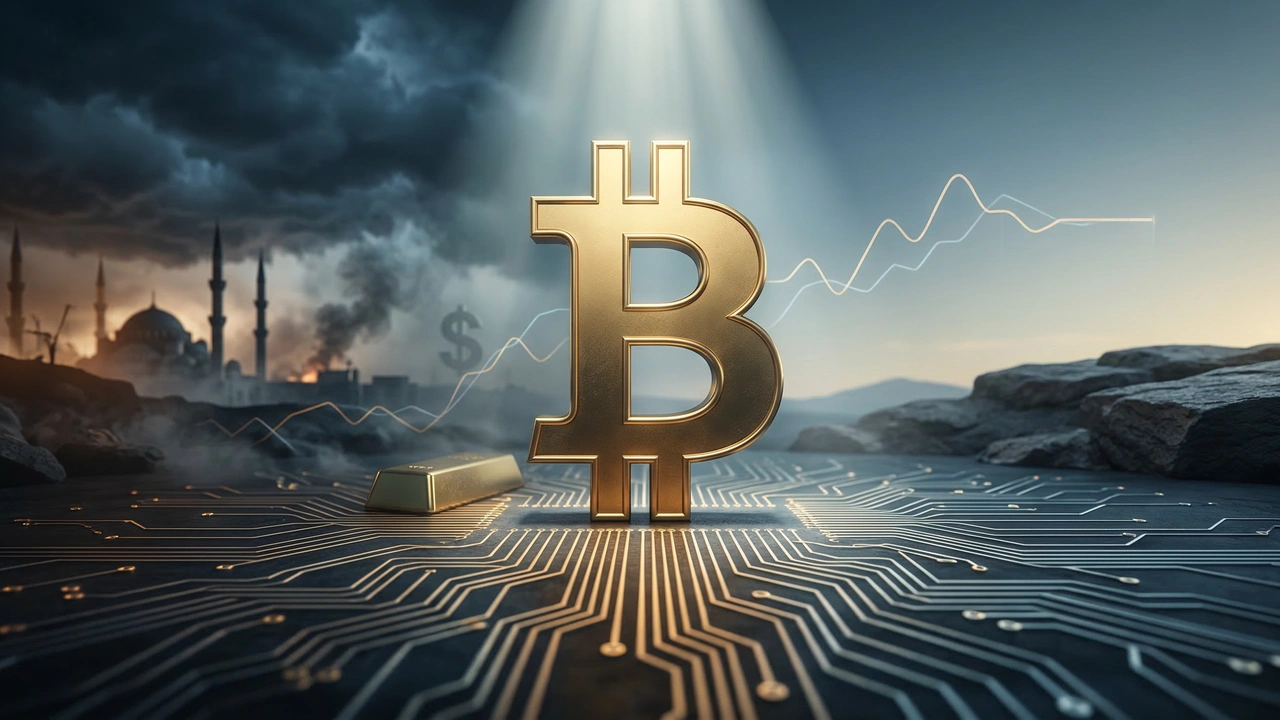
Despite geopolitical shocks that experts predicted would send Bitcoin tumbling to $55,000, the leading cryptocurrency held firm above $73,000 — a development that is reshaping how analysts think about Bitcoin's safe-haven narrative.
Key Takeaways
- Bitcoin's refusal to collapse during the Iran conflict escalation — holding above $73,000 when analysts like Luke Gromen expected $55,000 — marks a meaningful, if early, validation of its safe-haven narrative in crisis scenarios. [1]
- Capital flight dynamics from geopolitically unstable regions may be providing an underappreciated source of Bitcoin demand that traditional market models fail to account for. [1]
- Veteran macro analysts including Gromen and Arthur Hayes remain cautious on near-term Bitcoin positioning, with both citing the need for clearer signals of aggressive monetary expansion before increasing exposure. [1]
- The broader crypto market, as illustrated by XRP's on-chain data, is navigating a period of elevated unrealized losses and declining liquidity — a fragile structure that could amplify price movements sharply in either direction when a catalyst arrives. [2]
- Whale accumulation in both Bitcoin and XRP during this consolidation phase indicates that sophisticated large-capital players are treating current prices as a long-term opportunity, even as short-term traders remain on the sidelines. [2]
Bitcoin Defies the Geopolitical Playbook — And Analysts Are Taking Notice
When conflict erupts in a major geopolitical flashpoint, conventional financial wisdom says risk assets get crushed. Stocks fall, bonds rally, and speculative investments take the hardest hits. Bitcoin, long classified as a high-risk, high-volatility asset, was supposed to follow that same script. It didn't — and that divergence is forcing some of the sharpest minds in macro finance to reconsider what Bitcoin actually is.
The unexpected price stability Bitcoin demonstrated amid escalating Middle East tensions has opened a broader conversation about whether BTC is quietly maturing into something resembling a genuine store of value. The data, the behavior of large investors, and the candid admissions of veteran analysts all point to a market in a state of complex transition — one that rewards careful observation over reactive trading.
The Facts
Investment strategist Luke Gromen, founder of macro research firm FFTT, admitted in a recent episode of the What Bitcoin Did podcast that Bitcoin's performance caught him off guard. Asked where he would have predicted Bitcoin's price in the wake of the Iran conflict escalation, Gromen was direct: "If you had asked me two weeks ago, I would have expected Bitcoin closer to $55,000." [1] Instead, Bitcoin traded significantly higher and successfully breached the $73,000 mark on a Friday afternoon in March. [1]
Gromen offered a compelling explanation for this resilience: capital flight. When investors in conflict-adjacent regions need to move wealth rapidly across borders, Bitcoin's borderless, permissionless infrastructure makes it an obvious tool. "If you want to get your money out of the Emirates as fast as possible, you might just buy Bitcoin," he explained. [1] In this framing, Bitcoin temporarily functions as a crisis exit ramp — a role typically reserved for gold or the US dollar — which Gromen described as an "encouraging signal" for the digital gold narrative. [1]
Despite this optimism, Gromen has not re-entered the market with conviction. He disclosed having sold a substantial portion of his own Bitcoin position around the $95,000 level, citing several warning signals: Bitcoin's weak response to expanding money supply, years of sideways movement against gold, increased selling by long-term holders, and deteriorating technical indicators. [1] His threshold for renewed accumulation remains a significant shift toward more aggressive monetary expansion from central banks. "I would need to see more aggressive money printing," he stated. [1] BitMEX co-founder Arthur Hayes echoed a similar degree of caution, reportedly stating that if forced to deploy fresh capital right now, he would wait rather than allocate to Bitcoin. [1]
Meanwhile, in the broader altcoin market, XRP presents a contrasting picture of market structure under stress. Trading around $1.40, XRP is locked in a well-defined consolidation range with no decisive breakout in either direction. [2] On-chain data from Glassnode reveals that approximately 36.8 billion XRP — nearly 60% of the circulating supply — is currently held at a loss, representing roughly $50.8 billion in unrealized losses. [2] Trading volume on Binance, as measured by the 30-day Volume Z-Score, has dropped to approximately -1.16, indicating activity well below historical norms. [2] Liquidity in the order book has also thinned considerably, meaning that even moderately sized trades could produce outsized price movements. [2] However, whale wallets holding between 10 and 100 million XRP have added approximately 180 million tokens to their holdings in recent weeks, suggesting that large players view current prices as an accumulation opportunity. [2]
Analysis & Context
The core insight emerging from Gromen's analysis is historically significant. For most of Bitcoin's existence, critics dismissed it as a purely speculative instrument — one that would be the first casualty of any serious risk-off environment. The 2020 COVID crash briefly validated that view, when Bitcoin plunged alongside equities in March of that year. But the post-2020 maturation of Bitcoin's institutional base, combined with the emergence of spot Bitcoin ETFs, has fundamentally changed the composition of its holder base. When large, conviction-driven institutional holders don't panic-sell during geopolitical stress, the entire price dynamic shifts. The fact that Bitcoin held its ground — and in some cases appreciated — during a period of regional conflict suggests that the "digital gold" narrative is no longer purely aspirational. It is beginning to show up in actual market behavior.
Gromen's hesitance to re-enter the market, however, deserves serious attention. His concern that Bitcoin has underperformed relative to gold over a multi-year period is not a minor technical quibble — it speaks to a deeper question about whether Bitcoin is truly tracking the macro variables that drive its long-term thesis. If expansionary monetary policy is the primary fuel for Bitcoin's appreciation, and central banks remain in a tightening or paused posture, the near-term upside may be more constrained than headline prices suggest. The structural risks he identifies — AI-driven economic disruption, sovereign debt pressures, and bond market fragility — represent a complex macro environment where Bitcoin's correlation to risk assets could reassert itself at any moment.
The XRP data serves as a useful parallel and a cautionary tale about market structure in consolidation phases. The combination of a majority of supply held at a loss, declining volume, and thinning liquidity is a setup that historically precedes either a sharp relief rally or an accelerated breakdown. The whale accumulation is a bullish signal, but it is not sufficient on its own to drive a trend reversal without broader market participation and fresh demand catalysts. For Bitcoin observers, XRP's current state is a reminder that the entire crypto asset class remains susceptible to prolonged consolidation when macro tailwinds are absent.
Sources
- [1]btc-echo.de
- [2]btc-echo.de
AI-Assisted Content
This article was created with AI assistance. All facts are sourced from verified news outlets.