Bitcoin's Trust Problem: From Accidental Burns to Payment Guardrails
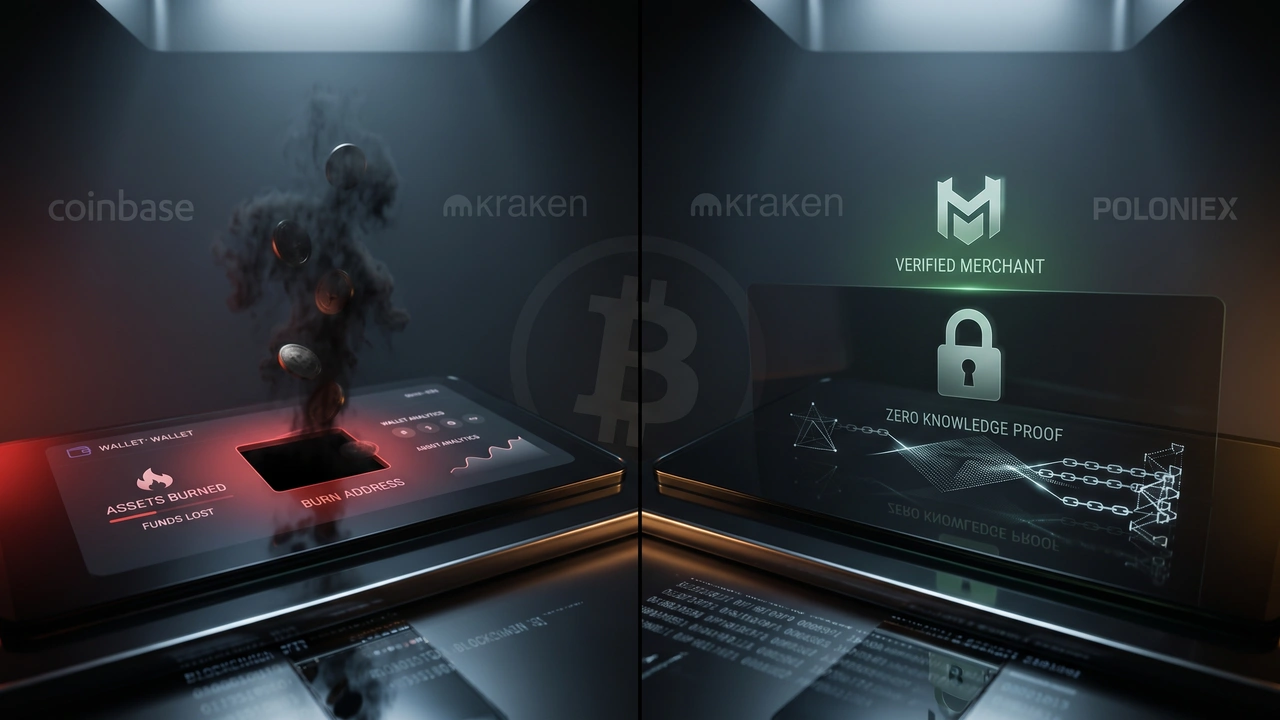
Two recent developments - 107 BTC sent irreversibly to a burn address and a new merchant-verification layer for Bitcoin payments - together expose the same underlying challenge: human error and eroded confidence remain among the sharpest threats to Bitcoin adoption.
Key Takeaways
- The irreversible loss of 107 BTC to a burn address most likely reflects a failure at the human layer - a recovery or inheritance process executed without adequate safeguards - rather than any weakness in Bitcoin's underlying protocol.
- Permanently lost or destroyed coins represent a quiet, ongoing tightening of Bitcoin's functional circulating supply, reinforcing the scarcity argument even without deliberate action by any market participant.
- Branta's Guardrails service, now integrated with Manna, demonstrates that the Bitcoin development community is building practical tools to reduce payment anxiety and human error at the moment of transaction - closing a gap that protocol-level security alone cannot address.
- The comparison to HTTPS adoption is instructive: user-facing trust signals - visible, simple, and frictionless - have historically been decisive in driving mainstream adoption of security standards, and Bitcoin payments may follow a similar trajectory.
- Inheritance and recovery workflows remain among the highest-risk scenarios in self-custodial Bitcoin, and the absence of standardized, error-resistant tooling for those processes is a gap the ecosystem has not yet adequately filled.
Bitcoin's Trust Problem: From Accidental Burns to Payment Guardrails
Bitcoin's most unforgiving property - its irreversibility - cuts two ways. It guarantees finality for legitimate transactions, yet it transforms a single moment of carelessness into a permanent, uncorrectable loss. Two developments that landed in quick succession this week put that double edge under a harsh spotlight: roughly 107 BTC dispatched forever to a known burn address, and a new security layer that tries to prevent exactly that kind of catastrophe from happening in the first place.
Read together, these stories are not just isolated incidents. They form a coherent portrait of Bitcoin's most stubborn unsolved problem - the gap between protocol-level security and human-level reliability.
The Facts
On May 25, an unidentified Bitcoin holder sent 107 BTC across five separate transactions to a well-documented burn address - one for which no controlling private key exists [1]. The coins are, by all reasonable assessment, gone permanently, removed from circulating supply with no mechanism for recovery. On-chain forensics trace the funds back to wallets with activity stretching to 2014, and the transaction trail suggests the bitcoin originated from hot wallets associated with major exchanges including Coinbase, Poloniex, and Kraken [1].
Speculation inside the Bitcoin community ran the full spectrum of possibilities. Some observers floated the idea of a fat-finger error during a recovery attempt; others joked about a rogue AI agent making its own decisions [1]. The most grounded explanation circulating is that whoever controlled these wallets made an error during a recovery or inheritance workflow, confusing a demo burn address for a legitimate destination - a mistake that would be tragically easy to make in an unfamiliar process [1].
While that drama was unfolding on-chain, a Bitcoin security company called Branta announced a meaningful step toward reducing this category of error for everyday users. Branta integrated its Guardrails service with Manna, a self-custodial payments application [2]. The practical result: before a user completes a payment through Manna, they now see the recipient merchant's logo and company details directly inside the wallet interface, providing a layer of visual confirmation that the funds are heading to the intended destination [2].
Branta's approach is deliberately privacy-preserving. The system uses zero-knowledge proofs to authenticate the link between sender and recipient without Branta itself ever learning the payment addresses or invoice details involved [2]. According to co-founder Kieth Gardner, the team prioritized privacy standards throughout the design process. Merchants who integrate the service benefit from a visible trust signal - their logo appearing in the customer's wallet at the moment of payment - which Gardner compares to the way browser padlock icons normalized HTTPS adoption in the early 2000s [2]. Adam Simecka, Manna's CEO, framed the core problem bluntly: the irreversibility of Bitcoin payments creates anxiety at the moment of sending, and that anxiety is a measurable drag on adoption [2].
Analysis & Context
The 107 BTC burn event is a reminder that the threat landscape for Bitcoin holders has always included a category of risk that no cryptographic protocol can fully address: the user's own actions. The scale of accidental loss across Bitcoin's lifetime is difficult to verify precisely, but industry estimates consistently place permanently inaccessible bitcoin - through lost keys, forgotten passwords, and misdirected transfers - in the millions of coins. The Satoshi-era coins that have never moved, the James Howells hard drive story, the countless wallets from 2011 and 2012 that no one can open anymore: the burn event on May 25 fits a pattern that is as old as Bitcoin itself.
What makes this particular incident notable beyond the dollar figure is the apparent source of the funds. If on-chain analysis is correct that these coins passed through major exchange hot wallets before ending up in wallets dormant since 2014, the scenario most consistent with the facts is an estate or inheritance situation - someone who either died or lost access, and a successor who attempted recovery without sufficient technical guidance [1]. Inheritance in Bitcoin remains one of the least-solved problems in the ecosystem. Unlike traditional assets, where probate courts and legal frameworks can unlock frozen accounts, Bitcoin inheritance requires flawless execution of technical procedures. One wrong address - especially a demo or placeholder address encountered during a tutorial - and the outcome is exactly what occurred here.
The Branta-Manna integration addresses a related but distinct slice of that risk surface: the moment of active payment. Poison address attacks, while more prevalent on Ethereum and other chains than on Bitcoin, have demonstrated that attackers can exploit users' habit of copying addresses from transaction history [2]. Bitcoin's UTXO model and address reuse norms offer some natural resistance, but they do not eliminate social engineering or pure human error. The Guardrails approach - establishing a cryptographically authenticated side channel that confirms merchant identity before funds move - is conceptually similar to two-factor authentication in traditional finance. It does not replace the user's judgment; it gives that judgment something solid to rely on.
The broader pattern here is that Bitcoin's security model is technically robust at the base layer but still fragile at the edges where humans interact with it. The ecosystem is gradually building a layered response: hardware wallets reduced private key exposure, multi-signature schemes distributed single points of failure, and now merchant-verification tools are beginning to close the gap at the payment interface. Each layer matters. The burn event on May 25 is a painful illustration of what happens when those human-interface safeguards are absent or ignored.
From a supply perspective, 107 BTC becoming permanently inaccessible is a marginal but directionally meaningful event. Bitcoin's fixed supply cap and the gradual accumulation of lost or burned coins mean the functional circulating supply is somewhat smaller than the headline issuance figures suggest. Each provably destroyed or inaccessible coin tightens that supply a fraction further - a dynamic that has symbolic weight even when the market impact of any single event is minimal [1].
Sources
AI-Assisted Content
This article was created with AI assistance. All facts are sourced from verified news outlets.