Bitcoin's Twin Threats: Quantum Computing and the Privacy Crisis
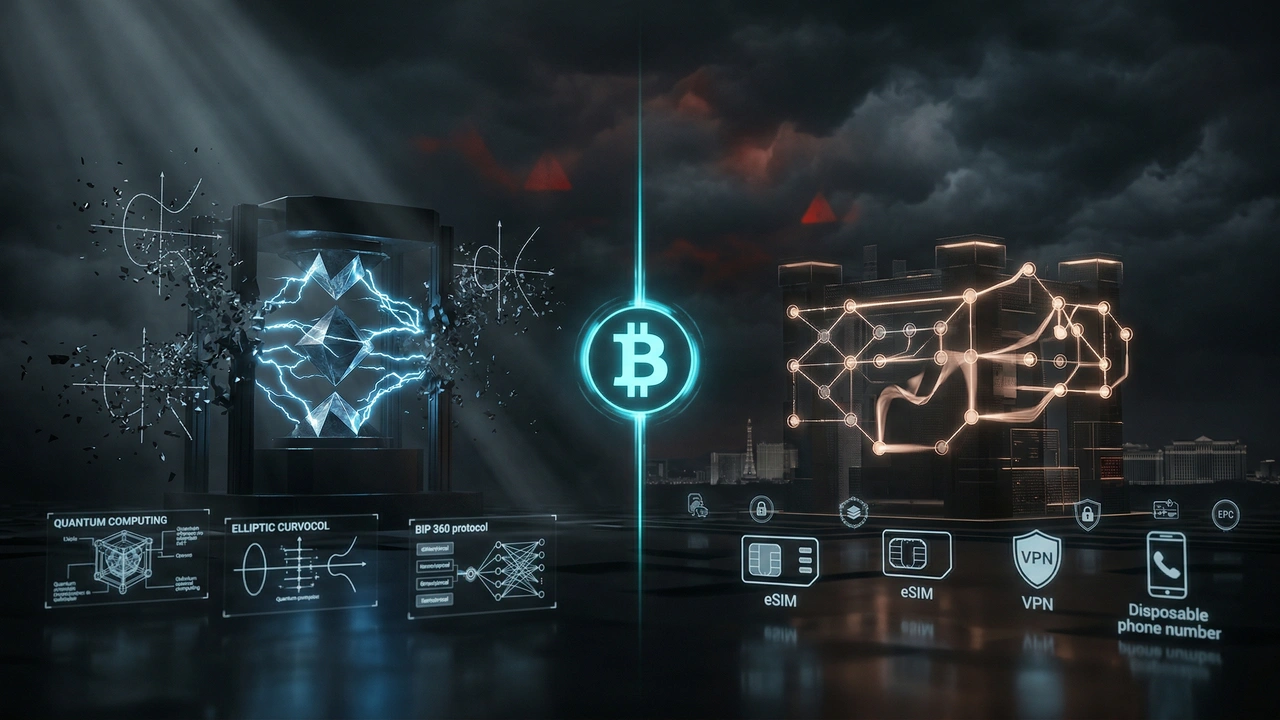
As quantum computing advances closer to cryptographic relevance, Bitcoin faces a dual challenge: protecting its foundational security while a new generation of privacy-first services built on Lightning signals how the ecosystem is already adapting.
Key Takeaways
- BIP 360 is real and moving fast: The quantum-resistant address proposal was merged into the Bitcoin Core BIP repository in February 2026 and is already live on testnet — this is no longer a distant theoretical debate but an active area of protocol development that Bitcoin holders should monitor closely.
- Not all wallets face equal quantum risk: Experts like Alex Thorn emphasize that quantum exposure today is concentrated in specific wallet types with exposed public keys, not the entire network — understanding your own wallet's vulnerability profile is increasingly important.
- The data breach environment validates the no-log model: With tens of millions of records compromised across Conduent, Mixpanel, and Ledger's payment processor in a matter of months, Lightning-powered, zero-log services like Nadanada.me represent a rational response to a systemic problem, not a niche privacy affectation.
- Lightning is evolving into a sovereign infrastructure layer: From VPNs to eSIMs to anonymous AI access, the use cases being built on Lightning payment rails are expanding well beyond financial transactions — this has long-term implications for Bitcoin's utility and adoption narrative.
- Bitcoin 2026 will be a key signal for protocol direction: The quantum panel at The Venetian on April 29 brings together the key architects and skeptics of BIP 360 — the tone and consensus (or lack thereof) that emerges will likely shape the pace of quantum-resistance implementation in the months that follow.
Bitcoin Faces a Privacy Reckoning — From Quantum Threats to Vanishing Data Trails
Bitcoin's long-term resilience has never been tested on quite so many fronts simultaneously. On one side, the specter of quantum computing looms over the elliptic-curve cryptography that underpins every Bitcoin wallet. On the other, a wave of data breaches at major corporations has exposed tens of millions of users and reframed privacy not as paranoia, but as rational self-defense. Together, these developments are pushing the Bitcoin ecosystem toward a critical inflection point — one that demands both protocol-level solutions and infrastructure-level innovation.
The convergence of these two themes — quantum vulnerability and personal privacy — tells a single, coherent story about where Bitcoin stands in 2026: a network built for trustless, permissionless finance is being stress-tested by forces that its original designers could only partially anticipate. The response from builders, developers, and entrepreneurs operating within the ecosystem is revealing.
The Facts
The quantum computing debate is moving from theoretical concern to active protocol development. Bitcoin 2026, scheduled for April 27–29 at The Venetian in Las Vegas, will host a dedicated panel titled "How Real Is The Quantum Threat?" bringing together five prominent voices across the technical and investment spectrum [2]. The panel includes Hunter Beast, co-author of BIP 360 — a proposal introducing a new quantum-resistant Bitcoin wallet address type that was merged into the Bitcoin Core BIP repository in February 2026 and deployed on the Bitcoin Quantum Testnet v0.3.0 in March [2].
The range of perspectives on the panel reflects genuine disagreement among serious experts. Charles Edwards of Capriole has argued that quantum computing is advancing more rapidly than most market participants appreciate and has advocated for implementing BIP 360 as soon as this year [2]. Meanwhile, Alex Thorn, head of research at Galaxy Digital, holds that while the quantum threat is real, its current impact is limited to specific exposed wallets, and that developers are building remediation pathways on a reasonable timeline [2]. Brandon Black has specifically cautioned that quantum computing timelines are frequently misunderstood by the broader market [2], while James O'Beirne — a Bitcoin Core contributor since 2015 — brings deep protocol expertise from projects including OP_VAULT and assumeutxo [2].
On the privacy infrastructure side, a company that began in 2022 as LNVPN — originally built at the request of human rights advocate Alex Gladstein for activists in oppressive regimes — has evolved into a full-spectrum anonymous services platform rebranded as Nadanada.me [1]. The service now offers anonymous eSIM data plans across more than 200 countries, disposable and rental phone numbers for SMS verification, WireGuard VPN access, and anonymous AI chat tools — all payable via Lightning Network with no accounts, no contracts, and no logs [1]. The name itself is a statement of policy: derived from the Spanish phrase for "nothing at all," the company describes its data retention posture with the words, "What do we know about our users? Nada. What do we log? Nada" [1].
The urgency behind such services is underscored by a cascade of high-profile data breaches. In November 2025, analytics firm Mixpanel was compromised, exposing names, emails, and location data of OpenAI API users [1]. In early 2025, U.S. government contractor Conduent suffered a ransomware attack that compromised the personal and health records of more than 25 million Americans [1]. In January 2026, Ledger customers had their names and contact information exposed through a breach at third-party payment processor Global-e [1]. Each incident serves as a live demonstration of why no-log, Lightning-powered services are gaining traction.
Analysis & Context
The quantum threat debate is not new to Bitcoin — researchers have been flagging elliptic-curve cryptography vulnerabilities to sufficiently advanced quantum computers for years. What is new is the pace. BIP 360's progression from proposal to testnet deployment within months signals that the developer community is shifting from awareness to action. Historically, Bitcoin protocol upgrades move slowly and deliberately — SegWit took years from proposal to activation, and Taproot followed a similarly cautious arc. The fact that a quantum-resistance proposal is already live on testnet suggests that at least a segment of the core developer community believes the timeline is shorter than the market currently prices in.
The disagreement between Edwards and Thorn — one urging immediate implementation, the other counseling measured progress — mirrors nearly every major Bitcoin upgrade debate in the network's history. This tension is actually healthy: Bitcoin's conservative upgrade culture has protected it from rushed changes that introduced unforeseen vulnerabilities. However, the asymmetry of quantum risk is worth noting. If the threat materializes before a mitigation is deployed, the consequences for exposed wallets — particularly those with public keys visible on-chain, such as early P2PK outputs or reused addresses — could be severe and irreversible. That is the core argument for urgency.
Meanwhile, the rise of Nadanada.me and similar Lightning-native privacy services represents something deeper than a product launch. It is evidence that Bitcoin's payment infrastructure is maturing into a foundation for a broader sovereign technology stack. When Gladstein's request for an activist-grade VPN in 2022 can evolve, by 2026, into a global anonymous communications platform accessible to anyone with a Lightning wallet, that is a meaningful expansion of what Bitcoin enables beyond simple value transfer. The repeated, large-scale failures of centralized data custodians — government contractors, hardware wallet makers, AI platforms — are making the "nada" model increasingly compelling not just for activists and dissidents, but for ordinary users who simply do not wish to be the next breach statistic.
Sources
AI-Assisted Content
This article was created with AI assistance. All facts are sourced from verified news outlets.