Bitcoin's Twin Threats: Social Engineering Today, Quantum Tomorrow
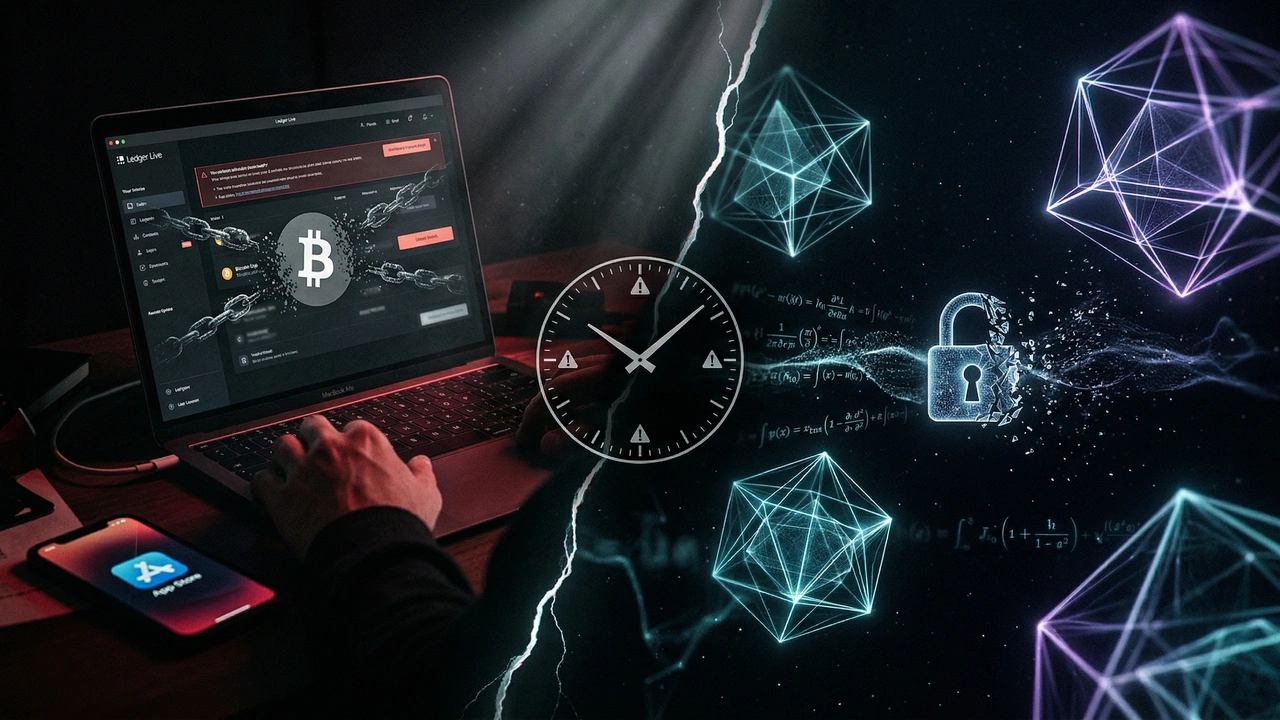
A musician's $420,000 loss to a fake Ledger app and a new quantum-resistant wallet recovery proposal reveal the two-front war Bitcoin holders must prepare to fight — one immediate and human, one distant but existential.
Key Takeaways
- Never enter your seed phrase into any application, ever. Legitimate wallet software and hardware devices do not require you to input your seed phrase during normal operation. Any prompt asking for it is almost certainly an attack.
- App store listings are not security guarantees. Both Apple's App Store and Microsoft's store have hosted malicious crypto applications that bypassed review processes — always verify software authenticity directly through the manufacturer's official website.
- The quantum threat to Bitcoin is real but not imminent — however, Osuntokun's zk-STARK proposal demonstrates that the developer community is actively building technical solutions rather than waiting for a crisis to force action.
- Bitcoin's Taproot architecture may prove to be a critical safety net, offering a path to disable compromised signature schemes in a post-quantum scenario without permanently locking legitimate holders out of their funds.
- The gap between Bitcoin's two biggest security challenges — human social engineering today versus cryptographic vulnerability tomorrow — requires holders to act defensively on both timescales: practice rigorous operational security now, and stay informed as post-quantum standards develop.
Bitcoin Security Is Under Attack on Two Fronts — and Only One Is Getting Enough Attention
Bitcoin's promise of financial sovereignty comes with an unforgiving corollary: you are your own security department. This week delivered a sharp reminder of that reality from two very different directions. On one front, a musician lost nearly half a million dollars to a fraudulent app that exploited nothing more sophisticated than human trust. On the other, Bitcoin developers are quietly racing to engineer a cryptographic escape hatch before quantum computing renders today's wallet infrastructure obsolete. Together, these developments paint a portrait of an ecosystem navigating threats that span the immediate and the existential.
The gap between these two threat categories is enormous — one requires clicking a malicious link, the other requires a computer that doesn't yet commercially exist — but both demand attention. And crucially, the Bitcoin community's response to each reveals just how seriously it takes the long game of security.
The Facts
Garrett Dutton, the American musician widely known as G. Love, publicly disclosed over the weekend that he lost 5.9 BTC — approximately $420,000 — after downloading a counterfeit version of the Ledger Live self-custody application from Apple's App Store onto his new MacBook [1]. The fraudulent app prompted him to enter his seed phrase, effectively handing attackers full access to his wallet. Dutton, who has followed Bitcoin since 2017 and had spent roughly a decade accumulating the funds for retirement, described the loss as happening "in an instant" [1].
On-chain investigator ZachXBT confirmed that Dutton's funds were subsequently routed to deposit addresses at crypto exchange KuCoin across nine separate transactions [1]. The exchange responded with a generic customer-oriented statement. Cointelegraph was unable to locate the offending app in the App Store at the time of reporting, and Apple had not responded to requests for comment [1]. The incident is not isolated: a nearly identical attack vector targeting Microsoft's app store in 2023 resulted in close to $600,000 in stolen Bitcoin from multiple victims before Microsoft acknowledged the app had bypassed its review process and removed it [1]. The FBI recently reported that Americans suffered over $11 billion in crypto-related losses in 2025, up from $9 billion the prior year [1].
Meanwhile, on a Bitcoin developer mailing list, Lightning Labs CTO Olaoluwa Osuntokun published a technical proposal addressing a very different class of threat: quantum computing [2]. The concern centers on the possibility that a sufficiently powerful quantum computer could compromise the cryptographic signatures Bitcoin currently relies on. Wallets with publicly exposed keys — a condition that applies broadly — would be particularly vulnerable [2]. Osuntokun's proposal describes a zk-STARK-based proof system, a form of zero-knowledge cryptography, that would allow a wallet owner to prove their seed-derived ownership of a public key without ever revealing the seed itself [2]. In testing on standard consumer hardware, generating such a proof took approximately 55 seconds, while verification required under two seconds, producing a file of around 1.7 megabytes [2].
The proposal draws on related academic work from Blockstream researcher Tim Ruffing, published in July 2025, which argues that Bitcoin's Taproot upgrade — active since 2021 — could serve as a cryptographic commitment mechanism in a post-quantum world, potentially allowing classic signatures to be disabled without permanently locking out legitimate coin holders [2]. Osuntokun notes that the approach could extend to all BIP-32-based wallets, covering the vast majority of Bitcoin wallet infrastructure [2]. No formal Bitcoin Improvement Proposal has been filed and no implementation timeline exists, but Google's stated goal of transitioning to post-quantum cryptography by 2029 is adding urgency to the broader conversation [2].
Analysis & Context
The G. Love incident is, at its core, a supply-chain trust failure — and it exposes a dangerous assumption that many Bitcoin holders make: that major app marketplaces provide meaningful security guarantees. They do not. Apple's App Store and Microsoft's equivalent have both proven permeable to well-crafted impersonators. The attack pattern is deliberately simple. A convincing app name and icon, a prompt to enter sensitive credentials, and the theft is complete before the victim has any reason for suspicion. Dutton's candid admission — "it was my own damn fault for not being more diligent" — is admirable, but it also illustrates how even experienced participants can be caught off guard. The real lesson is structural: seed phrases should never be entered into any application under any circumstances unless the user has independently verified the software's authenticity through the official manufacturer's website, not through an app store search. Hardware wallets exist precisely to make this interaction unnecessary.
The quantum threat is a different kind of problem entirely — one that operates on a decade-plus timescale but demands near-term architectural decisions. Bitcoin's conservative, consensus-driven development process means that any meaningful protocol upgrade requires years of proposal, debate, testing, and community alignment. Waiting until quantum computers are demonstrably capable of breaking elliptic curve cryptography before beginning that process would be reckless. Osuntokun's zk-STARK proposal is notable not because it is ready to deploy — it explicitly is not — but because it represents the kind of concrete, testable engineering that moves a theoretical concern into the realm of practical preparation. The fact that it ran successfully on a standard MacBook is a meaningful proof of concept. The 55-second proof generation time is clearly not production-ready, but optimization cycles in cryptographic engineering routinely deliver order-of-magnitude improvements.
Historically, Bitcoin has navigated existential-seeming technical threats through a combination of proactive developer engagement and its deliberately slow upgrade cadence. The Taproot upgrade itself took years from proposal to activation. If quantum-resistant signature schemes are to be integrated before they are urgently needed, the community needs to begin that process now — not when the threat is already at the door. Osuntokun's proposal, and Ruffing's academic groundwork, suggest that a coherent path forward is taking shape, even if the destination remains distant.
Sources
AI-Assisted Content
This article was created with AI assistance. All facts are sourced from verified news outlets.