Bitcoin's Two Paths: Government Hesitation vs. Grassroots Momentum
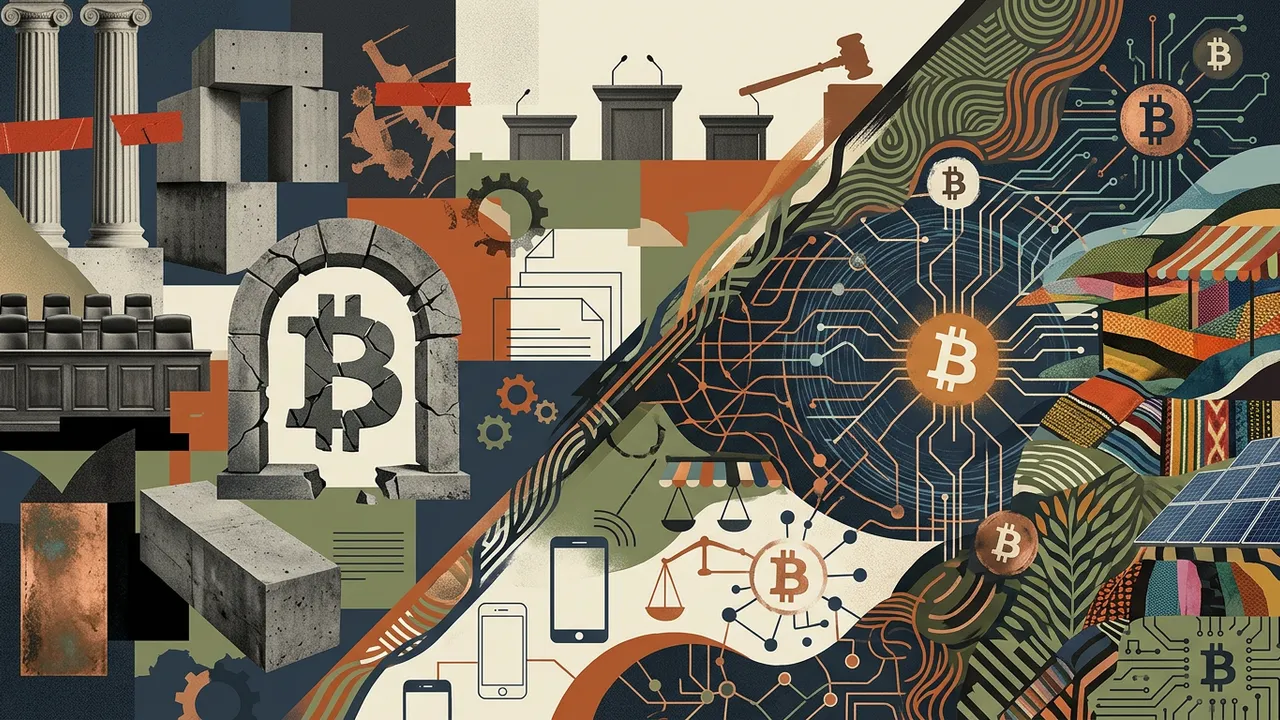
While U.S. policymakers stall on institutional adoption, African communities are already using Bitcoin as everyday money—revealing a stark divide in how the world approaches digital currency integration.
Key Takeaways
• Government support for Bitcoin faces structural barriers in developed economies where policymakers benefit from monetary expansion, creating a gap between political rhetoric and meaningful action that may persist regardless of administration changes.
• Economic necessity drives more sustainable Bitcoin adoption than political support—African communities experiencing severe currency debasement are implementing Bitcoin as functional money while U.S. institutions debate reserve policies.
• Sub-Saharan Africa's $205 billion in onchain value and 52% year-over-year growth demonstrates Bitcoin's transition from speculative asset to monetary infrastructure occurs first in economies with broken financial systems, following historical patterns of monetary innovation.
• The Strategic Bitcoin Reserve's stalled implementation reveals fundamental incompatibility between Bitcoin's fixed supply and government fiscal models built on monetary expansion, suggesting institutional adoption will remain gradual and politically fraught.
• Bitcoin's ultimate success likely depends more on continued grassroots adoption in high-inflation economies than on government reserves or institutional validation, reversing the top-down adoption narrative popular in Western Bitcoin circles.
Bitcoin's Adoption Paradox: Political Promises Meet Economic Reality
A striking contrast is emerging in global Bitcoin adoption that challenges conventional assumptions about how digital currency integration unfolds. In the United States, despite high-profile political support and executive orders, meaningful government action on Bitcoin remains stalled in bureaucratic process and political calculation. Meanwhile, in parts of Africa facing severe currency debasement, Bitcoin has moved beyond theoretical discussions to become functional money in circular economies where merchants prefer satoshis to dollars. This divergence illuminates a fundamental truth about Bitcoin: necessity drives adoption far more effectively than political theater.
The gap between these two approaches—top-down institutional hesitation versus bottom-up economic urgency—reveals much about Bitcoin's future trajectory and the conditions under which it transitions from speculative asset to monetary infrastructure.
The Facts
David Bailey, former crypto advisor to the Trump administration and current CEO of Bitcoin treasury company KindlyMD, delivered blunt criticism of U.S. government inaction during the Bitcoin Investor Week Conference in New York. "At the end of the day, liking Bitcoin is not enough," Bailey stated, pointing to the gap between political rhetoric and tangible progress [1].
While President Trump signed an executive order establishing a Strategic Bitcoin Reserve in March 2025, the government has yet to accumulate any Bitcoin beyond assets seized through illicit activity. "We're sitting here a year later, the Strategic Bitcoin Reserve was signed into an executive order. Last time I checked, we don't even know how much Bitcoin we have exactly," Bailey noted [1]. According to Arkham Research data, the U.S. currently holds 378,372 Bitcoin worth approximately $22.48 billion—entirely from law enforcement seizures [1].
White House AI and crypto czar David Sacks explained in May that Bitcoin purchases would need to be "budget-neutral" without adding to the national debt or requiring new taxes, effectively creating a political impasse [1]. Bailey argued that without willingness to "bear the political capital necessary to mobilize the different gears necessary to move the ball forward," supportive rhetoric produces the same outcome as opposition [1].
A dramatically different picture emerges from Africa, where Bitcoin adoption is driven by economic necessity rather than policy debates. Stafford Masie, executive chairman of Africa Bitcoin Corporation, told the Coin Stories podcast that Bitcoin functions as everyday money in parts of the continent. "Where I come from, Bitcoin is money," Masie explained, describing circular economies where merchants "won't accept dollars—they accept satoshis" [2].
Masie highlighted the stark difference in inflation experiences: "When you guys talk about debasement, you talk about 4% to 5% annually—we talk about 4% to 5% in an afternoon" [2]. He described Bitcoin as "pristine capital" that provides financial infrastructure individuals and businesses can build upon, stating: "In Africa, we know the age before 2008 and the age after 2008... Our lives changed, because suddenly we had something that couldn't be debased" [2].
Blockchain analytics from Chainalysis support this narrative shift. Sub-Saharan Africa received more than $205 billion in onchain value from July 2024 to June 2025, representing a 52% year-over-year increase and making it the third-fastest growing crypto region globally [2]. In March 2025 alone, monthly volume spiked to nearly $25 billion, driven largely by Nigerian activity following currency devaluation [2]. Notably, transfers under $10,000 accounted for over 8% of total value sent in the region—compared to 6% globally—indicating retail-driven adoption rather than institutional speculation [2].
Analysis & Context
The contrast between these two adoption pathways illuminates a critical insight: Bitcoin succeeds where it solves immediate problems, not where it requires political consensus. Bailey's frustration with U.S. government inaction, while valid, may ultimately prove less significant than the organic adoption occurring in economies with broken monetary systems.
The Strategic Bitcoin Reserve impasse reveals how Bitcoin challenges existing political and fiscal frameworks. In a system built on monetary expansion and debt monetization, accumulating a non-inflationary asset requires abandoning familiar policy tools. The "budget-neutral" requirement essentially asks politicians to acknowledge that Bitcoin acquisition—unlike bond purchases or currency swaps—cannot be papered over with newly created dollars. This creates cognitive dissonance at the heart of government finance.
Historically, major monetary transitions occur at the periphery before reaching the core. Gold standard abandonment began with smaller economies facing balance of payment crises. Internet adoption exploded first in countries lacking extensive legacy telecommunications infrastructure. Similarly, Bitcoin appears to be following a path where economies with the greatest monetary dysfunction adopt most aggressively, while reserve currency issuers move slowly, constrained by their investment in the existing system.
The African adoption model—driven by currency debasement exceeding 20% annually in a dozen countries and 650 million unbanked individuals—represents Bitcoin functioning as Satoshi Nakamoto originally envisioned: peer-to-peer electronic cash for populations excluded from or betrayed by traditional banking. This isn't speculative positioning or portfolio diversification; it's economic survival driving technological adoption.
Bailey's observation that Bitcoin will succeed "whether it's four years from now, or 10 years from now, or 20 years from now" regardless of government support is likely accurate, though the mechanism may differ from what U.S.-centric Bitcoin advocates expect. Rather than institutional adoption flowing from government reserves to corporate treasuries to individual investors, the reverse path may prove more powerful: grassroots adoption in desperate economies forcing recognition from institutions that initially dismissed Bitcoin's monetary properties.
The current Bitcoin price of $68,220—45% below its October high of $126,000—reflects this uncertainty about adoption pathways [1]. Markets remain fixated on institutional validation signals like Strategic Bitcoin Reserves while underpricing the significance of functional monetary adoption in emerging markets. Over time, these grassroots networks may prove more durable and significant than top-down institutional adoption dependent on political winds.
Sources
AI-Assisted Content
This article was created with AI assistance. All facts are sourced from verified news outlets.