Bitcoin Stalls at $83K While Altcoins Stage Broad-Based Rally
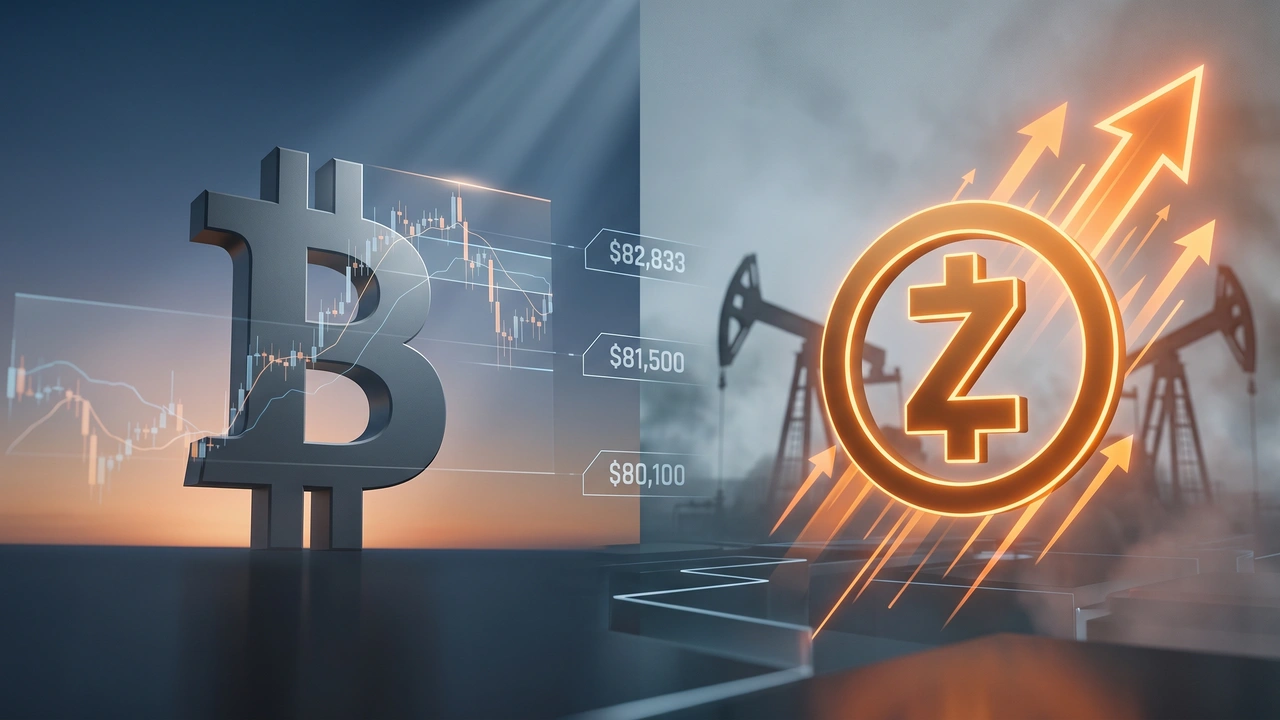
Bitcoin reached a 13-week high near $83,000 before geopolitical uncertainty dragged it back, but the pullback has done little to dampen a powerful altcoin rally led by Zcash's explosive 40% surge.
Key Takeaways
- Bitcoin's 13-week high near $83,000 is a technically significant milestone, but the $84,000 level is where real resistance lies - a clean break there opens the path toward $92,000, while a failure could see a reset toward $78,400 [2][3]
- Geopolitical headlines around US-Iran tensions are now functioning as a short-term Bitcoin price driver, introducing binary risk that technical analysis alone cannot anticipate [3]
- Zcash's 40% surge was catalyzed by an institutional disclosure from Multicoin Capital - a reminder that undisclosed accumulation followed by public announcement is a recurring pattern that can produce violent moves in lower-liquidity assets [1]
- ZEC's RSI above 76 and expanded Bollinger Bands signal that the sharpest gains may be near-term exhausted - the $517 support level is critical for sustaining the bullish structure [1][2]
- Broad altcoin strength across SOL, BNB, ADA, and DOGE suggests capital rotation rather than market-wide risk-off behavior - a pattern that historically precedes the next leg higher in Bitcoin once resistance is cleared [2]
Bitcoin Holds Three-Month Highs as Altcoins Break Out - A Market in Transition
The crypto market is sending a layered message this week. Bitcoin is pressing against technically significant resistance while a wave of institutional catalysts and renewed retail enthusiasm are driving explosive moves across the altcoin landscape. The confluence of a maturing Bitcoin price structure, geopolitical headline risk, and targeted capital flows into select altcoins paints a picture of a market that is anything but uniform - and one that rewards careful attention to the details beneath the surface.
For investors watching the broader cycle, the divergence between Bitcoin's measured advance and the velocity of certain altcoin moves is both an opportunity and a warning sign. Understanding what is driving each dynamic is essential to navigating the days ahead.
The Facts
Bitcoin climbed to a fresh 13-week high of $82,833 on Wednesday before sellers emerged to push the price back toward $81,500 - still representing a gain of roughly 1% on the day [3]. The rally was briefly supercharged by reports of a potential 14-point ceasefire agreement between the United States and Iran, which included language around resuming oil traffic through the Strait of Hormuz [3]. That optimism unwound quickly after President Trump publicly described Iran's acceptance of the terms as "perhaps, a big assumption," adding that military escalation remained on the table [3].
The geopolitical whiplash hit oil markets hard. WTI crude dropped more than 10% in a matter of hours before recovering to around $96 per barrel, with The Kobeissi Letter flagging nearly $1 billion in "unusually large" short interest ahead of the move [3]. Total crypto liquidations over the 24-hour period exceeded $550 million, with short positions accounting for roughly $400 million of that figure [3]. Despite the noise, BTC ETFs continued to attract capital, recording $1.63 billion in net inflows so far in May according to SoSoValue data [2].
On the technical side, analysts are watching a tight cluster of levels. Trader CrypNuevo described Bitcoin as "overextended" on shorter time frames and identified the 50-period SMA on the four-hour chart at $78,432 as the logical reset target [3]. Meanwhile, trader Daan Crypto Trades noted that the $80,100 and $78,200 zones are the key levels to monitor if price pulls back further [3]. On the upside, the $84,000 level is widely cited as the next battleground, with a sustained break there potentially opening the path to $92,000 [2].
The most dramatic action of the week, however, belongs to Zcash. ZEC surged nearly 40% in 24 hours, briefly touching $607 before consolidating [1]. The catalyst was a public disclosure by Tushar Jain, co-founder and managing partner of Multicoin Capital, that the fund had been accumulating a significant ZEC position since February [1]. The announcement gained further traction after prominent crypto influencer Ansem amplified the post, reigniting community interest in the privacy coin [1]. Cointelegraph reported separately that Multicoin's position is described as significant within a $2.7 billion hedge fund context, with some analysts projecting ZEC could reach $800 if momentum holds [2]. Zcash's RSI currently sits at approximately 76, firmly in overbought territory, while the Bollinger Band width has expanded to around $236 - a signal of an active breakout phase that carries elevated reversion risk [1].
Beyond Zcash, a broad range of major altcoins are pressing against key resistance levels. Solana broke above its moving averages and approached the $90.73 resistance zone, with $98 as the next major hurdle [2]. BNB closed above its moving averages and is targeting $687, a level analysts consider the gateway to $730 and potentially $790 [2]. Cardano cleared its 50-day SMA, with $0.31 identified as the critical breakout level [2]. Even Dogecoin continued its advance toward the $0.12 resistance, where a clean break could target $0.14 and then $0.16 [2].
Analysis & Context
What the market is experiencing this week is a classic late-consolidation dynamic within a broader Bitcoin recovery structure. Bitcoin has now reclaimed three-month highs and is testing resistance bands that, historically, have preceded either sharp corrections or powerful continuation moves. The fact that ETF inflows remain robust - $1.63 billion in May alone - suggests institutional allocators are not treating the current price level as a selling opportunity [2]. That is a structurally different backdrop than what existed during previous Bitcoin consolidation phases above $80,000.
The geopolitical factor deserves specific attention. Bitcoin has increasingly behaved as a macro-sensitive asset, responding to risk-on and risk-off signals with speed that mirrors traditional markets. The Iran-related headline volatility this week is a reminder that external shocks can override even strong technical setups in the short term. However, the market's ability to absorb $550 million in liquidations without a structural breakdown is itself a form of resilience. In prior cycles, a single geopolitical shock of this magnitude would have produced a far more damaging cascade.
The Zcash situation is emblematic of a recurring dynamic in altcoin markets: institutional disclosure acts as a permission structure for retail participation. Multicoin Capital building a position quietly since February and then going public with it is a playbook that has been used before - most famously in the early days of institutional Ethereum accumulation. The 40% single-day move makes clear that ZEC was significantly under-owned before the announcement. The technical picture - an RSI above 76 and dramatically expanded Bollinger Bands - does suggest that short-term buyers are taking on real mean-reversion risk [1]. The more sustainable trade, historically, has been to wait for the first wave of euphoria to exhaust itself and then assess the structure at lower levels. The $517 support is the key line in the sand for ZEC's medium-term bull case [1].
More broadly, the altcoin breakout attempts across SOL, BNB, ADA, DOGE, and HYPE suggest that capital is rotating - not fleeing. When Bitcoin stalls near resistance, experienced market participants often deploy capital into higher-beta assets to maximize returns during the consolidation window. That behavior is consistent with what charts across the top 10 are showing right now [2].
Sources
AI-Assisted Content
This article was created with AI assistance. All facts are sourced from verified news outlets.