Bitcoin Teeters at $65K as Regulated Perps Reshape the Market
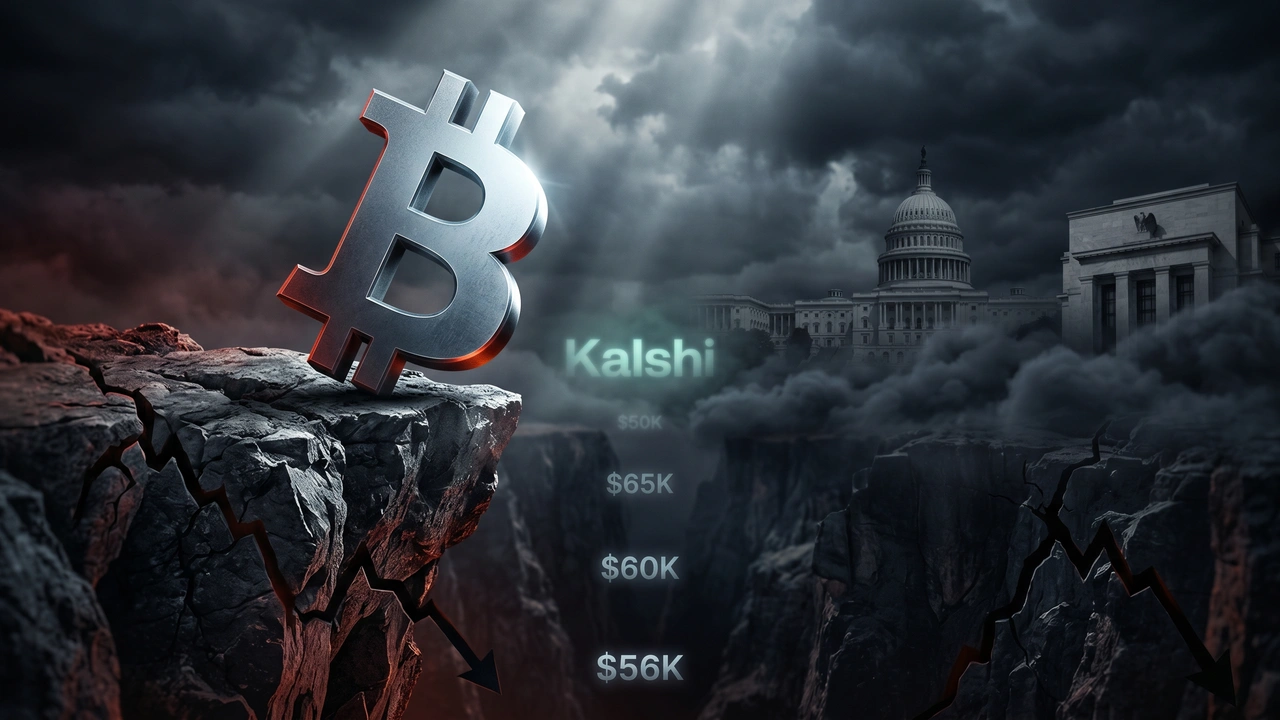
Bitcoin faces mounting downside pressure toward the $60,000 zone while Kalshi's CFTC-approved perpetual futures contract marks a structural turning point for how American capital engages with crypto derivatives.
Key Takeaways
- Bitcoin's critical near-term test sits in the $60,000-to-$62,500 zone; a clean break below that range would technically signal a deeper move toward $50,000, while holding it would be the minimum condition for any meaningful recovery.
- Peter Brandt's expanding triangle analysis targets a potential decline to $56,000, but the bearish setup is invalidated if Bitcoin reclaims $75,000 - giving traders two concrete levels to watch.
- Kalshi's CFTC-approved BTCPERP contract represents the first time American traders can access regulated onshore bitcoin perpetual futures, closing a structural gap that had pushed an estimated $92.9 trillion in annual volume to offshore venues.
- The rapid competitive response from Kraken, Robinhood, and Gemini suggests the regulated domestic perpetuals market will expand quickly, with broad implications for how U.S. institutions manage Bitcoin exposure and price risk.
- Among major altcoins, Hyperliquid stands out for its relative resilience during the selloff, while Stellar's sharp rally from $0.14 to $0.30 before retracing indicates selective momentum can still exist even in a broadly bearish environment.
Bitcoin Teeters at $65K as Regulated Perps Reshape the U.S. Derivatives Landscape
Two seemingly separate stories are converging this week into a single, consequential narrative about Bitcoin's maturation - one playing out on the price chart, the other in the regulatory architecture of American finance. While bulls scramble to defend critical support levels after a punishing week of liquidations, Kalshi has quietly launched what may be the most significant derivatives product U.S. regulators have ever greenlit for crypto. Both stories, read together, tell you something important about where Bitcoin stands right now: stressed, yes - but increasingly embedded in the legitimate fabric of global markets.
The irony is sharp. At the very moment that American institutions gain their first domestic access to perpetual futures - a product class that offshore venues have offered for years - Bitcoin itself is trading in a way that will test those institutions' appetite for risk almost immediately.
The Facts
Bitcoin found itself under severe selling pressure this week, bouncing tentatively from the $65,426 mark after breaking down through a key support line - a move that analysts read as evidence of aggressive long-position unwinding [1]. The proximate trigger was fresh military escalation between the U.S. and Iran, though Bitrue Research Institute's Andri Fauzan Adziima argued the geopolitical headlines were amplifiers rather than root causes, pointing to forced liquidations, institutional outflows from spot ETF products, and deteriorating chart structure as the more fundamental drivers [1].
From a technical standpoint, the picture is sobering. Veteran trader Peter Brandt identified what he characterizes as an expanding triangle formation - a pattern he considers both common and reliable - and projects a potential slide to around $56,000 if the bearish case plays out [1]. The formation would be invalidated only if Bitcoin clears $75,000 to the upside, a level that now sits well above where the market is trading [1]. More immediately, the $62,500-to-$60,000 corridor has emerged as the critical battleground: a decisive close beneath it would open the door to a far deeper correction toward $50,000, while a successful defense could set the stage for a relief bounce - one that bears would likely sell into [1]. Reclaiming territory above the 20-day exponential moving average, currently near $74,064, and then the $76,966 area would be required for bulls to credibly claim the worst is behind them [1].
Altcoins are faring little better. Ether broke decisively out of its recent $1,916-to-$2,465 trading band - to the downside - leaving the $1,750 level as the next meaningful floor, with $1,550 as a secondary target if that gives way [1]. XRP lost its $1.27 footing, with $1.11 now the line bears must push through to signal a fresh leg lower toward $1.00 [1]. Solana slipped under $76 support, putting the February low of $67 in focus, and a failure there would bring $60 into view [1]. Cardano slid beneath $0.22, triggering oversold readings on momentum indicators - though those readings alone rarely stop a trend in motion [1]. The lone standouts are Hyperliquid, which has held remarkably firm near the $75 area with shallow pullbacks indicating investor conviction, and Stellar, which surged from $0.14 on May 23 to $0.30 by May 30 before retracing to the 50% Fibonacci level near $0.22 [1].
Against this backdrop of market stress, Kalshi delivered arguably the most structurally important regulatory milestone in U.S. crypto derivatives history. The Commodity Futures Trading Commission formally approved the company's BTCPERP contract on May 29, 2026, under Commission Regulation 40.3 - making Kalshi one of the first domestic venues to offer regulated bitcoin perpetual futures to American traders [2]. Unlike standard futures contracts that expire on a fixed date, perpetuals carry no settlement deadline; instead, a funding rate recalibrated every eight hours keeps the contract price anchored to spot [2]. It is a mechanism that offshore exchanges have used for years to generate staggering volume - by some measures, offshore perpetual futures cleared roughly $92.9 trillion in 2025 alone, dwarfing spot market activity and representing capital that flowed entirely beyond the reach of U.S. regulators [2].
Kalshi CEO Tarek Mansour, speaking on CNBC, framed perpetuals as "the purest form of trading" and positioned the launch as evidence that the company has grown beyond its prediction-market origins into a full-scale derivatives venue [2]. The company, valued at $22 billion following a funding round earlier this year, intends to expand the perpetuals offering to more than a dozen cryptocurrencies once additional regulatory clearances are secured [2]. The competitive response has been swift: Kraken announced plans to list its own CFTC-regulated perps within 30 days of Kalshi's approval, and both Robinhood and Gemini have signaled their intent to enter the space [2]. The CFTC has indicated it will weigh additional perpetual contracts individually rather than through blanket authorization [2].
Analysis & Context
The Kalshi launch deserves to be read as more than a regulatory footnote. For years, the absence of onshore perpetual futures forced sophisticated U.S. crypto traders into one of two uncomfortable positions: use offshore platforms with their attendant counterparty and jurisdictional risks, or forego the product class entirely. That structural gap is now closing, and the timing - arriving precisely as Bitcoin tests multi-month support levels - creates a fascinating dynamic. Institutional participants who previously hedged or speculated offshore will increasingly be able to do so within a regulated framework, which could meaningfully alter how efficiently price discovery happens during volatile episodes like the current one.
The price action itself echoes patterns Bitcoin has revisited repeatedly across market cycles. Expanding triangle formations, forced liquidation cascades through leveraged positions, and ETF outflow events have each appeared before during cyclical corrections - and in prior instances, the $60,000 region has been an area where longer-horizon buyers have historically stepped in. That does not guarantee the same outcome now, particularly given the elevated geopolitical uncertainty layering on top of the technical deterioration. What is worth noting, however, is that the bearish scenario Brandt outlines - a drop toward $56,000 - would still keep Bitcoin well above the range that characterized the 2022 bear market trough, suggesting the structural bull case remains intact even if the near-term chart is under pressure [1].
The more subtle second-order implication of the Kalshi development is competitive. Offshore venues like Binance and Hyperliquid built enormous user bases specifically because regulated domestic alternatives did not exist [2]. As compliant U.S. perpetuals proliferate across Kalshi, Kraken, Robinhood, and Gemini, some portion of that offshore volume may gradually repatriate - bringing with it improved transparency, tighter regulatory oversight, and potentially more stable market behavior during stress events.
Sources
AI-Assisted Content
This article was created with AI assistance. All facts are sourced from verified news outlets.