Bitcoin Under Siege: Regulatory Pressure Mounts on Both Sides of the Atlantic
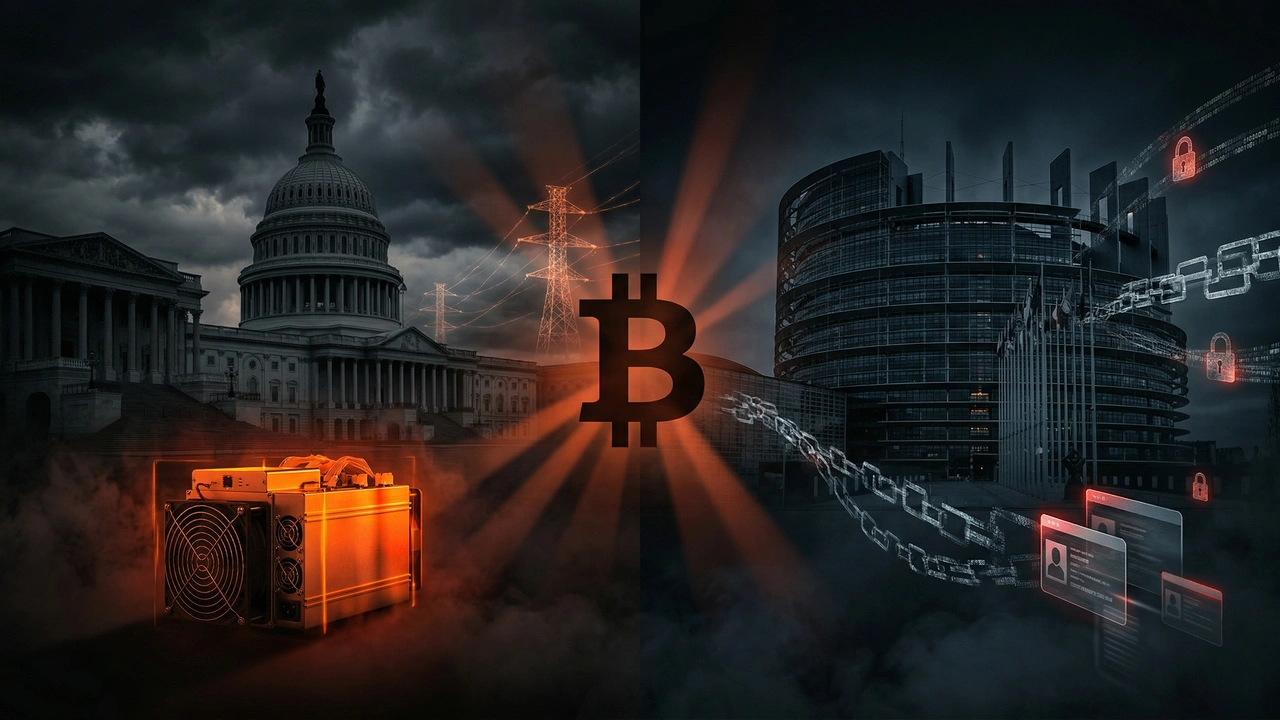
From U.S. national security probes targeting Chinese mining hardware to Europe's sweeping Travel Rule privacy mandates, Bitcoin faces a decisive regulatory moment that will reshape the industry's landscape for years to come.
Key Takeaways
- The U.S. national security probe into Bitmain ("Operation Red Sunset") remains unresolved and could result in import restrictions that create a hardware supply shock for Bitcoin miners, particularly affecting operations dependent on Chinese-manufactured ASICs [1].
- The political entanglement between Trump family investors in American Bitcoin Corp. and the Bitmain hardware supply chain introduces significant regulatory unpredictability — Warren's inquiry into potential political influence over national security decisions warrants close monitoring [1].
- Europe's Travel Rule, taking effect in 2026, will require all regulated crypto platforms to transmit sender and recipient identity data alongside transactions, effectively creating a mandatory identity layer for exchange-based Bitcoin activity [2].
- Self-hosted wallet users face the sharpest privacy implications: while ownership verification tools exist, transfers to third-party private wallets remain a regulatory grey area — this gap will likely be a key battleground for future enforcement actions [2].
- Investors and Bitcoin users should treat these developments as structural, not temporary: the regulatory trajectory on both sides of the Atlantic is toward greater oversight, and planning around compliance costs, privacy trade-offs, and hardware supply risks is now a core part of any serious Bitcoin strategy.
Bitcoin Under Siege: Regulatory Pressure Mounts on Both Sides of the Atlantic
The window of regulatory ambiguity that Bitcoin and the broader crypto industry have long operated within is closing — fast. Two distinct but deeply connected developments are converging to define what the next era of Bitcoin looks like: a hardening U.S. national security posture toward Chinese mining infrastructure, and Europe's imminent Travel Rule implementation that will fundamentally alter privacy norms for crypto users. Together, they signal a single, unavoidable reality — governments worldwide are no longer watching Bitcoin from a distance. They are reaching in.
For investors, miners, and everyday Bitcoin holders, the implications stretch far beyond compliance paperwork. These developments touch the core values of the Bitcoin ecosystem: sovereignty, privacy, and censorship resistance. Understanding both the facts and what they genuinely mean is not optional anymore — it is essential.
The Facts
On the U.S. front, Senator Elizabeth Warren has written to Commerce Secretary Howard Lutnick demanding documents and internal communications related to Bitmain, the Chinese manufacturing giant that produces a dominant share of the world's Bitcoin ASIC mining hardware [1]. The letter, sent to the Commerce Department, asks what steps have been taken to protect national security decisions from political interference — a pointed reference to the fact that American Bitcoin Corp., backed by Eric Trump and Donald Trump Jr., signed a $314 million deal to acquire 16,000 Bitmain rigs [1].
Warren's inquiry follows a previously reported federal investigation dubbed "Operation Red Sunset," led by the U.S. Department of Homeland Security, which examined whether Bitmain's ASIC machines could be remotely accessed for espionage or leveraged to disrupt the U.S. power grid [1]. That probe, according to Bloomberg, remains unresolved and its current status is unclear — national security investigations of this type can run for years without public disclosure or legal action [1]. Earlier actions have already included halted Bitmain shipments and a separate probe into a related Chinese chip firm over alleged ties to sanctioned Huawei [1]. A 2024 federal review also flagged the deployment of Bitmain machines near a U.S. military base as raising "significant national security concerns" [1].
Across the Atlantic, a different but equally consequential regulatory wave is building. Europe's Travel Rule, stemming from MiCA licensing requirements and rooted in Financial Action Task Force Recommendation 16, will require crypto platforms and wallet providers to record and transmit the names of both senders and recipients in crypto transactions starting in 2026 [2]. Speaking to BTC-ECHO, Uve Poom, COO and co-founder of compliance technology firm CryptoSwift, confirmed that non-compliant exchanges face significant financial penalties, though regulators are currently in a grace period as they familiarize themselves with enforcement responsibilities [2]. Poom noted that regulators "are not in a hurry to issue the first fines," but warned that when a major non-compliant actor is identified, they will be made a very public example [2].
The Travel Rule creates a parallel data infrastructure requirement: personal identity information must travel alongside crypto transactions between Virtual Asset Service Providers (VASPs), without being written to the public blockchain itself [2]. A particular grey area exists around self-hosted wallets — when users send funds to their own private wallets, they must currently prove ownership, but transfers to another individual's self-hosted wallet remain technically difficult to verify, leaving what Poom describes as an open "gap" in the regulatory framework [2].
Analysis & Context
These two developments — one rooted in geopolitical hardware risk, the other in financial surveillance infrastructure — are not isolated policy quirks. They represent the maturation of a long-anticipated regulatory reckoning, and Bitcoin sits squarely at the intersection of both.
The Bitmain situation is particularly explosive because it ties together three of the most volatile forces in current U.S. politics: national security concerns about China, the Trump family's direct financial entanglement with the crypto mining industry, and the broader debate about who controls America's energy and computing infrastructure. Bitmain's hardware dominance is not a minor detail — if estimates hold that Bitmain accounts for the majority of global ASIC production, then a significant portion of Bitcoin's hash rate runs on machines manufactured by a company under active federal security scrutiny. Historically, the U.S. has moved aggressively to restrict Chinese technology from critical infrastructure — the Huawei precedent is instructive here. Should "Operation Red Sunset" result in formal restrictions or import bans, it could trigger a meaningful supply shock in mining hardware, potentially affecting hash rate distribution and, by extension, network security dynamics in the medium term. The political dimension — with Trump-affiliated investors holding Bitmain rigs while Warren presses for transparency on White House-Commerce Department communications — adds a layer of unpredictability that markets have not yet fully priced in.
On the European privacy front, the Travel Rule represents a structural shift, not just a compliance checkbox. Bitcoin's foundational value proposition includes permissionless, pseudonymous transactions. The Travel Rule does not destroy that on-chain, but it creates an off-chain identity layer that effectively de-anonymizes regulated exchange activity. For users who rely exclusively on centralized platforms — the majority of retail participants — this fundamentally changes the privacy calculus. The historical parallel worth examining is the gradual KYC expansion since the late 2010s: each successive layer of identity requirements was met with industry resistance, predictions of user flight to unregulated venues, and ultimately broad compliance that normalized the surveillance infrastructure. The Travel Rule is the next layer of that same process. The risk is not a sudden collapse of Bitcoin usage — it is the slow normalization of identity-linked transactions that could make truly private Bitcoin usage the exception rather than the rule.
Sources
AI-Assisted Content
This article was created with AI assistance. All facts are sourced from verified news outlets.