Bitcoin Whales Bleed $337M Daily as Bear Market Signals Mount
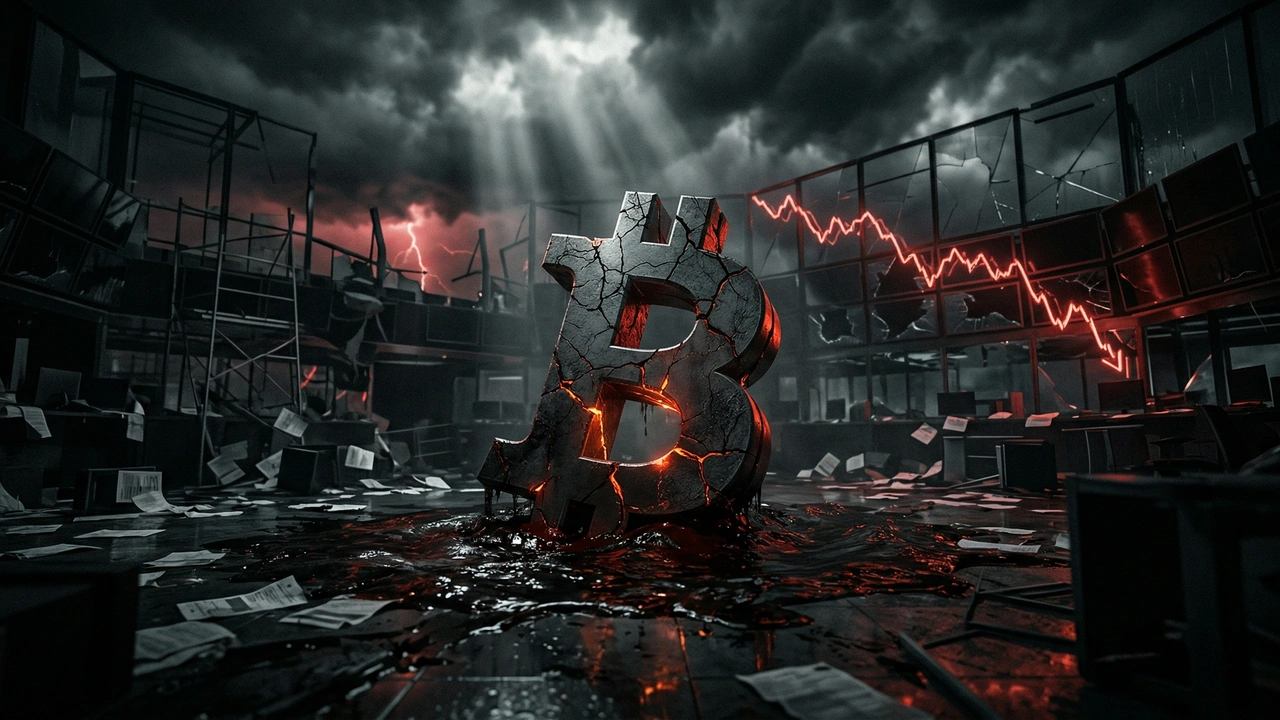
Large Bitcoin holders are capitulating at a pace not seen since the brutal 2022 bear market, while analysts debate whether prolonged consolidation signals a deeper breakdown or the calm before a major breakout.
Key Takeaways
- Bitcoin's whale and shark cohorts realized $30.91 billion in losses in Q1 2026, averaging $337 million per day — the worst large-holder capitulation since Q2 2022, when Bitcoin subsequently fell over 50% [1]
- Long-term holders are also selling at a loss at approximately $200 million per day on a 30-day average; Glassnode analysts say this needs to drop below $25 million per day before a credible market bottom can be confirmed [1]
- Price action remains trapped in a $60,000–$74,000 range, with analysts split between a breakout scenario above $71,000 and a deeper bear market that could target the $40,000–$50,000 zone [1][2]
- The macro triggers driving the 2026 sell-off — geopolitical inflation fears, quantum risk narratives, AI-sector stress — are structurally different from 2022's crypto-native collapses, meaning contagion dynamics may unfold differently even if price outcomes rhyme
- Sentiment indicators such as the Crypto Fear & Greed Index at 11 historically signal late-stage capitulation, creating a tension between bearish on-chain data and contrarian sentiment signals that makes directional certainty exceptionally difficult at this stage [2]
When Whales Bleed, the Market Listens: Bitcoin's Capitulation Warning
The largest participants in the Bitcoin market are not waiting to see how this plays out — they are selling, and doing so at historic losses. Data emerging from Q1 2026 paints a sobering picture of large-holder capitulation that echoes one of the most painful chapters in Bitcoin's history. Combined with a price chart stuck in neutral and a sentiment index deep in fear territory, the question is no longer whether Bitcoin is under pressure, but how deep this pressure will ultimately drive prices.
Two narratives are colliding in the market right now: a technical picture that some analysts read as coiled energy ahead of a breakout, and an on-chain reality suggesting the smart money is bracing for significantly lower prices. Understanding which force wins this tug-of-war may determine where Bitcoin stands by year-end.
The Facts
Bitcoin's largest holders — the so-called sharks and whales of the market — recorded catastrophic realized losses throughout Q1 2026. According to on-chain analytics firm Glassnode, addresses holding between 100 and 1,000 BTC locked in an average of $188.5 million in daily losses, while entities holding between 1,000 and 10,000 BTC added another $147.5 million per day [1]. Combined, that amounts to a staggering $337 million in average daily realized losses, and a cumulative $30.91 billion wiped out by these cohorts in the quarter alone [1].
To find a comparable period of institutional-scale pain, you have to go back to Q2 2022, when the same cohorts averaged roughly $396 million in daily realized losses — a quarter that saw Bitcoin's price collapse by more than 50%, with an additional 20% decline following before the year was out [1]. The macro triggers differ this time around, with Glassnode analysts pointing to Iran war-driven inflation concerns, quantum-security risk narratives, and stress in the AI-linked risk trade as the primary catalysts replacing the 2022 era's Terra/LUNA collapse and Three Arrows Capital implosion [1].
Long-term holders — investors who had held coins for more than six months before selling — are also contributing to the sell-off. Their realized losses have remained elevated at approximately $200 million per day on a 30-day moving average since November 2025 [1]. Glassnode analysts stated that a meaningful reduction toward levels below $25 million per day would be necessary before any credible base formation could be confirmed — a threshold still far from current readings [1].
On the price action side, Bitcoin has been grinding between $60,000 and $74,000 since reaching a yearly low of $60,000 in early February, with the asset trading around $66,890 at the time of the most recent analysis [2]. MN Trading Capital founder Michael van de Poppe characterized this range as a period of "no direction," while simultaneously arguing that "the longer it lasts, the heavier the breakout will be" [2]. He identified $71,000 as the key level to reclaim for any bullish momentum to reassert itself [2]. However, macro-focused Bitcoin analyst Willy Woo countered that there is "a very good chance we get a deeper bear due to a breakdown of the secular bull market in global macro," while veteran trader Peter Brandt expressed doubt that Bitcoin would set a new all-time high before Q2 2027 [2].
Analysis & Context
The $337 million daily realized loss figure from whales and sharks deserves to be understood for what it truly represents: these are not forced liquidations from leveraged retail traders. These are deliberate, on-chain decisions by sophisticated entities who purchased Bitcoin at higher prices and are now choosing to accept losses rather than hold through further potential downside. That distinction matters enormously. When large, patient capital exits the market at a loss, it is not panic — it is a calculated repositioning based on macro outlook. The implication is that the smart money is pricing in more pain ahead.
Historically, the pattern following elevated large-holder realized losses has been unforgiving. The 2022 analog referenced repeatedly in on-chain data saw Bitcoin ultimately bottom around $15,500 — roughly 77% below its prior all-time high. The current cycle's comparable drawdown levels, if history rhymes, have prompted some analysts to identify the $40,000–$50,000 range as a potential structural floor [1]. This would represent a significant further decline from current levels and would likely be accompanied by the kind of long-term holder exhaustion that Glassnode analysts describe as a prerequisite for genuine base formation. The key signal to watch remains that long-term holder realized loss metric: until it collapses toward $25 million per day, the data does not support declaring a bottom.
Yet the consolidation thesis cannot be entirely dismissed. Bitcoin has a well-documented history of compressing into tight ranges before explosive directional moves — and those moves have historically been more likely to surprise to the upside during broader bull market structures. The critical variable is whether the 2021–2025 bull market cycle is truly broken at a macro level, as Willy Woo suggests, or whether the current period represents a severe but survivable mid-cycle correction. The Fear & Greed Index sitting at a score of 11 — deep in Extreme Fear territory — is historically associated with capitulation lows, not the middle of prolonged bear markets [2]. Contradictions like this are precisely what make this moment so analytically challenging and so consequential for long-term Bitcoin positioning.
Sources
AI-Assisted Content
This article was created with AI assistance. All facts are sourced from verified news outlets.