Bitcoin Security's Two Fronts: Wrench Attacks and Quantum Threats
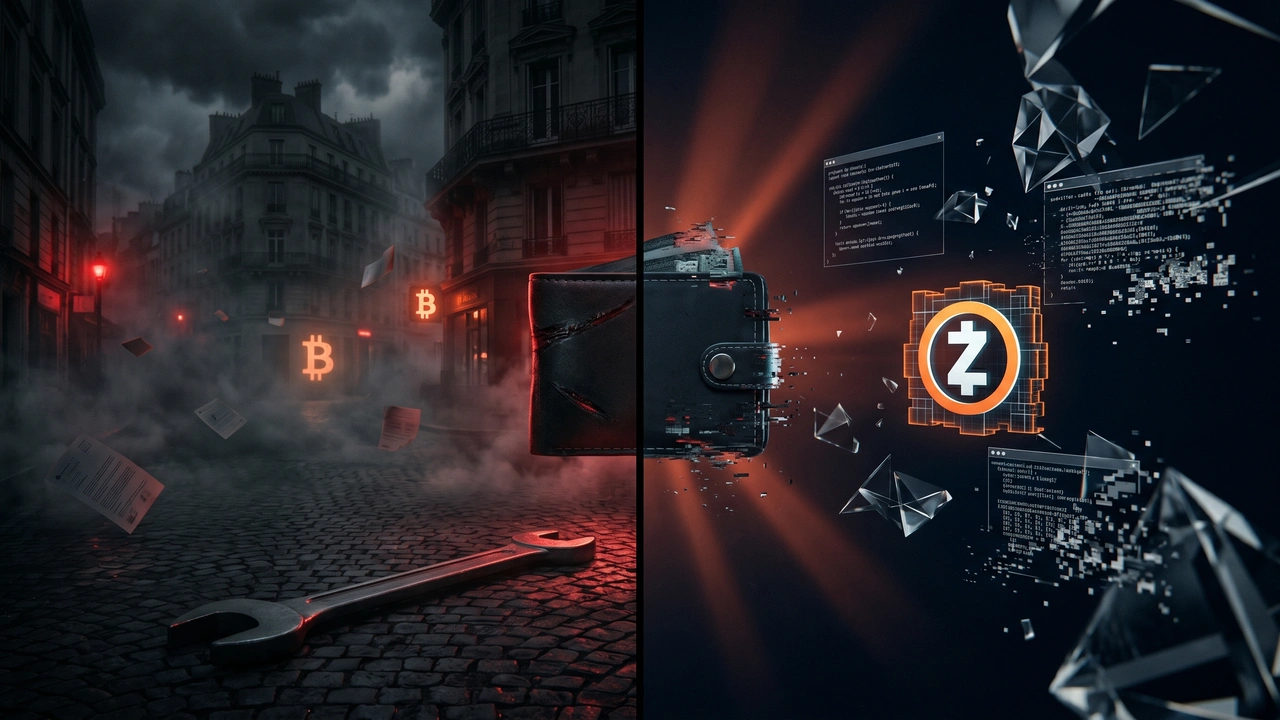
Physical assaults on crypto holders have surged 41% in early 2026, while Zcash's quantum-resistant wallet plans highlight a second, longer-term vulnerability - together they reveal that wallet security is now a multi-dimensional battlefield.
Key Takeaways
- Physical attacks on crypto holders have risen 41% year-over-year, with 28 of 34 documented cases in 2026 occurring in Europe, causing over 101 million dollars in losses - making operational security and privacy hygiene as important as technical wallet security [1]
- Criminals are now using data leaks and personal financial records to pre-select targets, and more than half of recent cases involve coercing victims through family members - publicly disclosing crypto holdings online is a material security risk, not just a social media choice [1]
- Google Research's revised quantum computing estimates suggest elliptic curve cryptography - the backbone of Bitcoin and most wallets - could be vulnerable sooner than the industry assumed, with roughly 20 times fewer qubits required than previously thought [2]
- Zcash's move to introduce a quantum migration pathway within a month and target full quantum-resistant infrastructure by 2027 sets a concrete benchmark that other projects, including Bitcoin, will face pressure to match or explain why they have not [2]
- Wallet security in 2026 demands a layered approach: strong technical controls, strict privacy practices around public disclosure of holdings, physical personal security planning, and an awareness of the long-term cryptographic roadmap - no single measure is sufficient on its own
When the Weakest Link Is You: Bitcoin Security Faces Threats From Both Ends of the Technology Spectrum
The popular image of a crypto hack involves hooded figures typing furiously in a dark room, exploiting lines of code. Reality in 2026 looks increasingly different - and far more visceral. Physical violence against crypto holders is rising sharply across Europe, while simultaneously, the cryptographic foundations underpinning wallet security face a slower but structurally significant threat from quantum computing. These two developments may seem unrelated, but they share a common thread: as technical defenses harden, the attack surface shifts elsewhere, whether to human bodies or to mathematical assumptions once considered unbreakable.
For Bitcoin holders, the message is uncomfortable but clear. Owning digital assets has never required more holistic thinking about security - not just seed phrases and hardware wallets, but operational security, privacy hygiene, and an eye on cryptographic infrastructure that most users never think about.
The Facts
Physical attacks on cryptocurrency holders - often called "wrench attacks" in reference to the low-tech but highly effective tool of coercion - are accelerating at a troubling pace. Security firm CertiK documented 34 such incidents globally between January and April 2026, representing a 41 percent increase compared to the same period the previous year [1]. The financial damage already tallies approximately 101 million US dollars [1].
What makes the trend particularly striking is its geographic concentration. Of the 34 recorded incidents, 28 occurred in Europe [1]. France has emerged as a particularly acute flashpoint. During the Paris Blockchain Week 2026, France's Interior Ministry disclosed that 41 physical attacks had taken place on French soil since the start of the year alone - a rate of roughly one attack every two and a half days [1]. The scale of the problem prompted rare public acknowledgment from government officials at an industry event.
CertiK's report details how criminal tactics have grown more sophisticated. Rather than opportunistic street robberies, attackers are now operating with what the firm describes as a "data-driven targeting model" that emerged at the start of 2026 [1]. Personal information harvested from data breaches - including home addresses, asset disclosures, and tax records - is being used to identify and locate high-value targets before attacks are carried out. Perhaps most chilling is the expansion of the target pool: CertiK reports that more than half of current cases involve family members of the primary victim, with spouses, children, and parents being used as direct leverage to compel asset transfers [1]. The firm also points to a "culture of flexing and voluntary doxxing" within crypto communities as a contributing factor, arguing that publicly broadcasting wealth creates a selection effect for potential attackers [1].
On a separate but related front, Zcash has announced plans to introduce quantum-resistant wallet architecture within approximately one month, according to statements by the CEO of the Zcash Open Development Lab at Consensus Miami [2]. The initial rollout will not be a fully quantum-proof solution, but rather a migration pathway - a safety net allowing users to move their holdings into a stronger cryptographic framework if current encryption standards are eventually compromised [2]. Zcash's full transition to quantum-resistant infrastructure is targeted for 2027 [2].
The urgency behind this move has been sharpened by a late-March announcement from Google Research, which indicated that future quantum computers could potentially break elliptic curve cryptography - the mathematical foundation of most cryptocurrency wallets - using approximately 20 times fewer physical qubits than previously estimated [2]. Google has set its own internal quantum-safety target at 2029. Bitcoin, like most major blockchains, still relies on elliptic curve cryptography, meaning the quantum threat is an industry-wide concern, not just a Zcash-specific issue [2].
Analysis & Context
The physical attack data from CertiK represents more than a crime statistic - it reflects a rational adaptation by bad actors. CertiK itself frames this succinctly: as wallet software, multi-signature schemes, and protocol-level security improve, the human holder becomes the most cost-effective attack vector [1]. This is a pattern with deep roots in security theory. When a vault becomes impenetrable, thieves target the person who holds the combination. The crypto industry spent years building better vaults. Now it is paying for the oversight of not protecting the vault-keeper.
The concentration of attacks in Europe, and France in particular, likely reflects several converging factors: a relatively high density of publicly identifiable crypto wealth, active conference culture that encourages profile-building, and perhaps a lag in law enforcement preparedness compared to the scale of the problem. The French government's public acknowledgment of the attack rate at Paris Blockchain Week suggests the issue has crossed a threshold into mainstream political concern - which may accelerate regulatory and law enforcement responses, but also signals how visible the problem has become.
The quantum computing dimension operates on a very different timeline, but the Zcash development is significant as a proof of concept for how blockchain projects can handle the transition responsibly. Bitcoin's own quantum vulnerability is a known long-term risk. The Google Research revision - suggesting the threat arrives with 20 times fewer resources than anticipated - compresses the theoretical timeline in ways that should prompt more urgency across the industry [2]. Bitcoin's development community has discussed quantum-resistant signature schemes for years, but implementation remains on no fixed schedule. Zcash setting a concrete 2027 milestone, even if only for a migration pathway rather than a complete solution, puts implicit pressure on other projects to move from discussion to planning. The broader point is that cryptographic assumptions are not permanent - they erode as hardware capabilities improve, and the window to act ahead of a crisis is finite.
For ordinary Bitcoin holders, these two threat vectors - physical coercion today and cryptographic vulnerability tomorrow - both point toward the same behavioral conclusion: security cannot be an afterthought, and it requires attention at multiple layers simultaneously.
Sources
- [1]btc-echo.de
- [2]btc-echo.de
AI-Assisted Content
This article was created with AI assistance. All facts are sourced from verified news outlets.