Blockchain Governance Under Stress: Sui's Bug Crisis and Cardano's Veto Moment
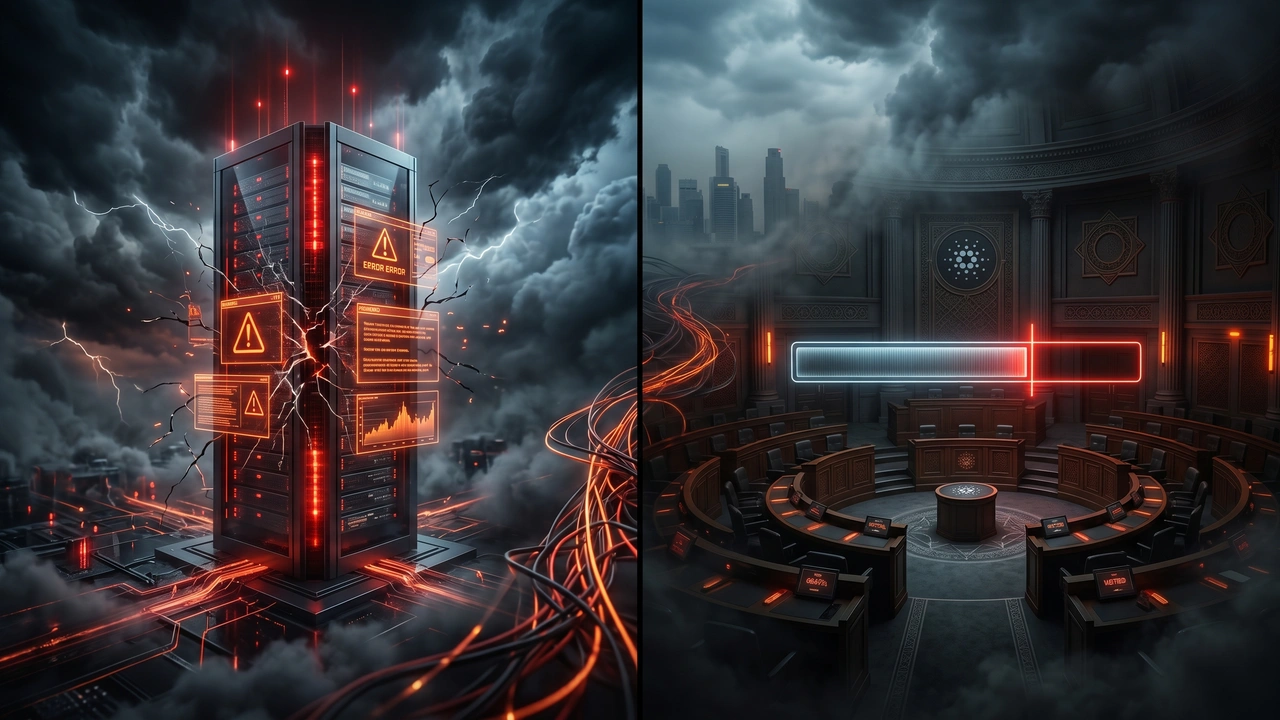
Two of crypto's largest Layer-1 networks confronted very different kinds of failure this week - one technical, one democratic. Together they reveal how blockchain maturity is being tested in real time.
Key Takeaways
- Sui's third major outage in under seven months traces directly to the v1.72 software release, and the network's rapid iteration model continues to create a tension between feature speed and stability guarantees.
- The patch restores normal operations but the recurring pattern raises legitimate questions about Sui's engineering maturity, even as on-chain metrics suggest the market selloff has been contained rather than panicked.
- Cardano's on-chain governance blocked the Summit 2026 funding despite backing from the Foundation, both project co-founders, and a numerical DRep majority - demonstrating that the two-thirds treasury threshold is not ceremonial.
- The defeated Cardano proposal was already a second, heavily revised version of an original request, meaning the community rejected a compromise offer, not a maximalist one.
- Both episodes underscore a maturing dynamic across Layer-1 networks: decentralisation is no longer a marketing claim but an operational variable with measurable costs and benefits.
Blockchain Governance Under Stress: Sui's Bug Crisis and Cardano's Veto Moment
Two of crypto's most prominent Layer-1 networks delivered contrasting lessons this week about what it actually means to build decentralized infrastructure. Sui scrambled to patch a software defect that had brought its mainnet to a standstill multiple times in 48 hours. Meanwhile, Cardano's community quietly exercised its newly minted veto power - cancelling the flagship Cardano Summit 2026 through an on-chain vote that fell agonisingly short of the required threshold. The events share a common thread: both networks are discovering, in public and under market pressure, that the promises baked into their architectures carry real consequences.
The Facts
Sui's reliability record took another hit in late May, when a defect introduced in software version 1.72 triggered at least three separate mainnet stalls within a 48-hour window [1]. The core issue resided in the network's gas-charging logic - specifically, an edge case exposed when transactions were processed with mixed gas payments and insufficient funds [1]. A fix deployed by developers to restore activity after the first two halts inadvertently activated a latent bug tied to the chain's on-chain randomness protocol, causing a third stoppage [1]. In total, Sui's mainnet was unable to process transactions for several hours across those incidents, adding to a track record that already included an outage in November 2024 and a second, six-hour stall in January 2026 [1].
The development team has since released a formal software update designed to close the identified vulnerabilities and reinforce overall network stability [1]. Transactions are now flowing normally, but the episode has renewed scrutiny of Sui's dependability given its standing as one of the larger Layer-1 blockchains by market capitalisation - currently in the region of $3.55 billion for the SUI token [1]. The price itself reflects that unease: SUI was trading near $0.8788 at the time of writing, roughly 2.5% below the prior day's close of $0.9013, and sitting beneath its 20-period exponential moving average at around $0.905 - a positioning that technical analysts typically read as a bearish signal [1]. The RSI reading of approximately 39 suggests the market is weak but not yet in deeply oversold territory, and Bollinger Band width indicates a consolidating rather than collapsing environment [1].
On the governance front, Cardano produced a headline of its own. The Cardano Foundation confirmed it will not hold a Cardano Summit in 2026, after a treasury funding proposal narrowly failed to clear the required approval bar on May 29 [2]. The vote - a revised request for 7.8 million ADA, equivalent to roughly $2 million - would have financed a two-day event in Singapore scheduled for October 5 and 6 [2]. Support among participating Delegated Representatives reached 65.21% of the staked voting weight, but under Cardano's governance framework, treasury withdrawals demand a two-thirds majority, set at 66.67% [2]. The proposal thus expired without ratification, despite both the Constitutional Committee and a head-count majority of 135-to-61 among DRep voters backing it [2].
The defeated proposal was itself already a significantly trimmed version of an earlier request. The original submission sought 14.07 million ADA - roughly $3.66 million - and had bundled Summit costs with a TOKEN2049 sponsorship arrangement managed by EMURGO, Cardano's commercial arm [2]. After that package attracted criticism, the Foundation separated the two initiatives, cut the overall budget by more than 20%, and added audited fund management, milestone-based disbursements and an independent oversight committee [2]. Even so, the revised ask could not close the gap. Cardano co-founder Charles Hoskinson and Foundation CEO Frederik Gregaard both publicly urged DReps to support the revised proposal in the final hours of voting; the Foundation itself, which holds DRep voting weight, abstained to avoid the appearance of self-interested influence [2].
Analysis & Context
Sui's recurring downtime pattern is worth placing in a broader context. The November 2024 outage - where all validators entered a crash loop - and the January 2026 six-hour stall were both attributed to distinct causes. The latest incident adds a third distinct failure mode: a feature-level bug that cascaded across multiple deployments. This is not merely a streak of bad luck. It suggests that Sui's rapid development cadence, which is a genuine competitive strength in terms of feature velocity, carries a commensurate engineering risk. Every new release that ships quickly is also one that has had less time to be stress-tested against edge cases at mainnet scale. The market's muted but negative reaction to the patch news - a sub-3% drawdown rather than a sharp sell-off - may reflect growing familiarity with this risk profile, or simply exhaustion with the cycle.
Cardano's situation is more structurally interesting, and arguably more consequential for the industry at large. The Plomin hard fork, activated in early 2025, brought Cardano's Voltaire governance framework to life - giving ADA holders the ability to elect DReps and enabling on-chain treasury votes for the first time. The Summit cancellation is one of the first high-profile demonstrations that this system has real teeth. A supermajority threshold for treasury spending is a deliberately high bar, designed to prevent any single faction - including the Foundation itself - from directing community funds without broad consensus. The fact that a proposal supported by the Foundation, both founders, and a numerical majority of DRep voters still failed is not a sign of dysfunction. It is the system working exactly as designed. Where it leads next - whether DReps will be more or less willing to fund ecosystem development going forward - is the question that Cardano's community now has to answer for itself.
Sources
- [1]btc-echo.de
- [2]btc-echo.de
AI-Assisted Content
This article was created with AI assistance. All facts are sourced from verified news outlets.