Chasing Yield: Liquid Staking Risks and the 1,000% ETF Anomaly
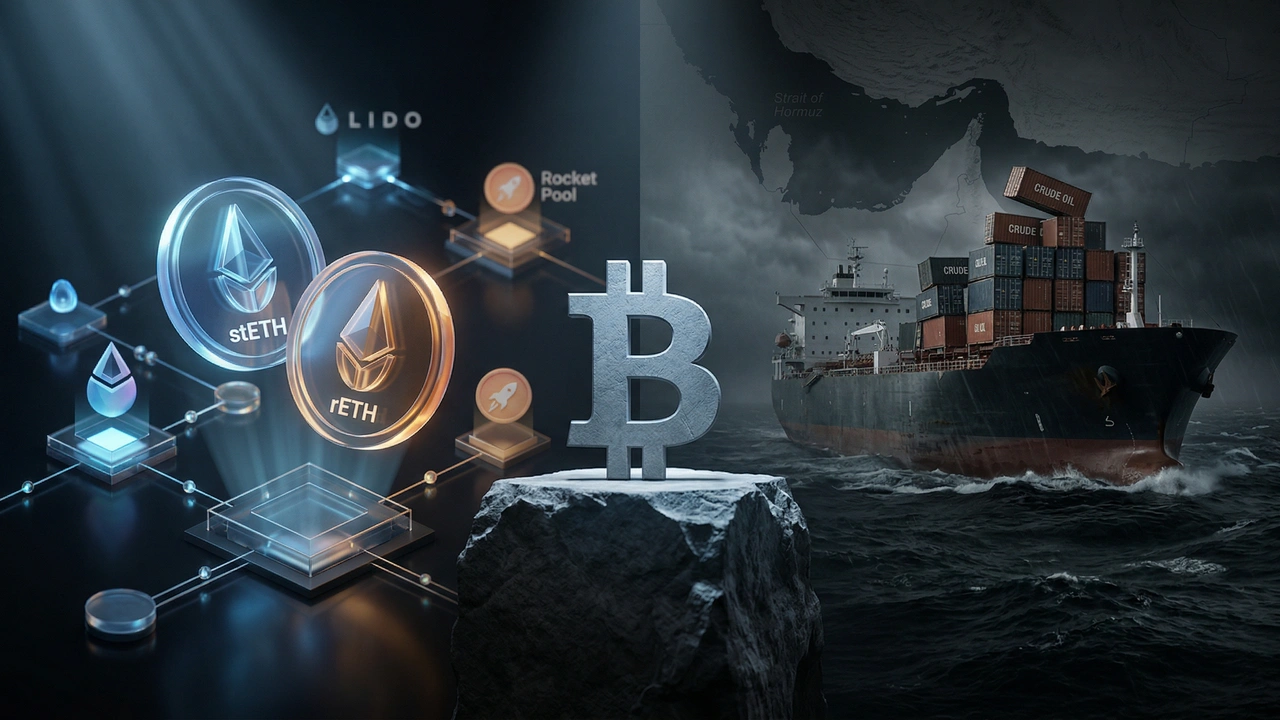
As investors hunt for superior returns in an uncertain macro environment, two contrasting yield stories reveal the fundamental trade-offs between sustainable income strategies and high-octane speculation — and what each means for the Bitcoin-focused investor.
Key Takeaways
- Liquid staking offers genuine capital efficiency gains — potentially boosting returns from 4% to 6% on a $10,000 position — but smart contract risk, liquidation exposure, and exit complexity make it unsuitable for investors who cannot actively manage these variables [1]
- The BWET tanker ETF's 1,000%-plus annual return is historically remarkable for a non-leveraged fund, but it is entirely a function of an unpredictable geopolitical event and carries no durable investment thesis — performance-chasing here is a high-risk proposition [2]
- Bitcoin's correlation with broader risk assets during the current macro shock is a feature of its maturation as a globally traded asset, not a fundamental flaw — its long-term store-of-value case remains structurally intact despite short-term drawdowns [2]
- In any yield-seeking environment, investors must rigorously separate return sources: staking rewards, DeFi leverage, geopolitical windfalls, and Bitcoin appreciation are fundamentally different instruments with incomparable risk profiles
- The most actionable insight from both stories is the importance of exit strategy and position sizing — whether unwinding a liquid staking position during a depeg event or knowing when a geopolitical trade has run its course, timing and discipline consistently determine real-world outcomes [1][2]
In a World Hungry for Yield, Not All Returns Are Created Equal
The eternal pursuit of superior returns has always driven financial innovation — and occasionally, financial recklessness. Two strikingly different yield stories are currently competing for investor attention: the growing sophistication of liquid staking in the DeFi ecosystem, and the jaw-dropping 1,000%-plus annual return posted by an obscure tanker-futures ETF that most market participants have never heard of. Together, they paint a revealing portrait of the risk-return landscape in 2025, and what genuinely sustainable performance looks like versus what is essentially a geopolitical lottery ticket.
For Bitcoin-focused investors, these narratives carry particular relevance. They force a clear-eyed reassessment of what "yield" actually means, what risks accompany it, and why Bitcoin's fundamental proposition as a long-term, decentralized store of value remains categorically different from either of these instruments.
The Facts
Liquid staking represents one of DeFi's more elegant innovations: platforms such as Lido, Rocket Pool, and Jito allow investors to stake their crypto assets and receive liquid staking tokens — think stETH or rETH — in return [1]. These tokens represent the deposited principal plus accruing rewards and can be freely traded, lent, or used as collateral in lending protocols. The critical advantage over traditional staking is capital efficiency: an investor's assets continue generating staking rewards while simultaneously being deployed elsewhere in the DeFi ecosystem [1].
The yield math, on paper, is compelling. A $10,000 position earning a 4% staking yield could theoretically generate an additional 2% by deploying the liquid staking token in DeFi applications such as Aave, lifting annual returns from $400 to $600 — before fees [1]. However, the risks are substantial and layered. Smart contract vulnerabilities remain a persistent threat, and using liquid staking tokens as collateral in lending protocols introduces liquidation risk: if the position's value drops, it can be automatically force-sold to cover outstanding debt [1]. Exit timing adds another layer of complexity, since liquid staking tokens trade at market prices that can deviate from the underlying asset, particularly during volatile conditions [1].
On the other end of the return spectrum sits the Breakwave Tanker Shipping ETF (BWET), which Bloomberg ETF analyst Eric Balchunas highlighted in a recent post as having achieved an annual return exceeding 1,000% [2]. Balchunas described it as "a rare 'Shiny-Object' moment that is largely being ignored despite decent trading volume," noting that the fund manages barely $50 million in assets — a rounding error compared to the iShares Bitcoin Trust ETF, which holds 782,000 BTC valued at approximately $52 billion [2]. BWET's extraordinary performance stems not from equity holdings but from futures contracts tied to crude oil tanker freight rates, which have surged following the geopolitical disruption caused by the closure of the Strait of Hormuz after a US-Israeli strike on Iran on February 28 [2]. The ETF profits directly from skyrocketing oil transport costs — a dynamic that is inherently unpredictable and entirely dependent on geopolitical developments.
Meanwhile, the broader macro backdrop has been brutal for most asset classes. Bitcoin had already corrected to roughly 50% below its all-time high of $126,000 before the military escalation, while gold shed 13% within five weeks of the conflict's outbreak, and US equities also declined materially [2].
Analysis & Context
What connects these two seemingly disparate yield stories is the underlying tension between complexity and clarity in investment strategy. Liquid staking is a genuinely innovative mechanism that improves capital efficiency within the crypto ecosystem, but it introduces a compounding stack of risks — smart contract exposure, liquidation cascades, and peg deviations — that are easily underestimated by retail investors attracted by incremental yield pickups. History offers cautionary precedents: the collapse of the Terra/LUNA ecosystem in 2022 demonstrated how DeFi yield strategies built on fragile assumptions can unwind catastrophically when market conditions shift. Liquid staking is more robust in design than algorithmic stablecoins, but the principle holds: complexity amplifies both opportunity and fragility. Small investors, as the source material correctly notes, often find the incremental gains relatively modest once fees are accounted for, raising the question of whether the added risk is genuinely compensated [1].
The BWET phenomenon is a different kind of lesson. A 1,000% return in a non-leveraged ETF is genuinely historic — Balchunas himself suggests it may be unprecedented for a non-leveraged fund — but it is the product of a highly specific, time-bound geopolitical event rather than any durable investment thesis [2]. Tanker freight rates are notoriously volatile, mean-reverting, and impossible to forecast with consistency. The ETF's obscurity is not an oversight; it reflects the narrow, specialized nature of the underlying exposure. Chasing this kind of return after the fact is precisely the behavior that destroys retail investor portfolios across market cycles.
Bitcoin's positioning within this landscape is instructive. Its underperformance in the current macro shock — down significantly from all-time highs — may frustrate short-term holders, but it also underscores that Bitcoin was never designed to profit from geopolitical chaos the way tanker futures do. Bitcoin's value proposition is architectural: fixed supply, decentralized issuance, and global accessibility. It functions as a long-term savings vehicle and monetary alternative, not a hedge against specific supply-chain disruptions [2]. Investors conflating these functions are setting themselves up for disappointment. The appropriate frame for Bitcoin is a multi-year horizon, where its properties become increasingly differentiated from both speculative instruments and yield-dependent strategies.
Sources
- [1]btc-echo.de
- [2]btc-echo.de
AI-Assisted Content
This article was created with AI assistance. All facts are sourced from verified news outlets.