Congress Moves to Lock Bitcoin Into Law - And the Clock Is Ticking
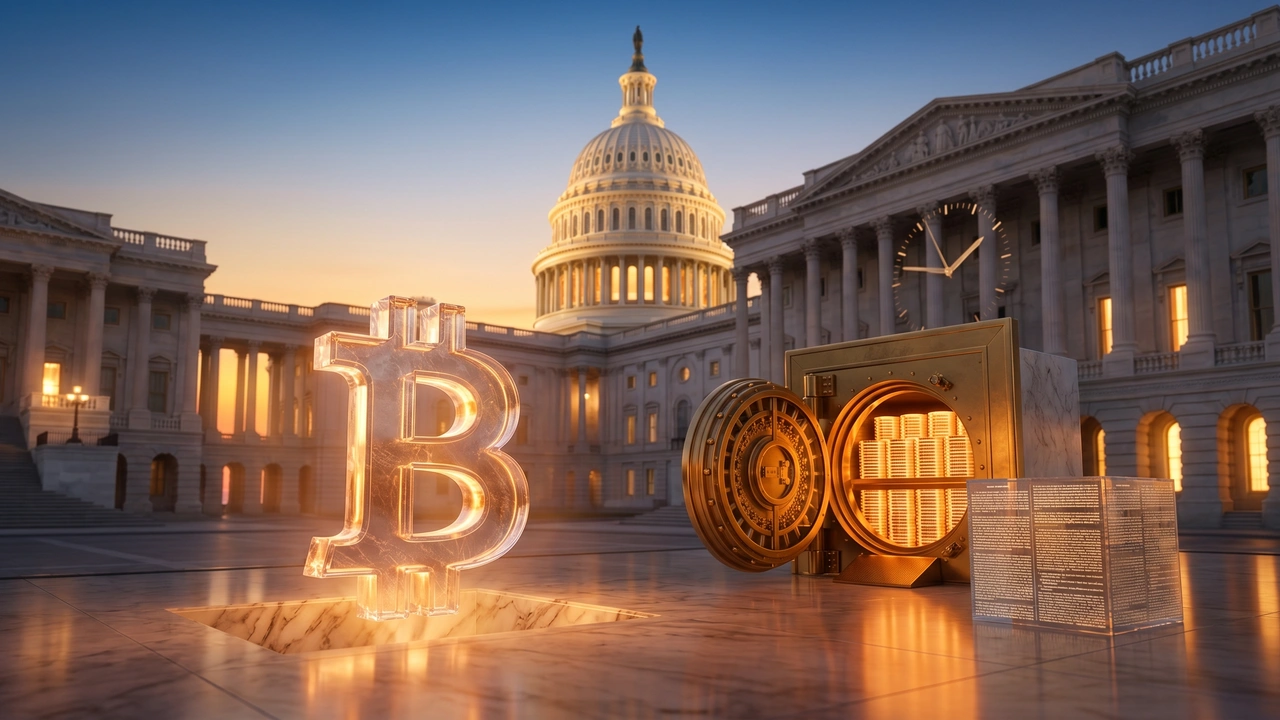
Two landmark legislative efforts are reshaping America's relationship with Bitcoin: one would freeze federal holdings for two decades, the other would finally resolve a years-long regulatory standoff. Together, they signal that Washington is done waiting.
Key Takeaways
- The Strategic Bitcoin Reserve bill imposes a 20-year lock-up that resets with each new deposit, making federally held Bitcoin legally untouchable for decades - a structural commitment with no equivalent in any existing sovereign reserve framework.
- Budget neutrality is hard-coded into the reserve legislation: the government could not borrow or tax its way into acquiring Bitcoin, forcing Treasury to explore gold revaluations, forfeiture conversions, and other non-deficit pathways.
- A coalition of over 200 companies is pressing the Senate for a floor vote on the Clarity Act before August recess - with analysts estimating roughly a 60% chance of passage, but warning that the available legislative window is very tight.
- The Clarity Act's core ambition - resolving the SEC versus CFTC jurisdictional dispute - has survived multiple near-collapses and now carries bipartisan Senate committee support, though DeFi provisions and AML language remain unresolved sticking points.
- Both bills together signal that Washington has moved past conceptual debate: Bitcoin regulation is now being drafted at the level of custody architecture, cryptographic audit mandates, and statutory asset definitions.
Congress Moves to Lock Bitcoin Into Law - And the Clock Is Ticking
Something fundamental is shifting in Washington's approach to Bitcoin. Rather than treating it as a problem to manage or a novelty to tolerate, two significant legislative pushes now underway suggest that policymakers are moving toward institutionalizing Bitcoin - both as a sovereign reserve asset and as a regulated financial instrument with a defined legal home. The details of each bill matter enormously, and the distance between executive action and durable federal statute has never been more visible.
The urgency is real. A hard calendar deadline looms over the Digital Asset Market Clarity Act before Congress breaks for August recess, while the newly published text of the Strategic Bitcoin Reserve bill reveals an architecture far more ambitious - and far more binding - than its executive-order predecessor ever was.
The Facts
The full legislative text of H.R. 8957, the American Reserve Modernization Act of 2026, became publicly available on the U.S. Congress website in late May, giving analysts and industry participants their first granular look at what a statutory Bitcoin reserve would actually entail [1]. The bill was introduced on May 21 by Rep. Nick Begich of Alaska, with Rep. Jared Golden of Maine as co-lead and more than 20 additional co-sponsors, and was sent to the House Committee on Financial Services upon introduction [1].
The centerpiece of the legislation is a mandatory 20-year lock-up on all Bitcoin deposited into the reserve. During that entire period, no holdings may be sold, transferred, encumbered, or disposed of in any form [1]. Critically, the clock resets with every new deposit - meaning Bitcoin seized through criminal or civil forfeiture proceedings, which the bill designates as qualifying assets, would be untouchable for two full decades from the moment it enters the reserve [1]. After that window closes, the Treasury Secretary gains the authority to recommend offloading no more than 10% of reserve holdings within any two-year span, a step that would still require Congressional review [1].
Transparency sits at the core of the bill's design. Mandatory quarterly cryptographic attestations of all holdings, independent third-party audits, and oversight by the Comptroller General would collectively form a proof-of-reserve system with no precedent in U.S. federal financial management [1]. Non-Bitcoin digital assets held by the government - Ethereum and other forfeited cryptocurrencies - would sit in a separate Digital Asset Stockpile, with any proceeds from their sale funneled either toward enlarging the Bitcoin reserve or paying down national debt [1]. The bill explicitly bars the government from using new debt issuance, tax increases, or deficit spending to acquire Bitcoin, instead directing Treasury and Commerce to jointly identify budget-neutral acquisition strategies within 180 days of passage, including potential revaluation of gold certificates and redirection of Federal Reserve surplus funds [1]. States may also voluntarily store their own Bitcoin in segregated Treasury accounts under the framework, while private Bitcoin ownership is explicitly protected from any government seizure [1].
On a parallel legislative track, over 200 companies and organizations sent a joint letter to Senate Majority Leader John Thune and Minority Leader Chuck Schumer on June 7, pressing for a full Senate floor vote on the Digital Asset Market Clarity Act [2]. Signatories ranged from Coinbase, Kraken, and Ripple to venture firm Andreessen Horowitz, exchange Binance.US, and dozens of state-level blockchain organizations spanning all 50 states [2]. The letter was coordinated by four advocacy groups: Stand With Crypto, the Blockchain Association, the Crypto Council for Innovation, and the Digital Chamber [2].
The Clarity Act passed the House in July 2025 with a bipartisan margin of 294 to 134 votes, then stalled twice in the Senate - including an episode in January 2026 when Coinbase temporarily withdrew support over a proposed prohibition on stablecoin yield products [2]. The Senate Banking Committee cleared a revised version on May 14, 2026, by a 15-9 margin, with two Democrats - Ruben Gallego of Arizona and Angela Alsobrooks of Maryland - joining Republicans in backing the measure [2]. The bill's core purpose is to end a long-running jurisdictional conflict between the SEC and CFTC by establishing statutory definitions for when digital tokens qualify as securities, commodities, or other asset types, while also creating formal registration pathways for market participants and extending legal protections to software developers [2]. Contested provisions remain, including DeFi-related language, ethics rules barring senior officials from profiting on crypto holdings while in office, and potential attachment of community bank deregulation provisions [2]. Sen. Elizabeth Warren and other Democrats have argued the bill's anti-money-laundering guardrails are insufficient [2]. Analysts at Galaxy Digital assessed the bill's probability of becoming law at roughly 60% after the committee vote, while noting the remaining legislative window before August recess is extremely narrow [2].
Analysis & Context
The 20-year lock-up provision in the Strategic Bitcoin Reserve bill is where most commentary will focus - and rightfully so. It represents something genuinely novel in sovereign wealth management: a deliberate, legally enforced commitment to remove an asset from any political administration's reach for a generation. Most reserve frameworks give governments discretionary authority to liquidate. This bill does the opposite, inverting that logic entirely. The effect, if enacted, would be that no future president or Treasury Secretary could sell a single satoshi without waiting out the clock. That is not merely a policy preference - it would be structural.
For the Clarity Act, the more instructive comparison is to the years-long effort to regulate derivatives markets after the 2008 financial crisis, which produced the Dodd-Frank Act roughly two years after the initial crisis. The digital asset industry has been waiting considerably longer for equivalent statutory clarity. The bipartisan coalition that assembled the current letter - and the 294-134 House vote from last year - suggests that legislative consensus is broader than the Senate's procedural pace implies. The real risk is not opposition but time: if the bill misses the window before recess, reconciliation between the Senate and Agriculture Committee versions would need to restart in the fall, bleeding momentum heading into a new legislative cycle.
Taken together, these two developments mark a maturation point. Bitcoin is no longer being debated at the conceptual level in Congress - it is being written into proposed law with granular custody rules, cryptographic audit requirements, and acquisition constraints. The era of vague executive orders and regulatory ambiguity may be nearing its end.
Sources
AI-Assisted Content
This article was created with AI assistance. All facts are sourced from verified news outlets.