Crypto Goes Mainstream: Meta Pays Creators in USDC as Bitcoin Bypasses Gatekeepers
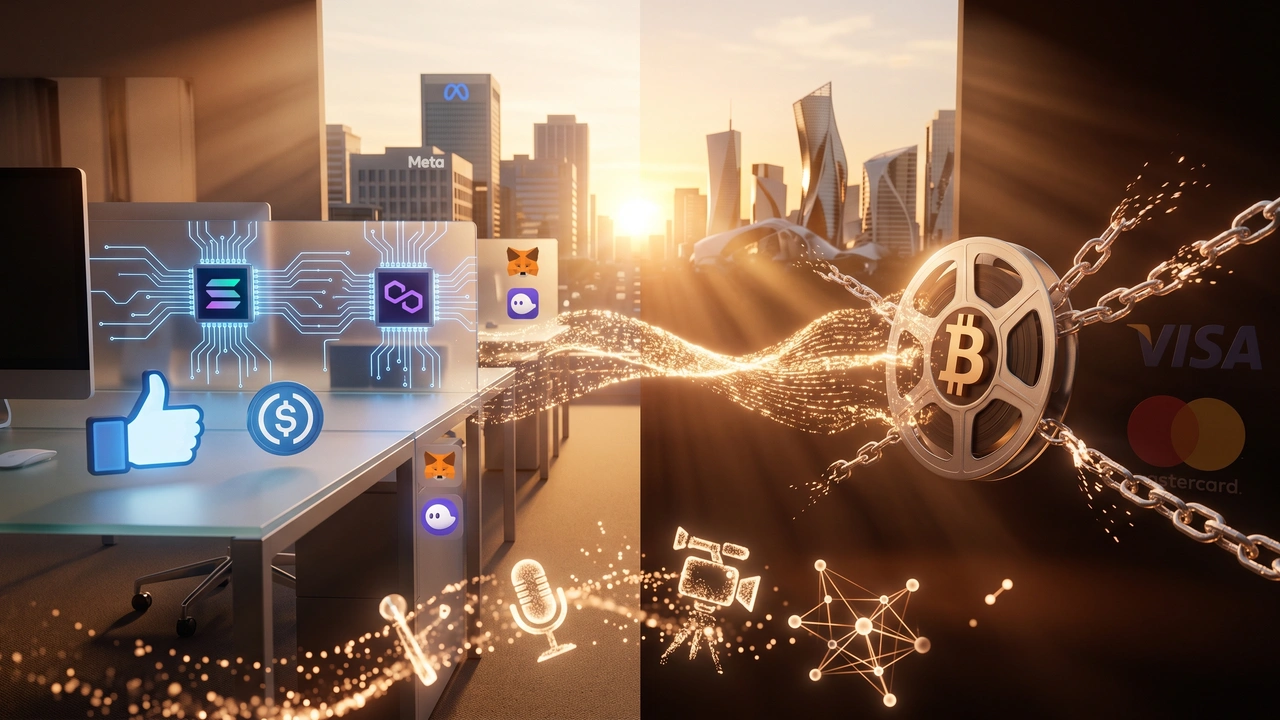
Meta's USDC payouts for creators and Jack Dorsey's Bitcoin-powered film distribution model signal a defining moment in crypto's integration into mainstream platforms — and reveal two very different visions of what that integration should look like.
Key Takeaways
- Meta's USDC creator payment system is a corporate crypto integration, not a decentralization play — responsibility and risk are shifted entirely onto individual users, making wallet hygiene and network selection critical for any creator who opts in.
- The collapse of Libra/Diem taught Meta that building proprietary monetary infrastructure invites regulatory destruction; the USDC model is the pragmatic alternative — leveraging existing stablecoin rails through Stripe rather than competing with central banks.
- Dorsey's framing of Bitcoin as a censorship-resistant payment layer — demonstrated by the 2011 WikiLeaks episode — remains the most compelling real-world argument for the network's existence beyond speculation, and the film distribution project is a deliberate attempt to activate that identity.
- The gap between stablecoin integration (Meta's model) and Bitcoin's open protocol principles (Dorsey's model) is widening, not narrowing — and investors should understand that these represent fundamentally different bets on the future of digital value.
- Mainstream platform adoption of crypto infrastructure, even in centralized stablecoin form, continues to normalize wallet usage and reduce onboarding friction for the next wave of Bitcoin users.
Crypto Integration Is No Longer a Pilot Program — It's Infrastructure
Two developments this week illustrate, with unusual clarity, the dual nature of cryptocurrency's march into the mainstream. On one side, Meta — the social media behemoth that once tried and failed to build its own digital currency empire — is quietly embedding stablecoin payments into its creator economy. On the other, Jack Dorsey and filmmaker Eugene Jarecki are betting that Bitcoin's original promise — censorship-resistant, gatekeeper-free value transfer — can do what Netflix and Amazon refused to: distribute a film about Julian Assange to a global audience.
These two stories are not unrelated. Together, they represent the full spectrum of crypto's integration into mainstream platforms: one corporate and compliance-driven, the other principled and adversarial by design. Understanding both is essential to understanding where this technology is actually headed.
The Facts
Meta has begun offering select creators the option to receive their earnings in USDC, a regulated dollar-pegged stablecoin, processed through payments infrastructure provider Stripe [1]. Creators can choose to receive funds via wallets operating on either the Solana or Polygon networks, with Meta recommending established wallet providers including MetaMask, Phantom, and Binance [1]. The company is emphatic about the irreversibility of crypto transactions, warning explicitly that "funds sent to an unsupported address or incorrect network cannot be recovered" [1]. Meta further places full custodial responsibility on the creator, stating directly: "You are responsible for the security of your account information, including your wallet credentials" [1]. Creators are also advised to retain both Meta payment history and Stripe records for tax reporting purposes, and will receive crypto-specific documentation to assist [1]. Whether this feature extends to creators in Germany or other European jurisdictions remains unconfirmed [1].
This marks a notable reversal of fortune for Meta in the digital asset space. The company's previous attempt to launch a proprietary digital payment system — first called Libra, later rebranded Diem — collapsed under coordinated regulatory pressure before it ever reached users at scale [1]. The USDC rollout, by contrast, leans on existing, battle-tested infrastructure rather than attempting to build a competing monetary network from scratch.
Meanwhile, in a very different corner of the crypto universe, Jack Dorsey appeared at a panel alongside documentary filmmaker Eugene Jarecki to discuss The Six Billion Dollar Man, a Cannes-recognized film about Julian Assange that major streaming platforms declined to carry [2]. Dorsey proposed an unconventional distribution model: a global pay-per-view watch party, accessible through the film's website, where ticket purchasers receive a credit on the film itself — transforming passive viewers into active participants and co-producers [2]. Dorsey framed the Bitcoin community as the natural audience and distribution engine for such a project, describing Bitcoin as "an open protocol for money transmission" that "routes around the gatekeepers — Visa, Mastercard, the banks" [2]. He pointed to 2011, when financial institutions severed WikiLeaks from conventional donation channels under government pressure, as the defining proof of concept for Bitcoin's real-world utility [2]. Dorsey also drew a philosophical parallel between Assange and Satoshi Nakamoto, arguing that Satoshi's decision to remain pseudonymous and ultimately disappear made Bitcoin structurally resistant to the institutional pressure that can be applied when a single identifiable founder stands behind a project [2].
Analysis & Context
Meta's pivot to stablecoin payments deserves more scrutiny than it is likely to receive. The company's Libra/Diem failure was not a technical one — it was a political one. Regulators and legislators worldwide made clear they would not permit a private company with Meta's scale and data-harvesting history to operate its own monetary network. The USDC model threads that needle elegantly: Meta outsources the monetary infrastructure to Stripe and Circle (the issuer of USDC), accepts no currency risk, and collects none of the regulatory heat that comes with issuing a digital asset. It is, in essence, a payment rail upgrade dressed as a crypto integration. For creators, the practical implications are meaningful — faster settlement, potential access to DeFi yield, and reduced friction for cross-border payments. But this is not Bitcoin, and it is not decentralization. It is a corporate entity adopting a regulated stablecoin to reduce its own operational costs while placing custodial risk squarely on individual users. The warning about irrecoverable funds is not a caveat — it is the defining legal architecture of the arrangement.
The Dorsey-Jarecki project operates from an entirely different set of assumptions. Dorsey's invocation of the 2011 WikiLeaks episode is historically accurate and analytically important: that moment — when PayPal, Visa, and Mastercard all cut WikiLeaks off within days of each other following U.S. government pressure — was not an edge case. It was a demonstration of how quickly financial infrastructure can become a censorship tool. Bitcoin's role as the only surviving donation channel for WikiLeaks during that period was not planned by its developers; it emerged organically from the network's properties. That Dorsey is now attempting to use the same community and the same infrastructure to distribute a film that institutional gatekeepers declined to carry is a direct application of that lesson. Whether the model succeeds commercially matters less than what it reveals: there is a growing constituency that views Bitcoin not merely as a speculative asset but as infrastructure for protecting speech and distributing information outside of corporate control.
For Bitcoin specifically, neither story is a direct price catalyst — but both are meaningful signals. Meta's stablecoin integration normalizes crypto wallet usage among millions of creators who may have never held a digital asset. That normalization, even in the form of USDC rather than BTC, lowers psychological barriers. Meanwhile, the Dorsey-Jarecki project reinforces Bitcoin's identity as a tool with a mission, not merely a market. Historically, Bitcoin has attracted its most committed users not during bull markets but during moments when its use case was demonstrated under pressure. The 2011 WikiLeaks episode was one such moment. Whether a documentary distribution project rises to that level is debatable — but Dorsey is clearly attempting to write the same kind of story.
Sources
AI-Assisted Content
This article was created with AI assistance. All facts are sourced from verified news outlets.