Crypto Markets Under Pressure: WLFI, TAO, and the Volatility Story
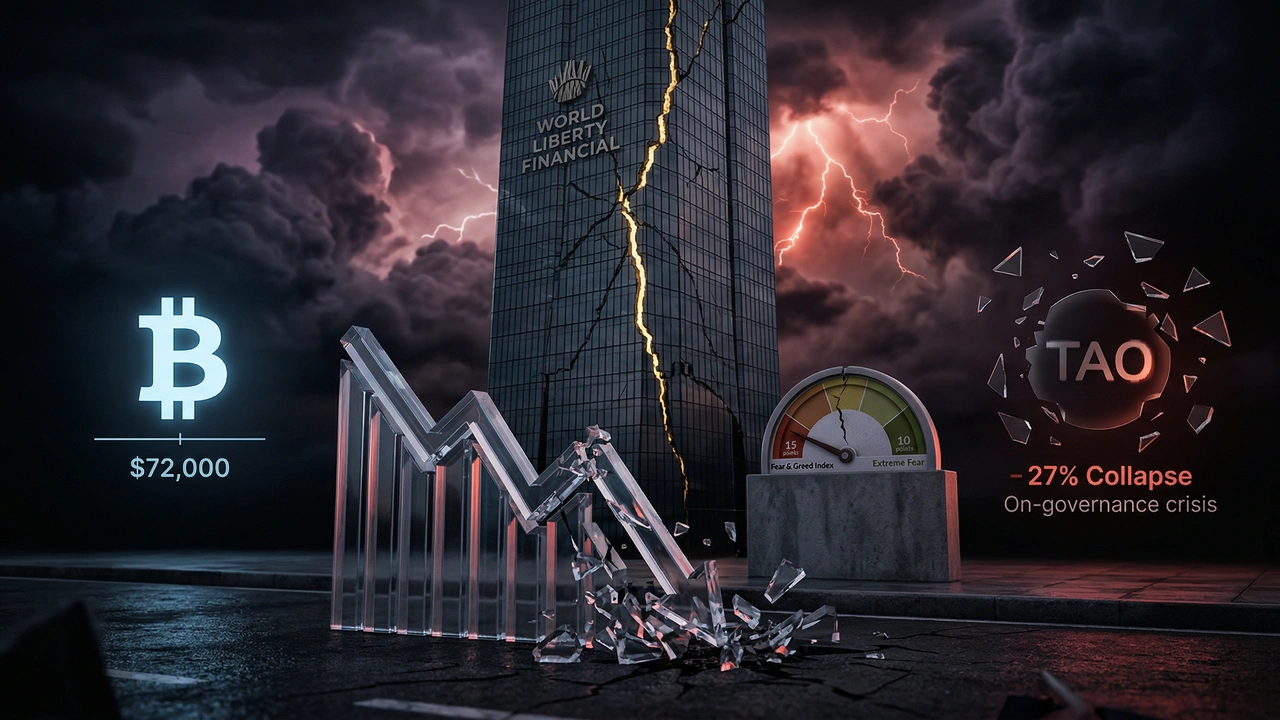
From Justin Sun's frozen millions in World Liberty Financial to Bittensor's governance crisis sending TAO tumbling 27%, this week's altcoin carnage reveals a market navigating extreme fear and deep structural questions.
Key Takeaways
- Narrative risk is real and repricing is brutal: Both WLFI (-74% from launch) and TAO (-27% in 24 hours) illustrate how quickly token valuations collapse when the stories underpinning them — political influence or decentralized AI — are credibly challenged.
- Governance transparency is a core investment variable: The Bittensor controversy highlights that decentralization claims require ongoing scrutiny; investors should treat governance structure as a fundamental due diligence item, not a marketing assumption.
- Conflicts of interest compound DeFi risk: The overlap between WLFI's lending activities on Dolomite and the advisory role of Dolomite's co-founder at World Liberty Financial is precisely the kind of entanglement that can accelerate a crisis if collateral values deteriorate further.
- Bitcoin dominance at 57% reflects rational capital rotation: In a market gripped by extreme fear, Bitcoin's relative stability is attracting capital away from higher-risk altcoins — a pattern consistent with prior periods of altcoin stress.
- Illiquidity is an underappreciated risk: Justin Sun's frozen WLFI position is a stark reminder that token lock-ups and wallet restrictions can transform paper losses into realized traps, with no exit available regardless of market conditions.
When the Narrative Breaks: Altcoin Volatility Exposes Fragile Foundations
Bitcoin may be holding its ground near $72,000, but the broader crypto market is telling a more turbulent story. This week, two high-profile altcoin implosions — one tied to Trump-affiliated DeFi project World Liberty Financial, the other to AI-blockchain darling Bittensor — have laid bare a recurring truth about speculative token markets: when the narrative fractures, the price follows fast. With the Fear & Greed Index sitting at a deeply uncomfortable 15 points, investors are being reminded that in a market driven by sentiment and story, governance failures and insider conflicts can be just as destructive as macro headwinds.
These are not isolated incidents. Together, they form a coherent and cautionary picture of how token performance is inextricably linked to credibility, transparency, and the integrity of the teams behind them.
The Facts
Bitcoin has demonstrated relative resilience this week, trading steadily around the $72,000 level after reclaiming that price point amid easing tensions in the Middle East conflict. The flagship cryptocurrency briefly touched highs above $73,000 before a modest pullback, while Ethereum trades near $2,200, recovering some ground from recent weeks but still below its year-opening level [2]. Bitcoin dominance stands at approximately 57%, suggesting capital is rotating toward the perceived safety of the market leader rather than spreading into riskier altcoin positions [2].
The most dramatic story in the altcoin space this week belongs to Bittensor's TAO token, which shed up to 27% within a single 24-hour period [2]. The trigger was the very public departure of Covenant AI, previously one of the most prominent builders in the Bittensor ecosystem. Covenant founder Sam Dare issued a scathing statement accusing the network of being "decentralization theater" and calling its core promise "a lie" [3]. The specific allegations are serious: Dare claims that co-founder Jacob Steeves exercises disproportionate control over the network, including suspending token emissions for competing subnets, stripping moderation rights, devaluing Covenant's infrastructure, and selling tokens during a period of active conflict — moves that Dare characterizes as economic warfare [3]. It bears noting that these remain unverified allegations at this stage, with no independent confirmation yet available [3].
Covenant AI was no minor player. Its flagship project, Covenant-72B — a 72-billion parameter language model trained with open, unpermissioned participants over the internet — had been widely cited as proof that meaningful AI development could be genuinely decentralized [3]. Its departure therefore strikes at the heart of Bittensor's investment thesis. From the Bittensor side, there are signals that structural reforms may follow, with sources close to Jacob Steeves indicating plans for a lock-based model tying subnet ownership more tightly to staked tokens [3].
Meanwhile, World Liberty Financial (WLFI), the Trump-affiliated DeFi project, continued its prolonged decline, hitting new all-time lows and registering a 20% weekly loss — bringing its total drawdown from launch to over 74% [1]. Justin Sun, the Tron founder who built a position worth approximately $75 million in WLFI and separately invested around $100 million in the TRUMP memecoin, has seen his frozen WLFI holdings collapse to roughly $45 million in current value — a paper loss exceeding $80 million [1]. Sun's wallet was blocked by World Liberty after approximately nine million WLFI tokens were moved, leaving his position locked and illiquid [1]. Additional scrutiny surrounds WLFI's use of its own tokens as collateral on the Dolomite lending protocol to borrow stablecoins worth tens of millions of dollars — a practice critics warn could endanger lenders if WLFI's price continues to deteriorate [1]. World Liberty has publicly denied being near liquidation, though observers have flagged a potential conflict of interest: Dolomite co-founder Corey Caplan simultaneously serves as an advisor to World Liberty Financial [1].
Analysis & Context
What we are witnessing across both WLFI and TAO is a pattern that has repeated throughout crypto's relatively short history: tokens whose valuations are built substantially on narrative and association — be it political cachet or technological idealism — are especially vulnerable when those narratives are challenged. WLFI benefited enormously from its proximity to the Trump brand during the political momentum of late 2024. TAO rode the AI boom, positioning itself as the decentralized answer to centralized AI giants. Both premiums are now being ruthlessly repriced.
The Bittensor situation is particularly instructive. The history of crypto is littered with projects that marketed decentralization while quietly maintaining centralized chokepoints. From early ICO-era governance scandals to more recent DeFi protocol disputes, the moment a credible insider stands up and says "this isn't what it claimed to be," the market rarely forgives quickly. The proposed lock-based reform may signal good faith, but it also implicitly acknowledges that the existing governance structure was inadequate — something the market has already priced in harshly. Rebuilding trust after a prominent builder becomes a public critic is a slow and uncertain process, and short-term token recovery typically lags the actual structural improvements.
For Bitcoin specifically, this environment is paradoxically constructive. When altcoins implode due to governance failures or insider conflicts, capital often flows toward Bitcoin as the only major crypto asset with a credibly decentralized governance model and no controlling founder. The 57% dominance reading reflects this dynamic in real time. Bitcoin's current consolidation around $72,000 amid extreme fear in the broader market underscores its growing role as the relative safe haven within the crypto asset class — a trend that has strengthened notably over multiple market cycles.
Sources
- [1]btc-echo.de
- [2]btc-echo.de
- [3]btc-echo.de
AI-Assisted Content
This article was created with AI assistance. All facts are sourced from verified news outlets.