Crypto's Security Crisis: Fake Apps and Bridge Exploits Expose Systemic Risks
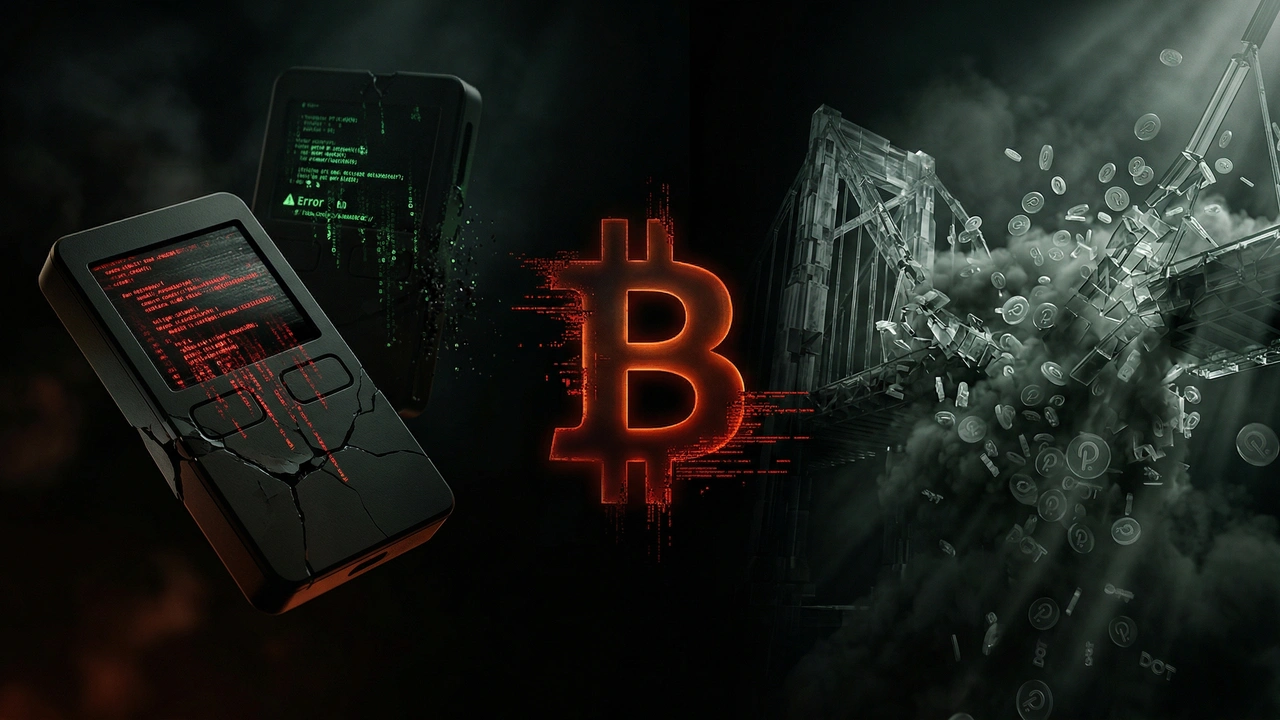
A musician lost $418,000 in Bitcoin to a counterfeit Ledger app while a Polkadot bridge exploit minted a billion unauthorized tokens — two incidents that reveal the expanding and increasingly sophisticated attack surface facing crypto holders in 2026.
Key Takeaways
- Seed phrase compromise is absolute and irreversible: The Ledger fake app incident confirms that once a seed phrase is entered into any unauthorized application, total loss of funds is essentially guaranteed — hardware wallet security provides zero protection in this scenario [1].
- Cross-chain bridges remain among the highest-risk infrastructure in crypto: The Polkadot Hyperbridge exploit demonstrates that flawed transaction verification can allow attackers to mint tokens from thin air; bridges securing large liquidity pools represent concentrated, high-value targets that the industry has repeatedly failed to adequately harden [2].
- Sophisticated attacks now target experienced users, not just beginners: The musician victim in the Ledger case likely understood crypto security basics — the attack succeeded because the fake application was indistinguishable from the genuine product, illustrating that experience alone is insufficient protection against well-resourced adversaries [1].
- Always verify software through official hardware channels only: Ledger software should exclusively be downloaded from ledger.com directly; any other distribution channel — app stores, third-party links, or search engine results — should be treated as a potential attack vector until independently verified.
- Market impact from exploits is real but often temporary: DOT's immediate technical weakness following the Hyperbridge incident reflects market anxiety, but historically, blockchain ecosystems that respond transparently and patch vulnerabilities quickly tend to recover — the more durable damage is reputational and trust-related [2].
The Illusion of Safety: When Trusted Tools Become Attack Vectors
The promise of self-custody — the idea that holding your own private keys makes you invulnerable to institutional failures — has long been central to the Bitcoin ethos. But two recent incidents shatter a dangerous assumption: that hardware wallets and established blockchain infrastructure are inherently secure. When attackers can clone the interface of a trusted device manufacturer or exploit a cross-chain bridge to conjure a billion tokens from nothing, the security conversation must evolve far beyond "not your keys, not your coins."
These are not isolated edge cases. They are data points in an accelerating trend of highly targeted, professionally executed attacks that exploit user trust, interface familiarity, and architectural complexity in equal measure.
The Facts
In the most viscerally personal of the two incidents, a musician lost approximately 418,000 USD — equivalent to 5.9 Bitcoin — after installing a fraudulent application that impersonated the official software of hardware wallet manufacturer Ledger [1]. The app appeared legitimate at first glance, bearing the visual hallmarks of the genuine product, and gave the victim no obvious indication that anything was amiss. Once installed, the malicious application harvested sensitive credentials, almost certainly the wallet's seed phrase, granting the attackers complete and irrevocable control over the funds [1].
Blockchain investigator ZachXBT, who routinely tracks on-chain fraud, was able to trace portions of the stolen Bitcoin and determined that some of the funds were routed through the exchange KuCoin — a common obfuscation step used to complicate asset recovery and thwart investigators [1]. The victim's Bitcoin were effectively gone the moment the seed phrase was compromised.
On a different front, the Polkadot ecosystem absorbed a significant blow when an attacker exploited a vulnerability in a Hyperbridge Gateway, a cross-chain bridge infrastructure component [2]. By taking advantage of flawed transaction verification logic, the attacker was able to mint approximately one billion "bridged DOT" tokens without depositing any real collateral on the originating chain [2]. Security firm CertiK assessed the actual financial damage at roughly 237,000 USD, as the attacker was unable to fully liquidate the artificially created tokens before the exploit was detected and contained [2].
The Polkadot incident triggered immediate market pressure on DOT, which at the time of reporting was trading around 1.184 USD — well below its EMA-20 of 1.2457 USD — with an RSI of approximately 21.7, signaling deeply oversold conditions [2]. The asset sits vastly below its 2021 all-time high of 54.98 USD, and the exploit added negative momentum to an already bearish short-term technical picture [2].
Analysis & Context
These two incidents, superficially distinct in their mechanics, are thematically inseparable. Both exploit a fundamental vulnerability that no amount of cryptographic innovation has yet fully solved: the human and architectural trust layers that sit between a user and their assets.
The fake Ledger app attack follows a well-documented playbook. Phishing through counterfeit software has been a persistent vector since at least 2017, but the sophistication has grown dramatically. Early crypto phishing attempts were crude — misspelled URLs, poorly rendered logos. Today's fake apps are pixel-perfect reproductions distributed through channels that appear legitimate, sometimes even surfacing in official app stores through lax review processes. The Ledger brand is a particularly attractive target precisely because it is synonymous with security; users who feel protected are less vigilant. This psychological inversion — trustworthiness as a liability — is the attacker's most powerful weapon. The case is also a sobering reminder that hardware wallet security is rendered completely moot the moment a seed phrase is entered into any software, on any device, regardless of how official it appears.
The Polkadot bridge exploit, meanwhile, belongs to a category of attack that has collectively drained billions from the crypto ecosystem over the past several years. The Ronin Network hack in 2022 ($625 million), the Wormhole exploit ($320 million), and the Nomad bridge attack ($190 million) all share the same architectural root cause: cross-chain bridges must trust information from external chains, and that trust relationship, if improperly validated, becomes an infinite money printer for attackers. The Hyperbridge exploit follows this exact pattern — unauthorized token minting via broken verification logic [2]. The relatively contained financial damage of $237,000 in this instance was largely a matter of fortunate timing and limited liquidity rather than any defensive mechanism catching the attack in progress. The theoretical exposure of a billion DOT tokens makes clear how catastrophic the outcome could have been.
For Bitcoin holders specifically, the fake Ledger app incident carries the most direct relevance. Bitcoin's security model is only as strong as the weakest link in a user's operational security chain. Cold storage and hardware wallets provide genuine protection against remote exploits — but they cannot protect against a user willingly handing over their seed phrase to a convincing impersonator. The bridge exploit, while not directly a Bitcoin issue, reinforces why the broader crypto infrastructure narrative of "DeFi is safe if you use the right tools" deserves sustained skepticism.
Sources
- [1]btc-echo.de
- [2]btc-echo.de
AI-Assisted Content
This article was created with AI assistance. All facts are sourced from verified news outlets.