Crypto Taxation in Focus: Germany vs. the Netherlands
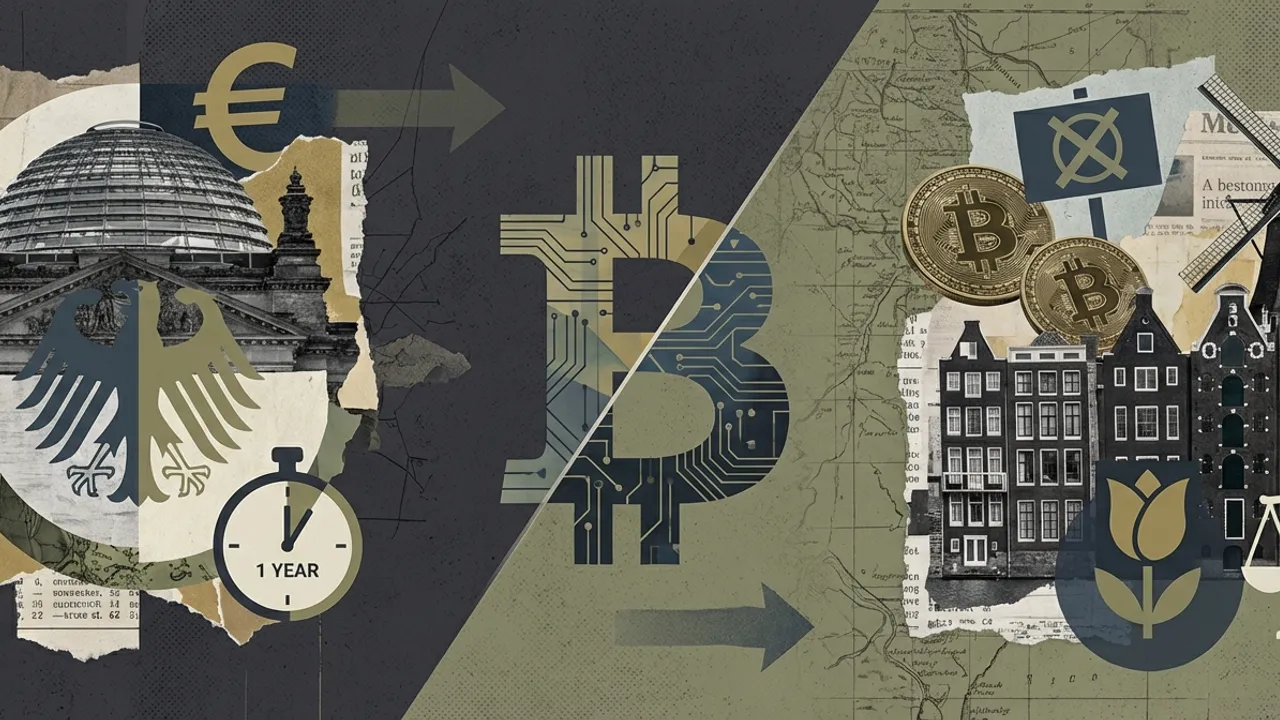
While the Netherlands withdraws its planned tax on unrealized gains after massive protests, Germany demonstrates that the one-year holding period remains the greatest advantage for Bitcoin investors.
Germany Offers Bitcoin Investors a Decisive Advantage
While political debate over a tax on unrealized gains escalates in the Netherlands and the cabinet temporarily withdraws the controversial bill after massive protests, Germany presents a fundamentally different picture. The one-year holding period for cryptocurrencies proves to be one of the most attractive tax mechanisms worldwide – provided investors understand the rules and avoid common mistakes. The divergent developments in both countries illustrate how complex and controversial the taxation of digital assets remains in Europe.
The Facts
The German Legal Situation: Holding Period as the Royal Road
In Germany, spot purchases and sales of cryptocurrencies are treated as private disposal transactions [1]. This means specifically: Anyone who holds their Bitcoin or other coins for longer than one year can realize gains completely tax-free. "In Germany, tax exemption after a twelve-month holding period is certainly the most significant lever for optimizing tax burden or reducing it to zero," explains tax law expert Stefan Winheller [1].
For sales within the one-year holding period, gains are subject to the personal income tax rate, which can range between 0 and 45 percent [1]. Additionally, there is an exemption threshold of 1,000 euros per year for gains from private disposal transactions. If this is exceeded, the entire gain is taxable, not just the amount exceeding the threshold [1]. A common misconception among investors: "Some investors still think that only the exchange of cryptocurrencies into euros or US dollars can be taxable. But that's not the case. Every exchange, even crypto for crypto, can trigger taxes," warns Winheller [1].
The situation is different for staking rewards: The rewards received are considered taxable income from other sources at the time of receipt, with an exemption threshold of 256 euros per year [1]. The market value at the time of receipt is decisive. For the subsequent sale of staking rewards, the one-year holding period applies again [1].
Netherlands: U-Turn After Public Outcry
In the Netherlands, a far-reaching reform of the so-called Box 3 taxation was to be implemented, which covers capital income [2]. The previous system, which operated on the basis of fictitious, government-assumed returns, was criticized by courts multiple times and partially declared unlawful [2]. The planned reform envisioned using actual return results in the future – including appreciation of stocks, funds, real estate, and other assets, even if they had not yet been sold [2].
This exact point triggered massive criticism. Numerous opponents argued that a tax on unrealized gains could lead to significant liquidity problems [2]. "Anyone holding shares in a company, real estate, or long-term investments would have to pay taxes under certain circumstances. And this despite no sale having taken place and thus no funds having been received," the criticism states [2]. This could lead to massive problems, especially with highly volatile assets like Bitcoin [2].
After sustained public protests and political pressure, Finance Minister Eelco Heinen announced that the bill would be revised for now [2]. Thus, the introduction of comprehensive taxation of unrealized gains is postponed for the time being. Whether a hybrid model will ultimately be developed remains open [2].
The Role of Documentation
Regardless of the respective tax system, documentation determines tax security. "Documentation, documentation, documentation," emphasizes Winheller [1]. "Investors frequently overlook their own wallets or can no longer reconstruct transactions from the past," the expert explains [1]. Without a complete transaction history, neither holding periods nor acquisition costs nor loss offsetting can be properly documented. The tax administration expects certain settings, for example, separate determination of purchases and sales per wallet [1].
Analysis & Classification
The contrasting developments in Germany and the Netherlands reveal a fundamental conflict in European crypto taxation. While Germany has established a system with the one-year holding period that favors long-term investments while remaining practicable, the Netherlands attempted a more radical approach – and failed, at least for now, due to political resistance.
The Dutch retreat has signal effect for all of Europe. The debate shows that while tax authorities are increasingly trying to capture wealth increases, they encounter significant practical and political limits. Especially with highly volatile assets like Bitcoin, taxation of unrealized gains would lead to absurd situations: An investor could have to pay taxes on paper gains that evaporate just weeks later. The liquidity problem would be real – many hodlers would have to sell Bitcoin to pay taxes on unrealized gains, which counteracts the purpose of long-term accumulation.
The German model, in contrast, proves to be pragmatic and investor-friendly. The clear regulation creates planning certainty: Anyone who waits one year pays no taxes. This simplicity not only reduces the tax burden but also significantly reduces administrative effort. For Bitcoin investors who pursue a long-term perspective anyway, this is a clear locational advantage of Germany. The greatest challenge remains clean documentation – but this is unavoidable with any form of taxation.
The tax treatment of staking in Germany is also interesting. While rewards must be taxed as income upon receipt, the holding period applies again for subsequent sales. This creates an incentive to hold staked coins long-term. However, this also carries risks: At high prices at the time of receipt, a high tax burden arises, while a subsequent price decline does not automatically have a corrective effect.
Conclusion
• Germany offers one of the most attractive tax mechanisms for Bitcoin investors worldwide with the one-year holding period – long-term hodlers can realize gains completely tax-free
• The withdrawal of the Dutch tax on unrealized gains shows the practical and political limits of radical taxation models, especially for volatile assets like Bitcoin
• Documentation remains the key to tax security: Only those who can seamlessly prove all transactions, wallet transfers, and exchange exports are protected against inquiries from the tax office
• Loss offsetting is worthwhile for active traders: Realized losses can be offset against gains from private disposal transactions – even retroactively and in subsequent years
• The different approaches in Europe make clear that harmonized crypto taxation is still a long way off – locational advantages like the German holding period will remain for the time being
Sources
AI-Assisted Content
This article was created with AI assistance. All facts are sourced from verified news outlets.