Crypto Treasuries Face Their First Real Test - Only One Is Winning
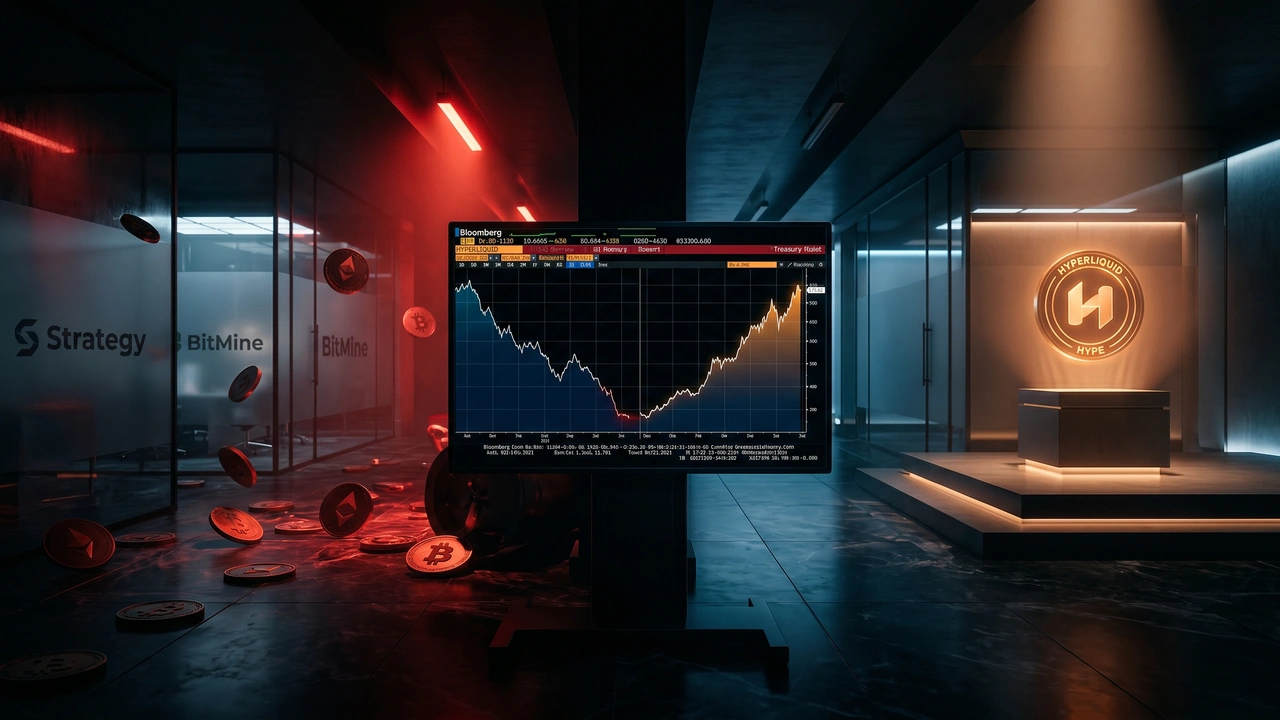
As the crypto treasury model endures its first serious market stress, most corporate Bitcoin and altcoin holders are sitting on deep unrealized losses - while Strategy scrambles to keep retail shareholders engaged ahead of a critical proxy vote.
Key Takeaways
- Of all major crypto treasury companies, only Hyperliquid Strategies is currently sitting on a meaningful unrealized gain - roughly $1 billion - while peers including Strategy and BitMine carry losses in the billions.
- BitMine's Ethereum-heavy approach illustrates the limits of yield as a risk buffer: staking income does not offset mark-to-market losses at scale when the underlying asset underperforms.
- Strategy's effort to shift STRC dividends to a semi-monthly schedule requires 50% of 85 million eligible shares to vote yes - a steep bar given that retail investors have historically voted less than a third of their holdings.
- Hyperliquid's outperformance reflects genuine platform fundamentals - exchange revenue, buybacks, and consistent token demand - rather than timing alone, suggesting that treasury quality matters as much as accumulation speed.
- The gap between retail and institutional voter participation is emerging as a concrete operational risk for crypto treasury companies that rely on retail-heavy shareholder bases for governance decisions.
Crypto Treasuries Face Their First Real Test - Only One Is Winning
The crypto treasury company playbook looked brilliant in a bull market. Load up on digital assets, issue equity, watch the premium expand. But markets have a way of separating clever strategies from genuinely sound ones, and 2026 has delivered exactly the kind of sustained price pressure that exposes which treasury desks bought well and which bought recklessly. The verdict, so far, is sobering - and it comes at precisely the moment that Strategy, the segment's flagship, is leaning hard on individual shareholders to show up for a proxy vote.
These two storylines - balance sheet pain across the sector and the governance scramble at Strategy - are not unrelated. Together they illuminate the growing complexity of a corporate model that was once pitched as almost automatically lucrative.
The Facts
Survey the major digital asset treasury companies right now and one name stands apart from the rest: Hyperliquid Strategies [1]. While virtually every other prominent player in the segment is carrying unrealized losses of varying severity, Hyperliquid Strategies holds an unrealized gain in the vicinity of $1 billion - making it an outlier in a landscape of balance-sheet pain [1].
At the other end of the spectrum, BitMine Immersion Technologies and Strategy account for the sharpest book losses. BitMine, the vehicle associated with analyst Tom Lee, has leaned into Ethereum as its primary treasury asset and built a substantial ETH position in a compressed timeframe [1]. The staking yield that Ethereum generates gives BitMine a theoretical operational advantage - the asset pays while it waits - but that income stream has done little to offset the fact that ETH has underperformed the broader market, leaving BitMine carrying the sector's largest unrealized loss, near $8.3 billion [1]. Strategy, meanwhile, holds 843,738 Bitcoin acquired at an average cost of roughly $75,700 per coin, and is nursing an unrealized shortfall exceeding $2 billion at current prices [1].
Hyperliquid's relative success is not purely a matter of lucky timing. The HYPE token, which forms the backbone of that treasury, has been among the stronger-performing crypto assets since its launch, driven by genuine platform traction on the Hyperliquid perpetuals exchange, meaningful fee revenue, and an active token buyback program [1]. HYPE-based exchange-traded products have recently logged record single-day volume figures, adding further momentum to the position [1].
Strategy's financial pressures are playing out against a governance backdrop that has grown notably complicated. The company is seeking shareholder approval to shift dividend payments on its STRC preferred stock from a monthly to a semi-monthly schedule [2]. Management argues the change would tighten reinvestment cycles, improve trading liquidity, and smooth price behavior for the instrument [2]. But the amendment requires affirmative votes from half of all 85 million STRC shares that were outstanding as of mid-April 2026 - a threshold that turns on retail participation, which is historically thin [2].
Strategy's leadership has mounted an unusually direct mobilization effort to close that gap. CEO Phong Le released a video message to STRC holders explaining the proposal in plain terms, and the company's investor relations team circulated an internal notice linking employees directly to the proxy materials [2]. The push reflects a well-documented structural problem: retail investors across the broader equity market have historically cast ballots on only around 29% of their shares during proxy seasons, compared with roughly 77% participation among institutional holders [2]. With the June 7 deadline approaching, "every single vote counts," Strategy's official account noted on X.com [2] - a framing that signals how tight the margin may be.
Blockstream CEO Adam Back added a technical dimension to the conversation, noting that Bitcoin's 200-week moving average has climbed well above $61,000 - a level that long-term trend followers typically interpret as a signal the macro uptrend remains intact [2].
Analysis & Context
The crypto treasury model was, in many respects, an arbitrage on market structure: companies could raise cheap equity capital, deploy it into appreciating digital assets, and capture a spread between their net asset value and the premium their stock commanded. That premium existed because retail investors wanted Bitcoin exposure without custody complexity. The model worked when assets went up. What we are watching now is the first genuine test of whether it holds when they do not.
BitMine's situation is the more instructive cautionary case. Ethereum's staking yield is real, but it is modest - industry estimates generally put it in the low single digits annually - and it cannot meaningfully insulate a treasury from a 30-40% drawdown in the underlying asset. The lesson is that yield does not transform a volatile asset into a stable one; it merely softens the blow at the margin. Investors who priced BitMine's treasury at a premium because of staking income may have conflated income generation with capital preservation.
Strategy's proxy scramble deserves attention beyond the mechanics of the STRC vote itself. A company that holds more Bitcoin than any other publicly traded entity on the planet, and that has built a financial architecture around continuous capital raises tied to Bitcoin's performance, depends structurally on shareholder confidence. When management has to personally video-call retail holders to secure a routine dividend-schedule amendment, it suggests the firm's shareholder base may be more fragile - and less engaged - than the scale of its balance sheet implies. That gap between institutional and retail participation is not a Strategy-specific problem, but it has specific consequences for a company whose governance math depends on broad turnout.
Sources
AI-Assisted Content
This article was created with AI assistance. All facts are sourced from verified news outlets.