Crypto Treasury Race: WLD Under Fire as XRP Bets Big on Wall Street
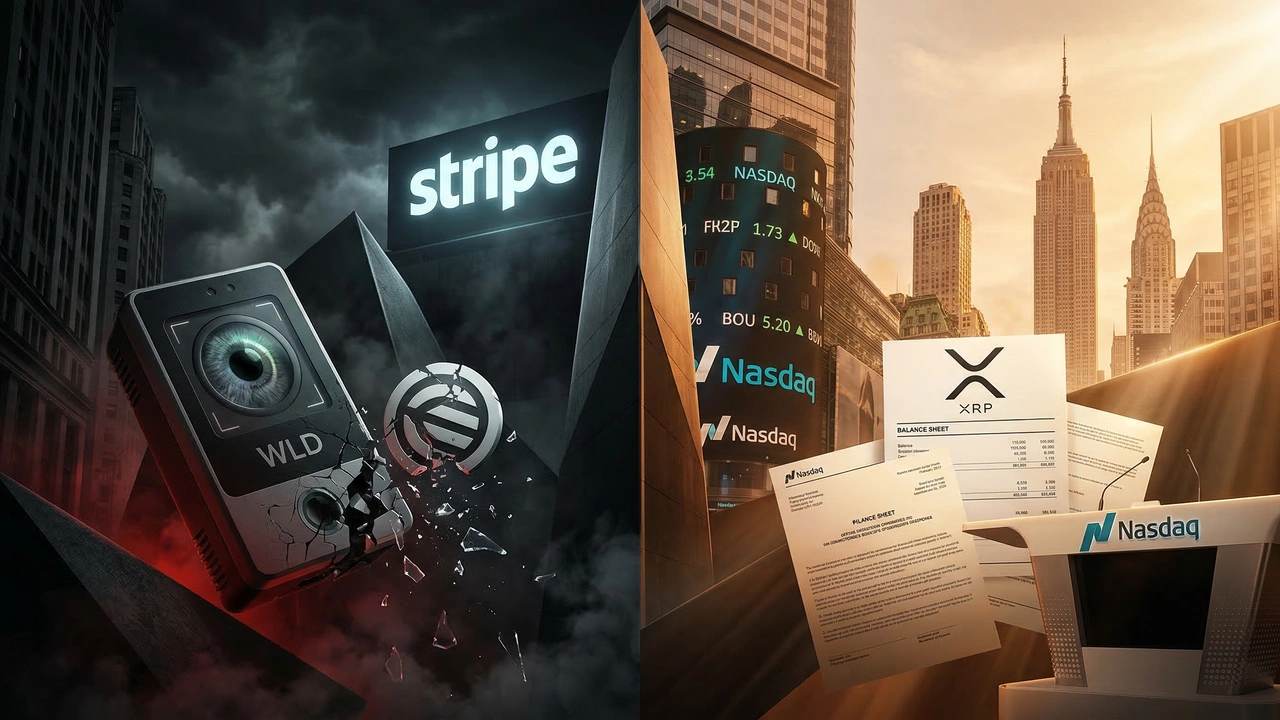
Two major crypto projects are making bold institutional moves — Worldcoin faces an existential competitive threat from Stripe, while an XRP-focused treasury vehicle prepares a Nasdaq debut backed by heavyweight investors.
Key Takeaways
- Worldcoin's AI-agent identity thesis faces a genuine competitive threat from Stripe's new blockchain and MPP standard, which targets the same use case with potentially superior resources — this is a fundamental narrative risk, not just a technical price correction [1]
- WLD's RSI near 20.6 indicates extreme short-term oversold conditions, suggesting a technical bounce is possible, but a break below $0.3415 support would signal accelerating downside pressure [1]
- Evernorth's planned Nasdaq listing via SPAC merger represents the XRP ecosystem's most significant attempt to replicate the MicroStrategy corporate treasury model, with at least 473 million XRP and over $1 billion in potential deal value [2]
- The participation of institutional names like Pantera Capital, SBI, Ripple, and Kraken in the Evernorth deal signals growing appetite for structured, regulated crypto exposure vehicles beyond Bitcoin — a trend worth monitoring closely [2]
- Both stories underscore the same macro truth: crypto projects are increasingly competing not just on technology, but on corporate strategy, institutional relationships, and the ability to survive well-capitalized competition from traditional finance players
When Corporate Crypto Strategies Collide With Market Reality
The past 48 hours have delivered a sharp reminder that in crypto, vision alone is not enough — execution, timing, and competitive moats determine survival. Two high-profile projects are navigating radically different paths toward institutional legitimacy: Worldcoin is watching its AI-agent identity narrative get challenged by a better-funded rival, while an XRP treasury vehicle is methodically building the kind of Wall Street infrastructure that once seemed unthinkable for a digital asset. Together, these developments paint a vivid picture of how crypto projects are increasingly being judged not by their whitepapers, but by their ability to withstand real-world competitive pressure.
The divergence is striking. One story involves a token bleeding double-digit losses amid strategic uncertainty. The other features institutional heavyweights queuing up to back a structured XRP vehicle heading for Nasdaq. Both are chapters in the same larger story: the maturation of crypto from speculative playground into contested corporate battleground.
The Facts
Worldcoin, the biometric identity and cryptocurrency project co-founded by OpenAI's Sam Altman, had recently positioned itself at the intersection of artificial intelligence and blockchain payments. The project struck a partnership with Coinbase that allows verified World ID holders to cryptographically delegate their identity to AI agents, enabling autonomous payments through Coinbase's x402 protocol [1]. The thesis was elegant: as the so-called agent economy scales, World ID becomes a prerequisite for trusted machine-to-machine transactions, creating sustained demand for WLD tokens.
That narrative took a direct hit when payments infrastructure giant Stripe unveiled its own high-performance blockchain alongside a new standard called MPP — explicitly targeting the same AI-agent payment use case, but promising faster execution and lower costs [1]. Markets responded swiftly and mercilessly. WLD dropped approximately 13 percent in a single trading session, with the token sliding to $0.3429 from the previous day's close of $0.3618 [1]. Technical indicators reinforced the bearish picture: the token is trading below its 20-day exponential moving average of $0.3712, the RSI has collapsed to roughly 20.6 — firmly in oversold territory — and price is sitting beneath the lower Bollinger Band, signaling elevated volatility and a short-term washout phase [1].
Meanwhile, a very different kind of crypto institutional story is unfolding around XRP. Evernorth, an XRP-focused crypto treasury company, has filed with the U.S. Securities and Exchange Commission to merge with the special purpose acquisition company Armada Acquisition Corp. II [2]. Upon completion, the combined entity would list on Nasdaq under the name Evernorth Holdings Inc., trading under the tickers XRPN for common shares and XRPNW for warrants [2]. Armada raised approximately $230 million during its own IPO in May 2025, providing the firepower for the transaction [2].
The scale of the planned XRP position is notable. Evernorth intends to hold at least 473 million XRP on its balance sheet, sourced from Ripple deposits and open-market purchases financed by transaction proceeds [2]. The deal could ultimately bring in over one billion dollars, according to earlier reporting, and the investor roster reads like a who's who of crypto-adjacent institutional finance: SBI, Ripple itself, Pantera Capital, Kraken, and GSR [2]. Beyond simple token accumulation, Evernorth's strategy includes yield generation through lending and liquidity provision, operating validators on the XRP Ledger, and incorporating Ripple's RLUSD stablecoin into operational activities [2]. Despite the positive structural news, XRP's price still declined 1.5 percent on the day to $1.44, caught in the broader market selloff [2].
Analysis & Context
The Worldcoin situation exposes a vulnerability that many crypto projects overlook when they build narratives around emerging technology trends: being early is not the same as being defensible. Worldcoin's bet on AI-agent identity was intellectually coherent, but it was always dependent on Coinbase's x402 protocol achieving dominant market adoption. Now that Stripe — a company with vastly superior distribution, developer trust, and balance sheet — has entered the same arena, the probability of x402 becoming the universal standard has diminished, and with it, the urgency of holding a World ID. This is not merely a technical setback; it is a strategic compression of Worldcoin's total addressable market. History offers cautionary parallels: early blockchain identity projects like Civic and SelfKey once commanded significant valuations on similar theses, only to be outmaneuvered when larger platforms integrated identity solutions natively. The RSI reading below 21 suggests the market has already begun pricing in a reassessment of the project's long-term relevance, though such deeply oversold readings often precede technical bounces — distinct from fundamental recovery.
The Evernorth-XRP story, by contrast, represents something more structurally significant than a single token's price action. The SPAC-to-Nasdaq pathway mirrors the MicroStrategy playbook that Michael Saylor popularized for Bitcoin — using public equity markets to create a leveraged, regulated exposure vehicle for an asset that many institutional investors still cannot hold directly. The participation of firms like Pantera Capital and SBI signals this is not a retail-driven vehicle but a deliberate attempt to create XRP-denominated institutional infrastructure. For the broader crypto market, successful listings of treasury vehicles for assets beyond Bitcoin would validate the model and potentially accelerate similar structures for other major tokens. The fact that XRP's price declined despite this news is largely a macro noise issue — the structural development of regulated institutional exposure vehicles tends to have longer-dated price effects than intraday sentiment.
From a Bitcoin perspective, both stories reinforce a consistent theme: Bitcoin's corporate treasury thesis, pioneered by MicroStrategy and now adopted by dozens of public companies, has inspired imitation across the crypto ecosystem. The critical difference is that Bitcoin's treasury model is built on the asset's unmatched scarcity, neutrality, and global recognition. Altcoin treasury vehicles carry execution risk, competitive risk, and regulatory risk that Bitcoin holders simply do not face to the same degree. Investors should weigh those distinctions carefully as the SPAC model spreads.
Sources
- [1]btc-echo.de
- [2]btc-echo.de
AI-Assisted Content
This article was created with AI assistance. All facts are sourced from verified news outlets.