Custody Failures and Crypto Theft: Why Self-Custody Still Matters
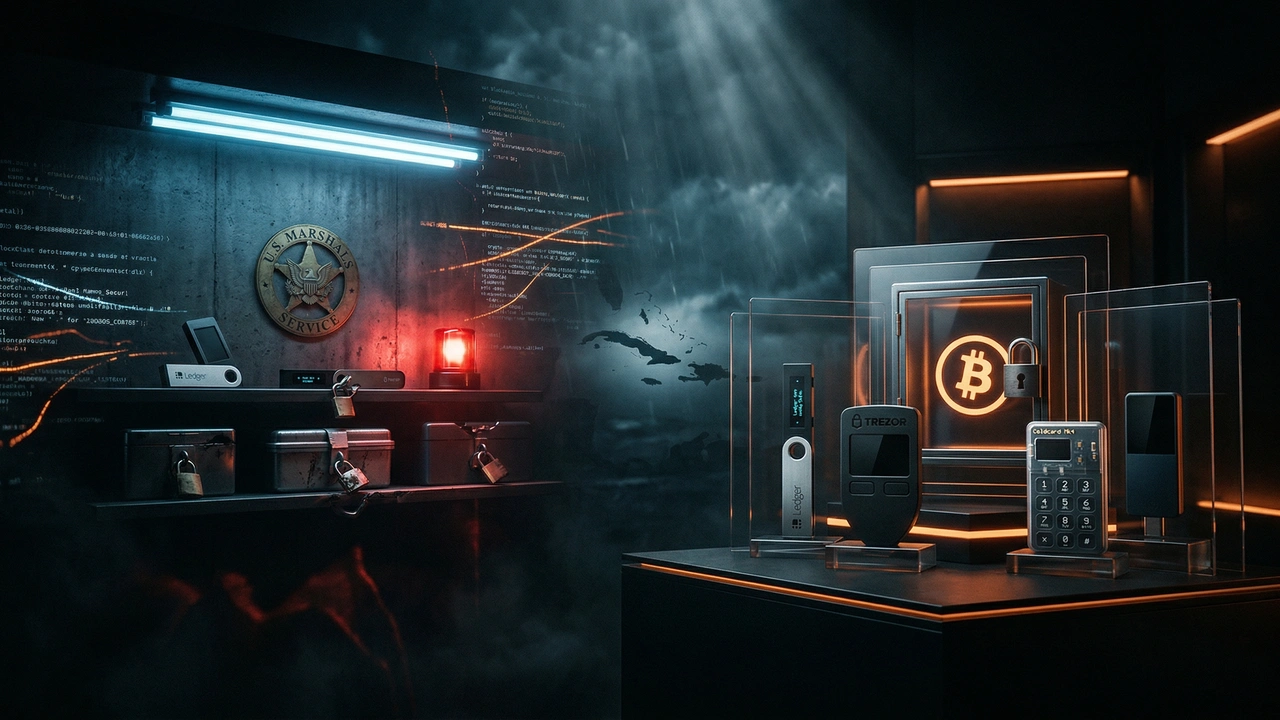
From a $46 million heist targeting US government crypto wallets to a detailed breakdown of the best hardware wallet options available, the case for robust self-custody has never been stronger — or more complex.
When Custody Fails: The Twin Lessons of Government Theft and Hardware Wallet Security
Two stories are dominating Bitcoin security discussions right now, and together they tell a single, urgent story: custody is everything. Whether your Bitcoin is held by a government agency managing seized assets or sitting in a poorly chosen hardware wallet on your desk, the principles of security are the same — and the consequences of getting them wrong are devastating. A spectacular alleged theft from US government crypto holdings and a comprehensive review of the hardware wallet landscape converge on one undeniable conclusion: self-custody, done correctly, remains the gold standard for Bitcoin protection.
The arrest of a suspected government contractor who allegedly stole $46 million in seized cryptocurrency, combined with the evolving hardware wallet market, offers a rare moment of clarity for Bitcoin holders at every level. The question is no longer whether to take custody seriously — it's how to do it right.
The Facts
Law enforcement made a dramatic arrest on the Caribbean island of Saint Martin, detaining John Daghita in a joint operation between the FBI and a French elite unit [2]. According to investigators, Daghita allegedly siphoned more than $46 million in cryptocurrency from wallets maintained by the US Marshals Service — the federal agency responsible for managing assets seized in criminal proceedings [2]. FBI Director Kash Patel publicly confirmed the arrest via social media, stating that US authorities would continue pursuing crypto fraud cases in coordination with international partners [2].
The case unraveled largely due to the work of independent blockchain investigator ZachXBT, who claims to have identified the theft in early 2026 by tracing on-chain activity linked to wallets holding confiscated crypto assets [2]. ZachXBT noted that Daghita had reportedly mocked him through Telegram during the investigation and had even attacked his publicly visible wallet address [2]. The alleged access vector is particularly alarming: Daghita's father reportedly owns an IT firm called Command Services & Support, which secured a contract with the US Marshals Service in 2024 to manage seized Bitcoin and other cryptocurrencies [2]. Investigators are now examining whether that family business relationship provided the son with privileged access to sensitive wallet credentials [2].
On the hardware wallet front, the market has matured considerably, with five major devices now catering to different user profiles [1]. Ledger's lineup — the Nano X, Nano S Plus, and Stax — offers broad compatibility with over 5,500 cryptocurrencies and features like Bluetooth and NFC, though the company's partially closed-source firmware and the controversial 2023 "Ledger Recover" episode continue to generate skepticism in Bitcoin circles [1]. Trezor's Safe 5 counters with full open-source firmware and a newly introduced EAL6+ certified Secure Element implemented without a non-disclosure agreement [1]. Swiss manufacturer Shift Crypto's BitBox02 Nova emphasizes transparency and offline operation, adding iOS support while deliberately omitting Bluetooth [1]. For Bitcoin maximalists demanding maximum isolation, the Coldcard Mk4 operates entirely air-gapped, signing transactions exclusively via microSD card [1]. At the top of the security pyramid, the NGRAVE ZERO carries an EAL7 certification — the highest available in the consumer space — and communicates solely through QR codes, never making any direct digital connection [1].
Experts consistently emphasize that the hardware itself is only part of the security equation. Secure seed phrase storage, a strong PIN, and disciplined operational practices remain non-negotiable regardless of which device a holder chooses [1].
Analysis & Context
The Daghita case is a textbook illustration of an insider threat — arguably the most difficult attack vector to defend against in any security architecture. The fact that the alleged theft targeted the US government, an entity with substantial resources and security protocols, should give every Bitcoin holder pause. If a federal agency managing seized crypto can be compromised through a contractor relationship, the lesson isn't that government custody is uniquely flawed — it's that centralized custody, by its very nature, creates a single point of failure. This is precisely the problem Bitcoin was designed to solve, and it's the argument that hardware wallet manufacturers have been making for years.
Historically, the pattern repeats itself with painful regularity. The collapse of Mt. Gox in 2014, the Bitfinex hack of 2016, and countless exchange failures since have all underscored that when you do not personally control your private keys, you are trusting someone else's security practices — and someone else's integrity. The Daghita case adds a new dimension: even government custody is not immune to the human element. On-chain forensics, however, proved transformative here. ZachXBT's ability to trace the alleged theft through blockchain data demonstrates one of Bitcoin's underappreciated features — while pseudonymous, the ledger is permanently public and auditable, making it a powerful tool for investigators willing to do the analytical work.
For the hardware wallet market, the timing of this story is instructive. The gap between entry-level devices and professional-grade solutions has narrowed in terms of usability, while security certifications have become more meaningful differentiators. The shift toward EAL6+ and EAL7 standards, along with air-gapped designs and QR-code-only communication, reflects an arms race against increasingly sophisticated attackers. Bitcoin holders with significant holdings should treat hardware wallet selection not as a one-time purchase decision but as an ongoing security audit — firmware updates, seed phrase custody practices, and physical security of the device all require periodic reassessment. The Coldcard Mk4 and NGRAVE ZERO represent the current ceiling of consumer-grade security, but they demand a level of technical discipline that entry-level users may not yet possess. Matching the device to your actual threat model remains the most important decision in this space.
Key Takeaways
- The alleged $46 million theft from US Marshals Service wallets confirms that centralized custody — even by government agencies — is vulnerable to insider threats, reinforcing Bitcoin's core principle of self-sovereignty through personal key management.
- Blockchain forensics by independent investigators like ZachXBT are proving increasingly effective at tracing on-chain theft, demonstrating that Bitcoin's transparent ledger cuts both ways: it protects honest users and exposes bad actors.
- Hardware wallet selection should be driven by your threat model: beginners are well-served by the Trezor Safe 5 or BitBox02 Nova, active DeFi users may prefer Ledger's ecosystem, and serious Bitcoin-only holders with high-value holdings should consider the air-gapped Coldcard Mk4 or the EAL7-certified NGRAVE ZERO.
- Open-source firmware remains a critical trust factor — particularly for Bitcoin holders — as it allows independent verification of security claims, a standard Trezor and BitBox02 Nova fully meet while Ledger and NGRAVE only partially satisfy.
- No hardware wallet compensates for poor operational security: protecting your seed phrase offline, using a strong PIN, and maintaining disciplined backup practices are the irreducible foundations of Bitcoin self-custody.
Sources
- [1]btc-echo.de
- [2]btc-echo.de
AI-Assisted Content
This article was created with AI assistance. All facts are sourced from verified news outlets.