Privacy Tools and Open Security: Bitcoin's Twin Frontiers in 2026
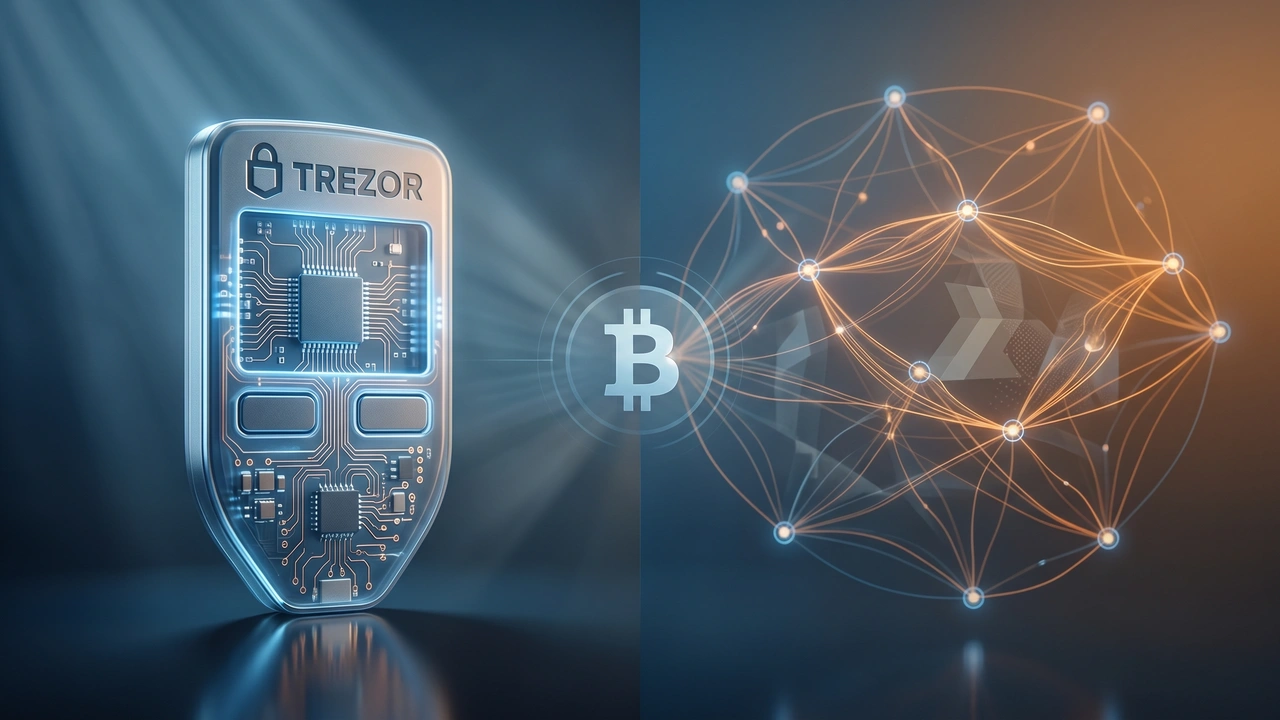
From peer-to-peer acquisition to hardware wallet vulnerability disclosure, Bitcoin's privacy ecosystem is maturing in ways that reward users who engage seriously with both the tools and the trade-offs.
Key Takeaways
- The biggest practical threat to Bitcoin privacy is not the protocol itself but the identity data collected by centralized intermediaries - choosing how you acquire bitcoin shapes your entire privacy posture.
- Peer-to-peer platforms like Bisq and local community trades offer meaningful privacy for routine accumulation, though trade sizes should be kept modest to limit counterparty risk.
- Running your own Bitcoin node is a prerequisite for serious on-chain privacy; tools like Sparrow Wallet, Silent Payments, and Payjoin layer additional protection on top of that foundation.
- The TROPIC01 vulnerability in the Trezor Safe 7 poses no danger to user funds - seed data is held in a separate architecture, and exploitation requires laboratory-grade hardware access far beyond any realistic attack scenario.
- Open-source hardware security produces better long-term outcomes than proprietary secrecy: vulnerabilities found by rivals and disclosed publicly are vulnerabilities that get fixed, not silently exploited.
Privacy Tools and Open Security: Bitcoin's Twin Frontiers in 2026
Two developments currently shaping the Bitcoin landscape share a deeper connection than they might appear to at first glance. On one side, a growing arsenal of privacy tools is giving ordinary holders meaningful ways to protect their financial sovereignty. On the other, a hardware vulnerability found in the Trezor Safe 7's custom chip has been handled with a transparency that most of the traditional financial industry could not imagine, let alone replicate. Together, they illustrate the same underlying principle: that openness - open code, open research, open disclosure - is Bitcoin's most durable defense.
The Facts
Bitcoin was never truly anonymous. It is more accurately described as pseudonymous - the network requires no personal information to operate, but the companies built around it routinely collect names, phone numbers, shipping addresses, and IP data to satisfy regulatory demands [1]. That creates a risk layer that has nothing to do with Bitcoin's core protocol and everything to do with the surveillance infrastructure wrapped around it. In countries like France, individuals who lawfully declared crypto holdings on their tax returns later found themselves targeted by home invasions, their public financial disclosures functioning as an inadvertent advertisement for criminals [1]. The threat landscape, in other words, varies sharply by jurisdiction and personal circumstance.
Acquiring bitcoin without leaving an identity trail is where most users stumble. Centralized exchanges survived years of regulatory and legal pressure precisely by over-collecting user data, crowding out the privacy-respecting alternatives that regulators repeatedly squeezed [1]. LocalBitcoins - widely credited as the originator of the peer-to-peer fiat-to-bitcoin model - operated for roughly a decade before Finnish regulatory pressure forced identity checks on its users around 2019, eventually culminating in its closure during the 2023 downturn [1]. Its successor in spirit, Bisq, answered that centralization risk by building a Tor-routed, decentralized trading network that continues operating today, processing an estimated $5 million monthly in volume - modest by institutional standards, but adequate for a consistent dollar-cost-averaging strategy [1]. Separately, Bitcoin communities in major cities offer a lower-tech alternative: cash-based peer trades with locals whose trust has been built over time, a method that leaves almost no digital record [1].
Once bitcoin is in a wallet, the privacy work is far from over. Public blockchains expose every transaction to analysis firms that attempt to map fund flows and link addresses to identities, particularly when exchange data enters the picture [1]. Running a personal Bitcoin node is a foundational countermeasure - without it, wallet software must query someone else's node, effectively announcing your addresses and balances to a third party [1]. Sparrow Wallet has emerged as a strong option for users who want to combine node connectivity with advanced features including Silent Payments, Payjoin support, and multi-signature account management [1]. Silent Payments, still in relatively early adoption, allow a recipient to publish a reusable address while the actual on-chain receiving address remains unlinkable to it by outside observers [1]. Payjoin, meanwhile, disrupts the pattern-recognition algorithms that blockchain analytics firms rely on by restructuring how transactions are assembled [1]. For those seeking off-chain solutions, the Lightning Network and eCash protocols - typified by wallets like Fedi and Cashu - leave no footprint on the base chain at all, though both require trusting counterparties to varying degrees [1].
The Trezor Safe 7 story runs on a parallel track. The device attracted attention when it launched as the first hardware wallet to incorporate TROPIC01, a secure-element chip with a fully auditable, open-source design - a deliberate departure from the proprietary, NDA-protected chips that dominate the industry [2]. Ledger's internal research team, known as Donjon, was engaged to evaluate the chip, and in late January 2026 informed Tropic Square - Trezor's sister company responsible for the chip - that a laser fault-injection technique had allowed them to extract certain chip-internal values [2]. Tropic Square then identified a second attack path capable of running custom firmware on the chip to pull out an additional secret [2]. The disclosure was handled in full public view, with Trezor releasing details to users before any rumors could circulate.
Critically, none of this translates into any danger for Safe 7 owners. Private keys and seed data are not stored inside the TROPIC01 chip; they live in a separate layer of the device's multi-component security architecture [2]. An attacker would need to defeat every independent protection layer simultaneously - a task requiring physical possession of the device, complete hardware disassembly, desoldering of components, removal of the chip casing, and specialized laser equipment operated by someone with deep hardware-attack expertise [2]. Trezor itself has acknowledged that phishing and seed-phrase exposure remain by a wide margin the more realistic threats facing typical users [2].
Analysis & Context
The Trezor-TROPIC01 episode is worth examining against how proprietary hardware vendors typically handle the same situation. Closed-source secure elements can and do contain undiscovered vulnerabilities - the difference is that those flaws often remain hidden for years, known only to sophisticated state-level actors or criminal organizations with the resources to find them quietly. The open-source model guarantees that any found weakness surfaces into the light, where it can be evaluated, contextualized, and fixed. That the discoverer was a commercial rival - Ledger - and that the disclosure was still handled cooperatively and publicly, is an encouraging sign about the norms developing around open hardware security. It also reinforces a pattern Bitcoin users should recognize: transparency is not a liability, it is the mechanism that makes trust verifiable.
The privacy tools landscape reflects a similar maturation. The closure of LocalBitcoins was widely interpreted at the time as a blow to financial privacy; in retrospect, it accelerated the development of more resilient, decentralized alternatives. Bisq's architecture was explicitly designed to survive the kind of regulatory pressure that killed its predecessor. That pattern - centralized tool gets shut down, decentralized replacement emerges with harder-to-attack design - has repeated itself across multiple Bitcoin privacy domains. Users who understand this cycle are better positioned to anticipate where the next generation of tools will come from and why certain design choices matter more than raw convenience.
Sources
AI-Assisted Content
This article was created with AI assistance. All facts are sourced from verified news outlets.