Debt, Inflation, and the Case for Hard Assets in 2026
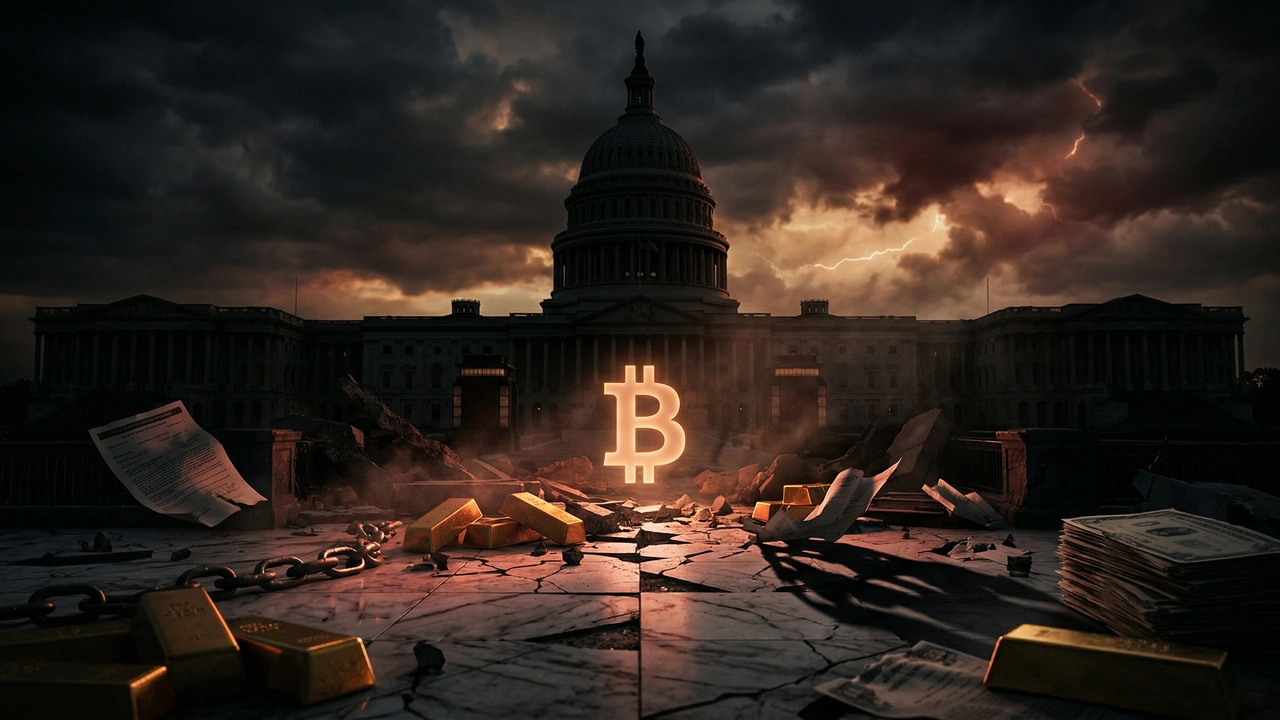
From America's $39 trillion debt burden to gold's historic correction and Bitcoin's role as a monetary hedge, a convergence of structural forces is reshaping how investors think about wealth preservation.
Key Takeaways
- The U.S. debt burden — now generating over $1 trillion in annual interest costs — is a structural driver of demand for inflation-resistant assets including Bitcoin and gold, not a temporary anomaly [2].
- Stablecoin issuers have become significant buyers of U.S. Treasuries, creating a fragile interdependency between the crypto sector and sovereign debt markets that could amplify stress in a risk-off environment [2].
- Gold's sharp March correction, despite record highs earlier in the year, does not appear to have dislodged institutional buyers; Goldman Sachs maintains its $5,400 year-end target, suggesting the broader monetary hedge thesis remains intact [1].
- Kiyosaki's framework — tracing today's debt and retirement crises to the 1974 decoupling from gold and pension system restructuring — reinforces Bitcoin's long-term narrative as a hedge against systemic monetary mismanagement [3].
- Elevated bearish sentiment on Bitcoin, as measured by social media analytics, has historically been a contrarian indicator of impending recoveries; investors focused on macro fundamentals may view current weakness as an entry opportunity rather than a trend reversal [3].
The Old Financial Order Is Breaking Down — and Bitcoin Is Watching
The signs have been accumulating for years, but in 2026 they are impossible to ignore. The United States is paying more than $1 trillion annually just to service its debt. Gold reached an all-time high before suffering its worst monthly decline in over a decade. And Robert Kiyosaki — the author whose financial philosophy shaped a generation — is pointing to a 1974 policy decision as the root cause of today's crisis. These are not isolated headlines. They are fragments of the same story: a global financial architecture under severe stress, and a growing consensus that hard, scarce assets may be the last line of defense for ordinary savers.
For Bitcoin investors, this backdrop is not noise — it is signal. Understanding the structural forces at play is essential to grasping why Bitcoin's long-term value proposition has never been more relevant, even as short-term sentiment wavers.
The Facts
America's debt crisis is no longer a future concern — it is a present fiscal emergency. The United States currently carries approximately $39 trillion in total debt, and interest payments alone now exceed $1 trillion per year [2]. This extraordinary cost of borrowing has created a politically charged environment in which President Donald Trump has publicly pressured the Federal Reserve to lower interest rates in an attempt to ease the burden [2]. The fiscal math is brutal: every percentage point of elevated rates compounds the cost of refinancing an ever-growing pile of obligations.
Into this gap have stepped an unlikely set of buyers: stablecoin issuers. Operators like Tether and Circle, who must back their dollar-denominated tokens with liquid reserves, have collectively parked more than 80 percent of their reserves in short-term U.S. Treasuries and repurchase agreements [2]. This makes stablecoin issuers among the most significant new purchasers of U.S. government debt — a dynamic that benefits Washington as long as capital continues flowing into the crypto sector. However, analysts caution that this relationship is inherently fragile. A stress event triggering mass stablecoin redemptions could force issuers to liquidate Treasuries at precisely the wrong moment, amplifying rather than cushioning a broader market shock [2].
Meanwhile, gold — historically the premier monetary hedge — experienced a dramatic repricing. After reaching an all-time high above $5,400 per ounce in January, the precious metal suffered a monthly decline exceeding ten percent in March, its steepest drop in more than a decade [1]. Despite this correction, Goldman Sachs maintained its price target of $5,400 by end-2026, arguing that the underlying buyers — predominantly long-term institutional investors and central banks accumulating reserves — remain committed [1]. The correction, in Goldman's view, reflects a temporary headwind from a stronger U.S. dollar and elevated interest rates rather than a fundamental shift in demand.
Robert Kiyosaki has offered a sweeping historical frame for these developments. In a recent post on X, he argued that the pivotal year was 1974, when the United States cemented the petrodollar framework after abandoning the gold standard, while simultaneously passing the Employee Retirement Income Security Act [3]. That legislation accelerated the shift away from defined-benefit pensions toward market-linked retirement accounts such as 401(k)s, transferring investment risk from institutions to individuals. Kiyosaki warns that millions of baby boomers are now approaching retirement with insufficient income security as a result [3]. His prescription: prioritize financial education and consider allocating to gold, silver, and Bitcoin — assets he characterizes as "real money" [3].
Analysis & Context
What connects these developments is a single underlying dynamic: the progressive erosion of trust in fiat monetary systems and the institutions that manage them. Kiyosaki's reference to 1974 is more than nostalgia — it marks the moment the dollar became fully untethered from physical constraints, enabling the debt expansion that has culminated in today's trillion-dollar interest bill. Every structural problem visible in 2026, from unsustainable sovereign borrowing to inadequate retirement savings, traces its lineage to that pivot.
For Bitcoin specifically, this environment is the use case made manifest. Bitcoin was designed precisely for this scenario: a monetary asset with a hard supply cap of 21 million coins, immune to the political pressures that compel central banks to inflate. History offers instructive parallels. During the 2020–2021 period, when the Federal Reserve expanded its balance sheet aggressively in response to the pandemic, Bitcoin surged from under $10,000 to nearly $70,000. The mechanism Kiyosaki describes — expanding money supply driving demand for scarce assets — played out almost textbook-perfectly. His projection of Bitcoin reaching $750,000 within a year of a major financial crisis may read as sensational, but the directional logic is consistent with Bitcoin's behavior during previous liquidity expansions [3].
The stablecoin-Treasury dynamic adds a fascinating and underappreciated layer to this analysis. The fact that crypto-native instruments are now structurally intertwined with U.S. government debt markets signals that Bitcoin and the broader digital asset ecosystem have moved beyond the periphery of global finance. Ironically, Washington's willingness to embrace stablecoin regulation may be partly motivated by fiscal necessity — a desire to lock in a new class of captive Treasury buyers. Bitcoin, which cannot be conscripted into this arrangement, stands apart. It offers no yield, makes no promises to governments, and owes its value to nothing other than decentralized consensus and mathematical scarcity. In a world where even monetary hedges are being quietly co-opted by sovereign debt dynamics, that independence is increasingly rare and increasingly valuable.
Bearish sentiment around Bitcoin has climbed to its highest level since late February 2026, with the ratio of bullish to bearish social media commentary dropping to 0.81 according to analytics platform Santiment [3]. Contrarian analysis suggests this type of sentiment extreme has historically preceded price recoveries — a dynamic well-documented across Bitcoin's prior market cycles. Whether this cycle follows the same script remains to be seen, but the macro backdrop arguably provides more fundamental support for a recovery than at any previous sentiment trough.
Sources
AI-Assisted Content
This article was created with AI assistance. All facts are sourced from verified news outlets.