DeFi's Security Crisis: State Hackers, AI Exploits, and a $1.22 Problem
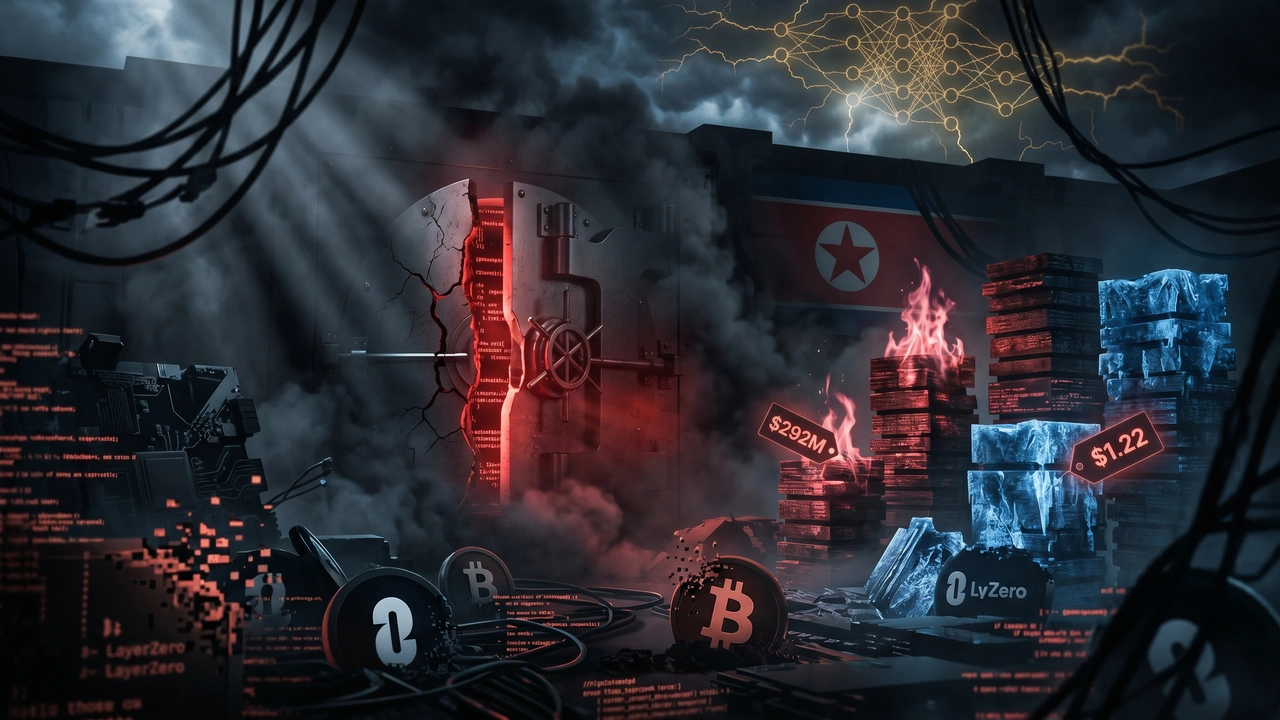
A $292 million hack attributed to North Korea's Lazarus Group and warnings that AI could slash the cost of breaking DeFi to just $1.22 expose a deepening structural vulnerability threatening the entire sector's future.
Key Takeaways
- Lazarus Group raises the stakes: The alleged North Korean involvement in the $292 million Kelp DAO hack confirms that DeFi protocols are now geopolitical targets, not merely honeypots for opportunistic criminals — demanding security responses of a fundamentally different caliber [1].
- Infrastructure is the new attack surface: Both major recent hacks exploited teams, trust relationships, and peripheral systems rather than core smart contract code, invalidating the assumption that a clean audit makes a protocol safe [1][2].
- AI is shifting the offense-defense balance: With tools like Anthropic's Mythos Preview demonstrating automated vulnerability discovery and exploitation, the marginal cost of attacking DeFi protocols is declining sharply — the "$1.22" framing is provocative but points to a real and accelerating trend [2].
- Single points of failure remain a critical liability: Kelp DAO's architecture, which lacked independent verification nodes to catch forged messages, illustrates how configuration choices — not just code quality — can be the decisive vulnerability [1].
- The industry must move from periodic audits to continuous defense: Static code reviews are increasingly insufficient; the path forward requires shared security standards, real-time monitoring infrastructure, and AI-assisted threat detection deployed at the protocol level [2].
When $292 Million Vanishes and AI Costs $1.22: DeFi's Existential Security Reckoning
Two developments have collided this week to force a long-overdue reckoning in the decentralized finance world. A sophisticated state-sponsored attack drained roughly $292 million from Kelp DAO, allegedly orchestrated by North Korea's Lazarus Group, while security analysts are simultaneously raising alarms that artificial intelligence could soon make large-scale DeFi exploitation trivially cheap. Together, these stories don't just describe isolated incidents — they sketch the outline of a systemic crisis that threatens to cap the growth of one of crypto's most ambitious experiments.
The uncomfortable truth emerging from both developments is this: DeFi's security assumptions were built for a different threat environment. What worked in 2021 is dangerously inadequate for 2025, and the window for the industry to adapt may be closing faster than most participants realize.
The Facts
LayerZero has publicly attributed the weekend attack on Kelp DAO — which resulted in losses of approximately $292 million — to a sophisticated state-sponsored actor, stating that "preliminary evidence points to a highly advanced state actor, likely the Lazarus Group from North Korea" [1]. The company clarified that the breach was confined to Kelp DAO's rsETH configuration and explicitly noted there were "no contagion effects on other cross-chain assets or applications" [1].
The technical anatomy of the attack reveals a sobering level of sophistication. Rather than exploiting a flaw in LayerZero's core protocol, the attackers targeted surrounding infrastructure. According to LayerZero, the perpetrators gained access to a list of RPC nodes, compromised two of them, and replaced the software running on those systems with manipulated versions that fed false transaction data into the protocol [1]. Simultaneously, other parts of the infrastructure were neutralized through targeted denial-of-service attacks. LayerZero pointed directly at Kelp DAO's architectural choices as the enabling vulnerability: "Operating a single-point-of-failure configuration meant there was no independent verifier present to detect and reject a forged message" [1]. The company also noted that prior recommendations to implement stronger security measures had gone unheeded.
This incident does not stand alone. In a widely circulated post, the founder of Dexu — an AI-powered social analytics platform — warned that DeFi faces a far broader threat profile than smart contract bugs alone [2]. The Drift Protocol hack, in which alleged North Korean actors reportedly spent months cultivating trust before extracting approximately $285 million, was cited as a prime example of how teams, operational processes, and infrastructure have become as attractive a target as the code itself [2].
The AI dimension of the threat is where the debate turns genuinely alarming. Anthropic's recently introduced system "Mythos Preview" has demonstrated an ability to identify severe software vulnerabilities at scale and, in controlled tests, to execute exploits with high accuracy [2]. Research from Anthropic conducted in late 2025 showed that AI agents' success rates at exploiting certain smart contract vulnerabilities climbed sharply within a single year [2]. The Dexu founder's provocation — that the cost of "breaking DeFi" now stands at just $1.22 — distills this trajectory into a single, sobering number: as AI tooling becomes more capable and accessible, the capital required to mount an attack approaches zero [2].
Analysis & Context
The Lazarus Group's involvement, if confirmed, fits a well-documented pattern. North Korean state hackers have systematically targeted crypto infrastructure for years, with the United Nations estimating the regime has stolen billions in digital assets to fund its weapons programs. What has evolved is their methodology. Early Lazarus operations often relied on brute-force exchange hacks; the Kelp DAO and Drift Protocol incidents represent a generational leap in sophistication — patient, multi-vector campaigns that exploit human trust and peripheral infrastructure rather than frontal assaults on audited code. The industry's response has not kept pace.
The AI threat layer compounds this in ways the industry has barely begun to internalize. Historically, DeFi security operated on an asymmetry that slightly favored defenders: writing and auditing correct code was hard, but so was finding and exploiting vulnerabilities at scale. AI is eroding that asymmetry from the attacker's side. If models can systematically scan thousands of protocol deployments, identify exploitable conditions, and generate functional attack transactions autonomously — all at negligible cost — then the "audit and hope" model doesn't just become insufficient, it becomes actively misleading. It creates a false sense of security that could accelerate capital deployment into protocols that are fundamentally undefended against next-generation threats. For Bitcoin specifically, this dynamic is instructive rather than directly threatening — Bitcoin's deliberately minimal scripting environment and its lack of complex DeFi contracts make it structurally resistant to exactly the class of attacks devastating the broader sector. In an environment of escalating DeFi risk, Bitcoin's conservative design philosophy looks less like a limitation and more like a considered engineering choice.
The broader market implication is a potential trust ceiling on DeFi adoption. Retail and institutional participants alike require some threshold of confidence that their capital is not perpetually exposed to state-sponsored hackers or AI-powered exploit factories. When that confidence erodes, the barriers to DeFi participation become psychological and structural, not just technical — and no amount of improved user interfaces or higher yields can fully compensate for genuine existential risk.
Sources
- [1]btc-echo.de
- [2]btc-echo.de
AI-Assisted Content
This article was created with AI assistance. All facts are sourced from verified news outlets.