DeFi Under Legal Fire: Courts Become Crypto's New Battlefield
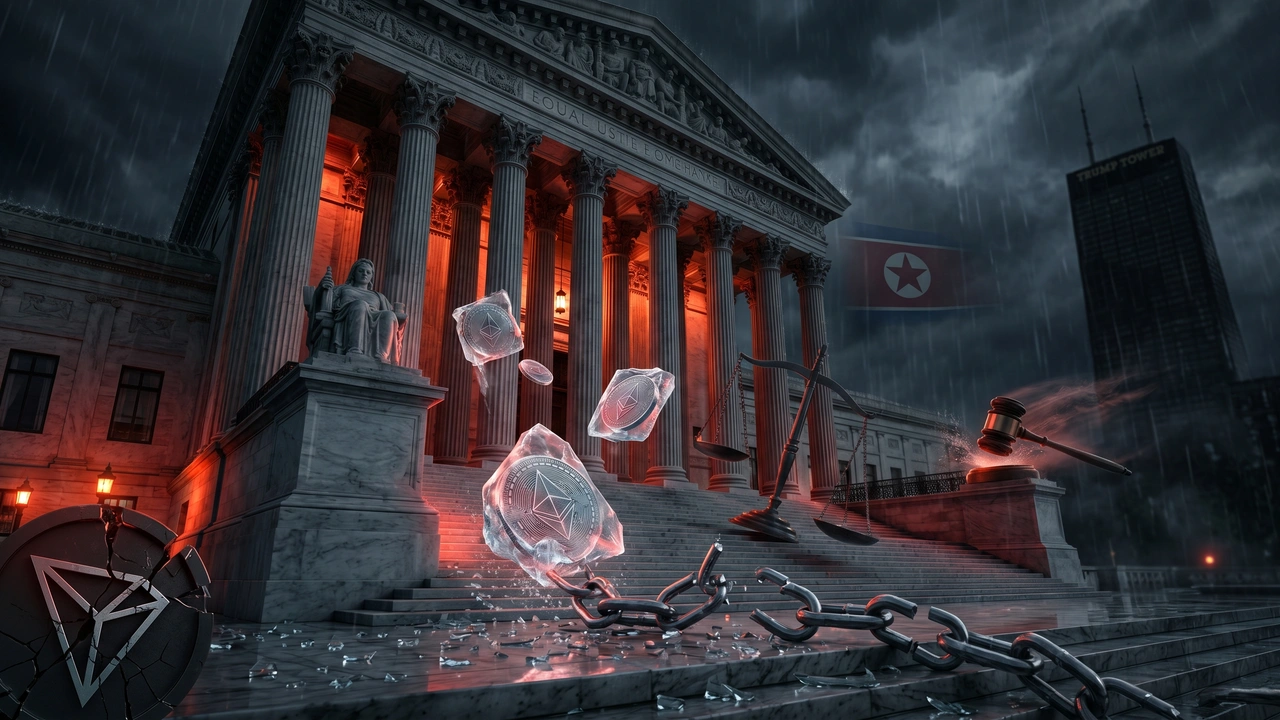
From frozen Ether linked to North Korean hackers to a bitter feud between the Trump family's DeFi project and Justin Sun, two high-profile legal battles signal that courts are increasingly shaping the future of decentralized finance.
Key Takeaways
- The Aave case sets a potentially dangerous precedent: US courts can freeze DeFi recovery funds based on alleged links to North Korean hackers, directly harming innocent users who had nothing to do with the original attack [1].
- DeFi protocols operating under any US legal jurisdiction should now consider that hack-related asset recovery processes may be subject to third-party legal claims, adding a new layer of operational and legal risk.
- The WLFI versus Justin Sun conflict illustrates how governance disputes in politically exposed crypto projects can escalate into costly, reputation-damaging legal battles that create sustained market uncertainty [2].
- Sun's alleged behavior - using bots and influencers to manipulate token prices - if proven, would represent one of the more brazen examples of coordinated market manipulation in recent DeFi history, and the outcome could influence how similar conduct is treated legally going forward [2].
- Both cases together signal that DeFi's next major challenge is not technical but legal: protocols need to anticipate courtroom risks with the same rigor they apply to smart contract audits.
DeFi Under Legal Fire: Courts Become Crypto's New Battlefield
Decentralized finance was built on the promise of operating beyond the reach of traditional legal and financial systems. That promise is being tested in real time. Two separate but thematically connected legal disputes are now forcing crypto protocols into courtrooms, raising fundamental questions about who owns digital assets, who controls them, and who bears responsibility when things go wrong. The outcomes could define the legal architecture of DeFi for years to come.
What makes these cases particularly significant is not just the sums of money involved - though they are substantial - but the precedents they threaten to set. When courts start dictating who can access funds sitting in DeFi protocols, the entire value proposition of permissionless, trustless finance comes under scrutiny.
The Facts
The first case centers on Aave, one of DeFi's most established lending protocols. Aave has filed an emergency motion in a US federal court seeking the release of approximately 30,766 ETH, valued at roughly $73 million, that were frozen following a hack of the KelpDAO protocol [1]. A court order issued on May 1st currently prevents these funds from being distributed back to the users who were harmed in the attack [1].
The legal pressure stems from a claim by the US law firm Gerstein Harrow, which represents plaintiffs holding existing damages judgments against North Korea [1]. The firm argues it has a right to the frozen assets on the grounds that the attackers behind the KelpDAO exploit are connected to North Korea's notorious Lazarus Group [1]. The hack itself exploited a vulnerability in a cross-chain bridge associated with the rsETH token, draining approximately $230 million in Ether from the Aave protocol before some of those funds were later recovered [1].
Aave is pushing back firmly. In its court filing, the protocol argues that even if North Korean actors were involved, that connection alone does not create a valid ownership claim over the assets [1]. The core argument is straightforward: the Ether belongs to the users who suffered losses, not to holders of third-party judgments against a foreign government. Aave has also warned that continued blocking of these funds would not only hurt individual victims but could undermine the broader functioning of the DeFi ecosystem [1].
The second dispute is playing out with far more drama. World Liberty Financial (WLFI), the DeFi project backed by the Trump family, has filed a defamation countersuit against Tron founder Justin Sun [2]. Filed on May 4th, the suit accuses Sun of launching what WLFI's lawyers describe as a "scorched earth campaign" against the project after his token holdings - worth approximately $240 million at current prices - were frozen [2]. According to the complaint, Sun allegedly used social media, influencers, and bots to systematically damage WLFI's reputation, and even reportedly stated his intention to drive the token price "into the dirt" [2].
The backstory adds another layer of complexity. Sun himself had filed a lawsuit against WLFI at the end of April, accusing the project of fraudulently blocking the sale of his crypto positions [2]. WLFI's countersuit alleges that Sun, through his company Blue Anthem, violated contractual obligations by purchasing tokens on behalf of other investors, making unauthorized transfers to Binance, and conducting short sales [2]. The protocol insists the freezing of Sun's wallet in September 2025 was a legitimate contractual response that was clearly disclosed in the terms of sale [2]. Sun, for his part, dismissed the countersuit as a "meaningless PR stunt" and said he looks forward to winning in court [2].
Analysis & Context
These two cases represent something larger than individual disputes over money. They mark a turning point where DeFi's collision with legacy legal systems is no longer theoretical. For years, the standard argument in crypto circles was that smart contracts replace legal contracts - code is law, and the blockchain is the final arbiter. Both of these cases expose the limits of that argument. Courts are now issuing orders that effectively override protocol logic, freezing assets that smart contracts would otherwise release automatically.
The Aave situation is particularly instructive for the broader Bitcoin and crypto ecosystem. The Lazarus Group angle is not new - US authorities have long used North Korea's alleged hacking operations as a vector for asset seizure claims. But applying that logic to freeze funds owed to innocent DeFi users sets a troubling precedent. If any hack with a potential North Korean connection can trigger a freeze on recovery funds, recovery efforts become legally precarious for any protocol operating under US jurisdiction. This is a structural risk that Bitcoin maximalists have long warned about: once you bring assets into systems that touch US courts, you inherit US legal exposure.
The WLFI versus Sun drama operates on a different frequency. It is less a test of DeFi's legal framework and more a case study in what happens when high-profile, politically connected actors enter the space. The involvement of the Trump family has always made WLFI a target for scrutiny, and a public war with one of crypto's most controversial figures in Justin Sun - himself under scrutiny from the SEC on separate matters - is the kind of spectacle that draws regulatory attention. For the broader market, legal fights of this nature tend to introduce uncertainty and suppress appetite for risk in affected tokens. More broadly, they remind investors that governance disputes in DeFi projects can escalate quickly and unpredictably.
Sources
- [1]btc-echo.de
- [2]btc-echo.de
AI-Assisted Content
This article was created with AI assistance. All facts are sourced from verified news outlets.