DeFi's Dual Crisis: Protocol Innovation Races Against a Security Meltdown
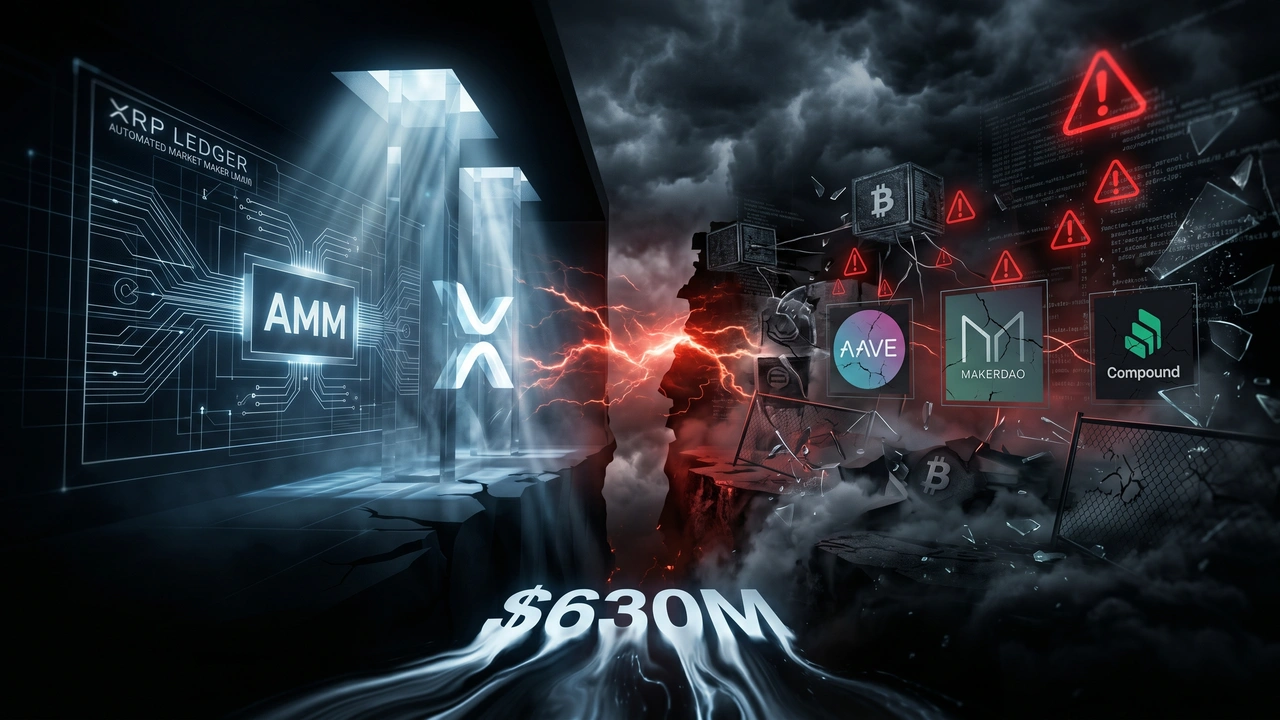
As the XRP Ledger prepares a sweeping overhaul of its automated market maker, a leading security expert warns that all of DeFi is structurally broken - raising a fundamental question about whether the industry can build fast enough to outrun its own vulnerabilities.
Key Takeaways
- The XRP Ledger's AMM v2 proposal targets real inefficiencies - flexible liquidity mechanisms and better capital deployment - but it adds protocol complexity at a moment when the broader DeFi ecosystem is hemorrhaging capital to exploits [1].
- A co-founder of OpenZeppelin, one of the most respected names in smart contract auditing, has declared the entire DeFi market structurally unsafe - and is advising personal contacts to exit even blue-chip protocols like Aave, MakerDAO, and Compound [2].
- Approximately $630 million was lost to DeFi exploits in April 2025 alone, while Total Value Locked dropped by nearly $24 billion over the same period - direct losses and eroding trust are now compounding each other [2].
- The core security problem is not per-protocol but systemic: DeFi's composability model means each new upgrade expands an interdependent attack surface that defenders cannot fully audit in advance.
- The widening gap between the pace of protocol innovation and the pace of security infrastructure development is the most consequential structural risk facing DeFi today.
DeFi's Dual Crisis: Protocol Innovation Races Against a Security Meltdown
Two developments landed this week that together paint a precise picture of where decentralized finance stands in mid-2025: ambitious infrastructure upgrades on one side, a mounting security catastrophe on the other. The gap between those two realities is widening fast - and the industry has no credible plan to close it.
The Facts
The XRP Ledger Foundation published a detailed proposal on May 26 for a major redesign of the network's Automated Market Maker system, referred to as AMM v2 [1]. The proposal targets the core mechanics of how trades are settled on the ledger's built-in decentralized exchange, and its ambition is notable: rather than locking liquidity providers into a single pricing model, the upgrade would allow them to switch between different mechanisms depending on prevailing market conditions [1]. The practical promise is lower trading costs for end users and reduced price volatility - both long-standing pain points for on-chain trading venues [1]. Crucially, the proposal also argues that capital could be deployed more efficiently under the new framework, concentrated where actual demand exists rather than spread uniformly across a price curve [1]. Whether or not the upgrade proceeds depends on the network's validator voting process, meaning adoption is not guaranteed [1].
While XRP developers are optimizing for efficiency, the broader DeFi ecosystem is grappling with a more urgent problem. Manuel Aráoz, co-founder of smart contract security firm OpenZeppelin, stated flatly this week that he considers the entire DeFi market to be unsafe [2]. Aráoz - whose firm has audited code underlying a significant portion of the DeFi ecosystem - said he is now advising people in his personal network to exit their positions entirely, including exposure to protocols as established as Aave, MakerDAO, and Compound [2]. The warning did not come out of nowhere. In April alone, approximately $630 million was drained from DeFi protocols, according to DefiLlama data [2]. Two incidents dominated that figure: an attack on Drift totaling around $285 million, and an exploit targeting Kelp DAO worth roughly $293 million [2].
The capital destruction is showing up in aggregate metrics. Total Value Locked across DeFi fell from approximately $172 billion in mid-April to around $148 billion - a drawdown of nearly $24 billion in a matter of weeks [2]. That decline reflects a combination of direct losses and the broader risk-off sentiment triggered by high-profile breaches. The trend is self-reinforcing: as trust erodes, capital retreats, which narrows the revenue base that protocols depend on to fund ongoing security work.
Aráoz framed the underlying structural problem with unusual clarity. His argument rests on a fundamental asymmetry: defenders must identify and patch every single vulnerability in a system, while attackers need find only one [2]. In a composable, permissionless environment where code is public and stakes are high, that asymmetry systematically favors the attacker. It is not a problem solvable through incremental auditing - it is a design-level challenge.
Analysis & Context
The timing of these two developments is not coincidental - it reflects the permanent tension inside DeFi between two competing impulses. Protocols are under relentless pressure to add features, attract liquidity, and differentiate themselves in a crowded market. Each new capability, from concentrated liquidity pools to cross-chain bridges to restaking derivatives, expands the attack surface. The XRP Ledger's AMM v2 proposal is a textbook example of this dynamic: a well-intentioned upgrade that adds optionality and complexity in equal measure.
Historically, the AMM model has undergone exactly this pattern of iterative expansion followed by exploitation. When major DEX platforms introduced concentrated liquidity mechanisms, they dramatically improved capital efficiency - but also introduced new edge cases around position management and fee accounting that security researchers picked apart over subsequent months and years. The XRP Ledger is now walking a similar path: the v1 AMM was only integrated into the live network in early 2024, and before the ecosystem has had years to stress-test it under adversarial conditions, a v2 is already on the table. Speed of iteration is a competitive necessity, but it compresses the time available for the kind of adversarial review that catches subtle bugs before they become nine-figure headlines.
Aráoz's alarm should be read against the long arc of DeFi security history. Notably, analysts at The Block have observed that in the current cycle, DeFi hack losses have not risen in lockstep with TVL - which they described as "a key divergence from earlier cycles, where rising TVL usually meant more successful attacks". That divergence may now be reversing. The April 2025 losses, concentrated into just two incidents worth nearly $580 million combined, suggest attackers are operating at institutional scale and coordination [2]. The pattern has been consistent across DeFi's history: TVL growth attracts exploiters at a roughly proportional rate, and no amount of auditing has permanently broken that relationship.
There is a common misreading to push back on here. Media coverage tends to frame each major hack as an isolated failure - a specific team's coding error, a rushed audit, an overlooked edge case. Aráoz's broader point is that this framing misses the root cause. The vulnerability is not in individual protocols; it is in the composability model itself. When lending platforms interact with liquidity pools that interact with price oracles reading from thinly traded markets, the security of any one piece is not independent of the others. A flaw anywhere in that chain can cascade system-wide. This is precisely the environment the XRP Ledger is trying to compete in by making its own AMM more sophisticated - and the irony is that every improvement raises the stakes for getting the next detail wrong.
The forward-looking implication is this: DeFi is approaching a credibility threshold. If large-scale exploits continue at their current pace, institutional capital - which has been cautiously entering the space - will find it rational to treat DeFi exposure as effectively uninsurable. That would not kill the sector, but it would bifurcate it sharply between well-resourced protocols that can afford continuous formal verification and the long tail of projects that cannot. Protocol upgrades like AMM v2, however technically sound in isolation, cannot substitute for the systemic security architecture that DeFi still fundamentally lacks.
Sources
- [1]btc-echo.de
- [2]btc-echo.de
AI-Assisted Content
This article was created with AI assistance. All facts are sourced from verified news outlets.