The Two Faces of Crypto Crime: Staged Trust and Physical Force
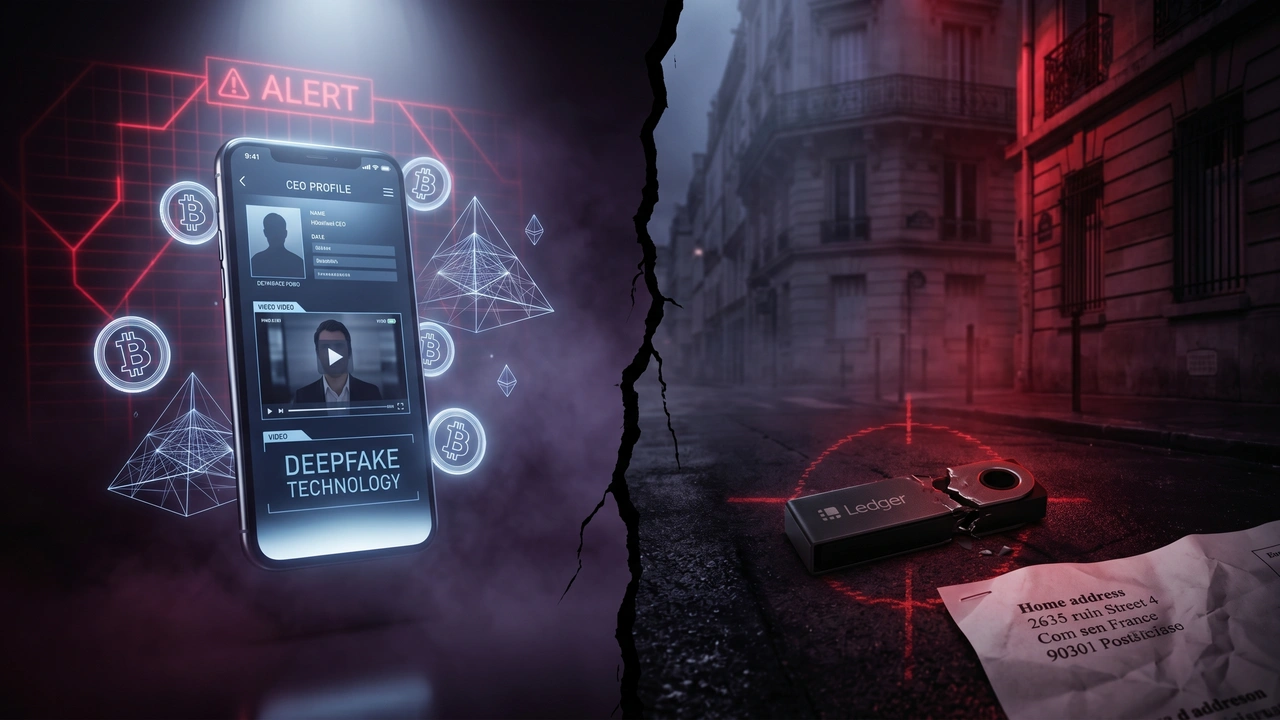
From fake CEOs luring billions into a crypto pyramid scheme to armed kidnappers hunting down Bitcoin holders in France, two landmark cases expose a single uncomfortable truth: owning cryptocurrency has never been more dangerous - on-screen or in the street.
Key Takeaways
- The 2020 Ledger breach demonstrates that centralized KYC databases are not just a privacy liability but a direct physical safety risk - attackers now use stolen customer records to identify and locate crypto holders in the real world.
- France's extraordinary concentration of wrench attacks (roughly 70 percent of global cases) shows how a single data-exposure event can seed years of downstream violence when organized crime networks acquire the resulting dossier.
- HyperVerse's $1.89 billion damage figure places it among the largest documented crypto frauds, and its use of a fictional CEO, fabricated credentials, and a celebrity cameo underscores how far sophisticated schemes will go to manufacture institutional legitimacy.
- The serial reappearance of HyperVerse's central figure under new project names in a lighter-touch regulatory jurisdiction is a pattern investors should treat as a structural warning sign, not an isolated curiosity.
- Both cases argue for the same core investor discipline: scrutinize who holds your personal data, question every yield guarantee, and treat social-proof credibility - including celebrity association - as a manipulation vector until independently verified.
The Two Faces of Crypto Crime: Staged Trust and Physical Force
The threat landscape facing cryptocurrency holders in 2025 and 2026 has evolved along two distinct but equally alarming lines. One is digital - meticulously choreographed fraud that weaponizes celebrity proximity and community pressure to extract billions from retail investors. The other is brutally physical - organized gangs targeting known crypto holders at home, often armed with nothing more sophisticated than the threat of violence. Together, these developments reveal an industry still struggling to protect the people it has attracted.
The connecting thread is data. Whether a scammer needs to manufacture credibility or a criminal needs a home address, the raw material is information - and the crypto industry has repeatedly shown it cannot safeguard it.
The Facts
France has become the global center of what security researchers call wrench attacks - physical assaults on cryptocurrency owners designed to coerce access to digital funds. According to reporting by Bitcoin journalist Joe Nakamoto, roughly 70 percent of all documented cases worldwide are now occurring on French soil [1]. In 2026 alone, the country has already recorded 41 crypto-linked kidnappings, a pace that works out to approximately one incident every two and a half days [1].
Investigators and industry observers frequently point to a single catalytic event: the 2020 data breach at hardware wallet manufacturer Ledger, in which the personal records of more than 270,000 customers - including home addresses, phone numbers, and email addresses - were published online [1]. That database effectively handed organized criminal networks a ready-made target list. Many of the attacks, Nakamoto reports, are coordinated by overseas criminal groups that recruit young people locally inside France to carry out the physical operations [1].
The HyperVerse case represents the other extreme of crypto criminality - elaborate, slow-burning, and operating entirely through manufactured legitimacy. At the center of the scheme is Sam Lee, who built HyperVerse and its predecessor HyperFund into a worldwide network of investors, promoters, and referral recruiters over several years [2]. U.S. authorities now allege that Lee and a business partner lured investors with unrealistic return promises, funding earlier payouts with newly recruited capital - a structure the SEC explicitly labels a pyramid scheme with a multi-level referral model [2]. The regulator has put the total investor damage at approximately 1.89 billion dollars [2].
What made HyperVerse uniquely audacious was the casting of a fictional CEO. The platform presented a figure named Steven Reece Lewis to the world as its chief executive, complete with a fabricated biography and professional history. Regulators and international media later confirmed the individual was reportedly a Thai actor hired to play the role [2]. Compounding the deception, a personalized video cameo featuring Apple co-founder Steve Wozniak was deployed heavily in HyperVerse marketing materials, creating a powerful impression of high-profile endorsement. Wozniak subsequently clarified that the video had been a personal custom order and carried no commercial relationship with the platform [2] - but by then, for most investors, the damage was done.
Analysis & Context
These two stories inhabit different corners of the crypto crime universe, but they share a structural root: the industry's chronic inability to protect sensitive holder data, and the ease with which the promise of financial independence can override basic due diligence. The Ledger breach is now widely regarded as one of the most consequential data security failures in crypto history. Unlike exchange hacks that drain funds directly, the 2020 incident exposed something arguably more dangerous in the long run - the physical identities of people known to own significant digital assets. The current wave of French kidnappings is, in a very real sense, the delayed human cost of that single corporate security failure.
The pattern of wrench attacks is not new, but the concentration in one country is remarkable. Security researcher Jameson Lopp has maintained a publicly documented database of physical crypto attacks for years, and the trajectory has tracked closely with Bitcoin's price appreciation - a grim reminder that rising valuations draw not just institutional interest but criminal attention. The French situation suggests that when a high-density, identifiable population of crypto holders exists in a jurisdiction - and organized crime networks have a usable dossier to work from - the results can be catastrophic.
The HyperVerse anatomy fits a well-worn playbook that stretches back at least to BitConnect's collapse in 2018, and echoes the implosion of Terra/LUNA in 2022. Each of those episodes shared core mechanics: early investors received genuine payouts (funded by later entrants), community euphoria suppressed skepticism, and by the time withdrawals froze, the architects were either unreachable or operating under new branding. HyperVerse added a theatrical layer - a fictitious executive, scripted Zoom events with hundreds of attendees, and social pressure inside closed community groups - that made it harder for individual investors to distinguish the performance from the product [2]. Sam Lee's subsequent reappearance in Dubai under the banners of HyperOne, Stable DAO, and Vidilook illustrates a recurring dynamic: regulatory arbitrage, where actors accused of fraud in one jurisdiction simply relocate to lighter-touch environments [2]. The UAE's removal from the FATF grey list in 2024 improved its formal standing, but critics argue enforcement gaps remain wide enough for sophisticated actors to exploit [2].
The disambiguation worth making for readers: neither story is an argument against Bitcoin itself. What both cases indict is the infrastructure built around it - centralized custodians and registries that aggregate sensitive personal data, and an investment culture where social proof and influencer proximity routinely substitute for transparent financials. The fix for wrench attacks is not a different blockchain; it is better operational security and a rethink of how KYC data is stored and protected. The fix for the next HyperVerse is not new regulation alone; it is an investor community trained to treat manufactured celebrity endorsements and guaranteed yield promises as immediate red flags rather than signals of credibility.
Sources
- [1]btc-echo.de
- [2]btc-echo.de
AI-Assisted Content
This article was created with AI assistance. All facts are sourced from verified news outlets.