Enterprise Blockchain Heats Up - and the Token War Has No Winner Yet
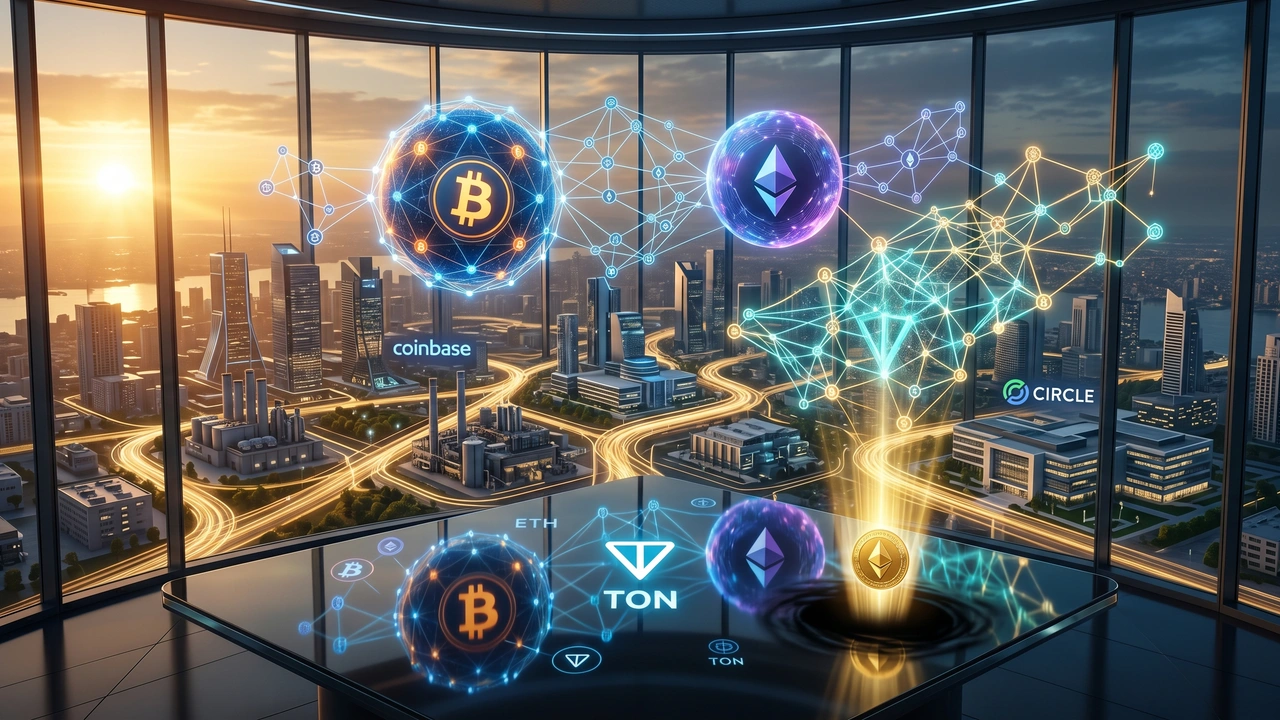
Kevin O'Leary sees S&P 500 companies as the next frontier for blockchain, while Telegram's Pavel Durov revives the Gram name for TON - two signals that corporate adoption and token identity are converging at the center of crypto's next chapter.
Key Takeaways
- O'Leary believes the enterprise blockchain race is the defining investment theme of the next market cycle - not specific coins, but the underlying network that captures Fortune 500 workflows across supply chain, logistics, and contract management.
- He has not named a winning chain yet, but his framework is clear: the first network with customers across all eleven S&P 500 sectors is the one worth backing through its native token.
- A Coinbase survey puts the share of Fortune 500 executives who have active blockchain initiatives at nearly 60 percent, providing hard evidence that O'Leary's thesis is grounded in real corporate behavior rather than speculation.
- TON's planned rename from Toncoin to Gram - reviving the original 2018 token identity that the SEC once forced off the table - signals growing confidence that the regulatory environment has fundamentally shifted in crypto's favor.
- TON's technicals currently suggest consolidation, not a breakout: holding above the $1.920 support level is the near-term priority, while a sustained close above $2.282 would be needed to confirm any resumption of the broader uptrend.
Enterprise Blockchain Heats Up - and the Token War Has No Winner Yet
Two stories dominated crypto headlines this week that, on the surface, look unrelated: a veteran investor laying out his thesis for the next blockchain champion, and a messaging-app billionaire resurrecting a token name that regulators once forced him to bury. Read together, they illuminate a single, larger tension running through the industry - the race to decide which blockchain wins the corporate world, and what happens to the tokens tied to that outcome.
The stakes could hardly be higher. Corporate blockchain deployment is no longer a futurist talking point; it is a measurable, accelerating trend. And wherever institutional demand flows, token valuations follow.
The Facts
Kevin O'Leary, the investor and entrepreneur best known from Shark Tank, has staked out a clear position on where blockchain's next wave of value will be created - not in any one coin, but in large-scale corporate deployment across every sector of the economy [1]. In a clip published on X, O'Leary argued that the real prize is the blockchain that can simultaneously serve companies in all eleven S&P 500 sectors - from energy to financial services to technology [1]. His thesis is deceptively simple: whichever network achieves that kind of cross-sector penetration first stands to become the defining winner of the coming market phase [1].
What makes O'Leary's view credible is the data underpinning it. A Coinbase survey found that nearly six in ten Fortune 500 executives have blockchain projects underway at their firms, and one in five described on-chain initiatives as a core pillar of their corporate strategy [1]. O'Leary himself has skin in that ecosystem - his holdings include stakes in Circle, Coinbase, and Robinhood, all infrastructure-layer plays rather than speculative token bets [1]. He continues to treat Bitcoin and Ethereum as the two anchor assets of the sector, but is explicit that a third, enterprise-focused network could emerge as the critical winner [1]. Crucially, he has not identified a favorite yet - and says investors should watch closely for the moment one chain can claim clients across all eleven S&P sectors, because that is when he would move decisively into its native token [1].
Meanwhile, from a very different corner of the blockchain world, Telegram founder Pavel Durov announced on June 1 that The Open Network - better known as TON - plans to rename its native token from Toncoin back to Gram, its original designation from the 2018 whitepaper [2]. The rebrand, which Durov posted directly to Telegram, is expected to complete within roughly three weeks, and an in-progress vote showed approximately 80 percent of participating holders supporting the change [2]. Importantly, the technical substance of the network remains untouched: wallets, balances, smart contracts, and open positions all carry over automatically, with no token swap or migration required [2].
The name Gram carries significant baggage. It was abandoned after the SEC intervened against the original initial coin offering in 2018, forcing Telegram to shelve the token entirely before it could launch [2]. Reviving that name is therefore not a trivial cosmetic decision - it is a deliberate act of reclamation, signaling confidence that the regulatory environment has shifted enough to make the original brand viable again [2]. TON's market responded with a sharp move: the token spiked to a 24-hour high of $2.282 before pulling back to close around $1.991, with a market cap in the vicinity of $5.39 billion [2]. Technical readings placed the RSI at 58.3 - modestly bullish but not overheated - while the price held above its 20-period EMA at $1.959 [2]. The chart structure points to consolidation in the $1.920 to $2.206 range as the most probable near-term outcome, with a decisive break above $2.282 needed to open a path toward the $2.80 zone [2].
Analysis & Context
O'Leary's framing deserves to be taken seriously, and not just because he is a prominent name. The Coinbase survey data corroborates an inflection point that has been building for years. The question of which chain captures S&P 500 loyalty is structurally identical to earlier platform wars in tech - the network that wins enterprise contracts at scale tends to become self-reinforcing, as developer talent, tooling, and integration costs all accumulate around the dominant player. O'Leary's reluctance to name a winner is not evasiveness; it reflects a genuine state of the race where no single chain has yet achieved the cross-sector footprint he describes. That ambiguity is precisely what makes his eventual call, whenever it comes, so worth watching.
The TON rebranding sits at an interesting intersection of regulatory history and market psychology. Telegram's original 2018 ICO raised roughly $1.7 billion before the SEC halted distribution and forced a settlement that included repaying investors - a landmark enforcement moment that colored how regulators approached token offerings for years afterward. The decision to resurrect the Gram name in 2025 is a pointed statement about how much the regulatory landscape has changed under the current administration. Whether that confidence is warranted remains to be seen, but the near-supermajority vote in favor of the rename suggests the community views the rebranding as a net positive for long-term legitimacy rather than a vanity exercise.
Sources
- [1]btc-echo.de
- [2]btc-echo.de
AI-Assisted Content
This article was created with AI assistance. All facts are sourced from verified news outlets.