Europe's Crypto Regulation Moment: Three Fronts, One Battle
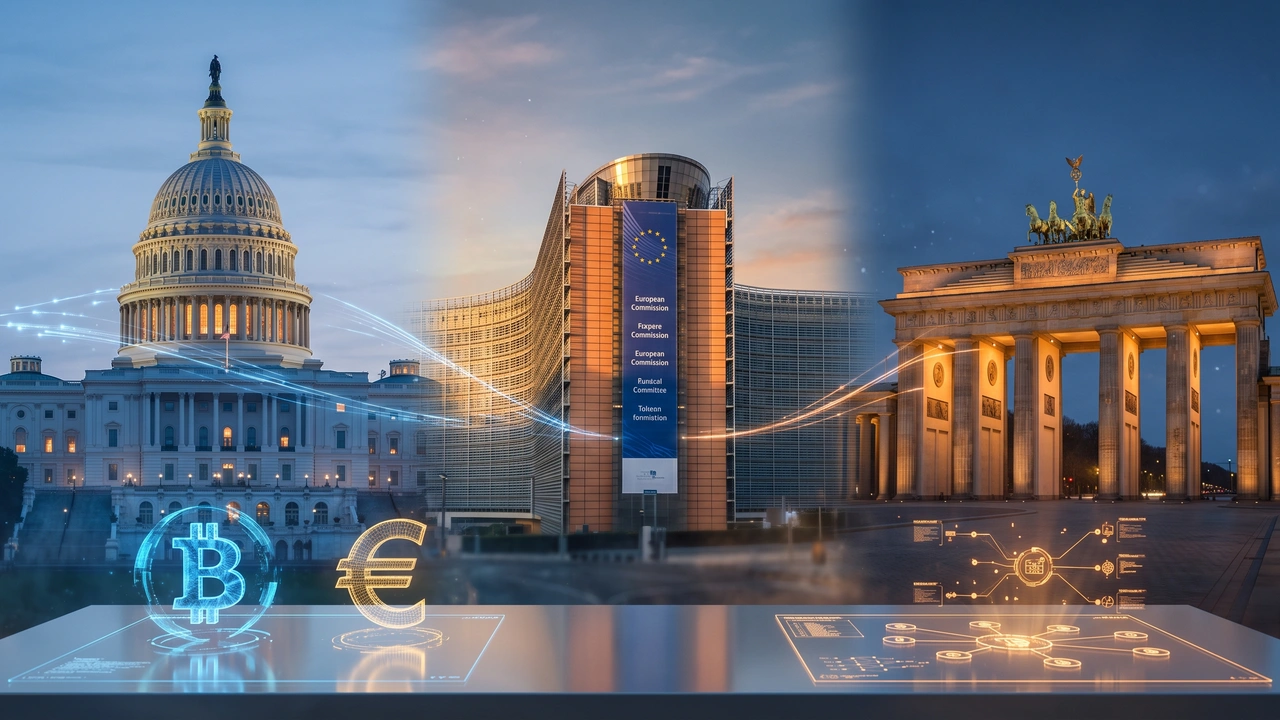
From Washington's stalled Clarity Act to Brussels' digital euro push and a 500-million-euro tokenization sandbox in Berlin, the regulatory architecture shaping Bitcoin's future is being built right now - and the decisions made in the coming weeks will echo for years.
Key Takeaways
- The Clarity Act faces a genuine legislative cliff: if it fails to reach a Senate floor vote before summer recess, the entire drafting process would restart in the next Congress, erasing months of bipartisan work.
- The ethics provisions fight is the most politically loaded obstacle - Democratic senators are tying crypto market legislation to concerns about presidential and congressional conflicts of interest, which makes compromise structurally difficult.
- The digital euro is advancing procedurally but Moody's expects modest real-world impact, pointing to an existing wallet cap designed to protect bank deposits and widespread uncertainty about whether citizens will actually adopt it.
- Moody's explicitly notes that the digital euro will not counter dollar-pegged stablecoin competition - a reminder that CBDC design and stablecoin competition are separate regulatory problems requiring separate solutions.
- The Electric Blue and Lava Network sandbox demonstrates that MiCA-compliant tokenization of real-world assets is moving from concept to tested infrastructure, with 500 million euros in target capital giving the project genuine commercial weight.
Europe's Crypto Regulation Moment: Three Fronts, One Battle
Regulation rarely moves in a straight line, but right now it is moving on multiple fronts simultaneously - and the pressure is compressing. In Washington, the window for comprehensive crypto market legislation may close before summer recess. In Brussels, a central bank digital currency is clearing procedural hurdles on its way to a 2029 launch target. And in Berlin, a blockchain infrastructure firm and an energy trader are quietly proving that tokenization under the EU's MiCA framework is no longer theoretical. Taken together, these three developments sketch the contours of a digital asset regulatory order that will define the next decade.
The Facts
The most time-sensitive drama is playing out in the US Senate, where the Clarity Act - a bill designed to establish the first comprehensive federal regulatory framework for cryptocurrency markets - is racing against the congressional calendar [1]. Senator Cynthia Lummis has publicly stated that the bill's text would be released around July 4th, with a floor vote targeted for later that month [1]. The legislation would divide oversight jurisdiction between the SEC and the CFTC, drawing clearer lines around which digital assets qualify as securities and which fall under commodity regulation [1].
But the finish line keeps shifting. Democratic senators are pushing for ethics provisions that would constrain the President, Vice President, and sitting members of Congress from certain transactions involving digital assets [1]. Anti-money-laundering requirements remain a live negotiating point, with Senator Angela Alsobrooks telling US outlet 535 News: "We need rules on ethics issues. We need rules on combating illicit finance." She added that negotiators are "close to an agreement" on those provisions, though that optimism has not yet translated into signed text [1]. A separate sticking point involves carve-outs for developers of non-custodial software - the crypto industry views such exemptions as essential legal clarity, while law enforcement agencies argue the provisions could hamper criminal investigations into digital asset crimes [1]. If the bill does not pass before the summer recess, the entire legislative process would likely need to restart in the next Congress, resetting months of negotiation [1].
Across the Atlantic, the digital euro is advancing through the EU's institutional machinery at a more measured pace. On June 23rd, the European Parliament's economic committee voted to authorize trilogue negotiations between the Parliament, the European Commission, and the Council of Ministers [2]. A full parliamentary plenary vote is scheduled for July, with formal three-way negotiations set to begin in September [2]. Rating agency Moody's, in a report reviewed by BTC-ECHO, described the committee vote as a landmark moment in the history of the common currency, and the ECB is targeting a launch no earlier than 2029 [2].
Moody's analysis offers a notably sober read on the digital euro's practical significance [2]. The agency expects limited disruption to existing banks or payment infrastructure, partly because European payment systems already function efficiently. A proposed wallet cap of 3,000 euros per user is specifically designed to prevent deposit migration away from commercial banks, and even under stress scenarios the agency sees manageable liquidity consequences for financial institutions [2]. Perhaps most pointedly, Moody's concludes that the digital euro will not resolve the competitive pressure posed by dollar-pegged stablecoins - a challenge that is structurally different and not addressed by a central bank liability denominated in euros [2]. Whether ordinary Europeans will adopt it at all remains, in Moody's phrasing, an open question, given how many digital payment alternatives already exist [2].
The third front is quieter but arguably the most immediately concrete. Berlin-based energy trader Electric Blue and blockchain protocol Lava Network have launched a joint sandbox project aimed at tokenizing battery storage assets under MiCA compliance requirements, with a fundraising target of 500 million euros [3]. The underlying collateral consists of battery systems with documented operating histories and verifiable cash flows, paired with solar and wind generation capacity [3]. Lava Network provides the blockchain infrastructure; participating teams within the sandbox are building tokenization models that satisfy MiCA's regulatory standards [3]. For Lava, this is already the second tokenization sandbox of its kind - the first involved a real estate portfolio in the Dominican Republic [3]. Electric Blue, active in Germany's intraday electricity market since 2018 and in renewable energy marketing since 2022, frames the project as a test of whether blockchain ownership structures can unlock capital for the energy transition at a speed and scale that conventional financing cannot match [3].
Analysis & Context
The parallel timing of these three developments is not coincidental - it reflects a regulatory cycle that was always going to arrive roughly here. Bitcoin and the broader digital asset market spent the better part of four years operating in a legal gray zone after the 2020-2021 bull run catalyzed political attention. The frameworks being debated and built today are the direct institutional response to that period.
The Clarity Act's stumbling block is worth reading carefully, because the ethics provisions dispute reveals something structural. The Trump administration's visible entanglement with crypto ventures has given Democratic senators a legitimate political lever - and they are using it. This is not simply obstruction. It reflects a genuine concern, held by a meaningful portion of the electorate, that crypto regulation could be designed to benefit insiders at the top of government. Whether or not that concern is proportionate to the actual legislative text, it has real procedural teeth. A bill that cannot muster bipartisan support before recess is a bill that may not exist in its current form by 2027.
The digital euro debate, meanwhile, illustrates a persistent tension that Bitcoin observers will recognize immediately: the difference between a system designed for state legibility and one designed for individual sovereignty. Moody's assessment that the CBDC will not address dollar-pegged stablecoin competition is correct precisely because those stablecoins derive much of their appeal from their dollar denomination and their accessibility outside traditional banking rails. A programmable euro issued by the ECB solves a different problem - namely, reducing Europe's payment infrastructure dependence on Visa, Mastercard, and US-domiciled fintech. It is a geopolitical instrument as much as a monetary one. Conflating it with the stablecoin question misreads the architecture entirely.
Sources
- [1]btc-echo.de
- [2]btc-echo.de
- [3]btc-echo.de
AI-Assisted Content
This article was created with AI assistance. All facts are sourced from verified news outlets.