Fear, Flows, and False Signals: Crypto Sentiment Reaches a Crossroads
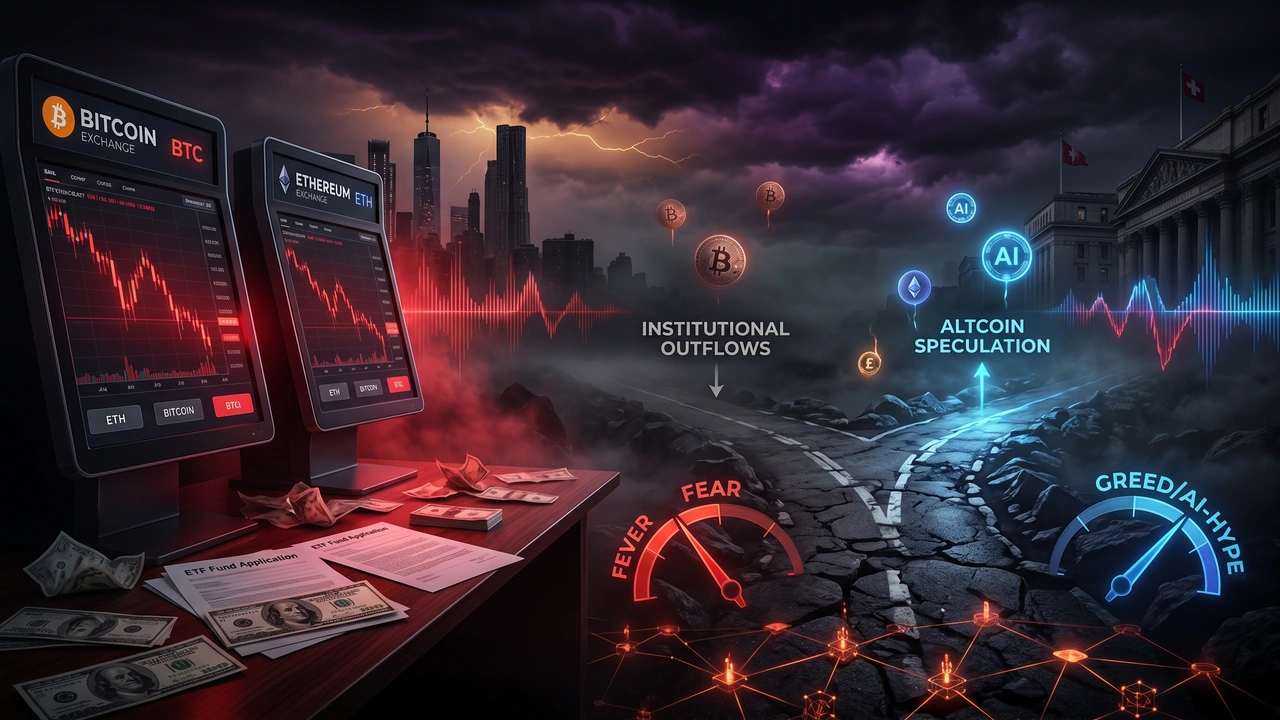
A convergence of ETF outflows, deteriorating social sentiment around Ethereum, and an AI-driven altcoin surge reveals a market caught between panic selling and contrarian opportunity - with Bitcoin funds bearing the heaviest institutional retreat.
Key Takeaways
- The scale of Bitcoin ETF outflows last week is severe, but historical precedent and Santiment's own contrarian analysis suggest extreme redemption events can mark sentiment floors rather than the start of prolonged declines.
- Ethereum's sentiment crisis appears to be largely price-driven rather than fundamentals-driven - developer activity remains a sector leader, and the pessimistic narrative may be amplifying a correction rather than reflecting a structural deterioration.
- The negative feedback loop around ETH - falling price, rising fearful commentary, ETF outflows, more fear - is a textbook sentiment trap; the resolution historically comes when pessimism reaches such consensus that it exhausts itself.
- Worldcoin's AI-driven surge illustrates where speculative capital migrates during broad risk-off periods, but overbought technical readings and volume spikes of this magnitude warrant caution about sustainability.
- The geographic spread of ETP outflows - from North America to Europe and Asia - confirms this is a coordinated institutional risk reduction rather than a localized event, making the eventual reversal potentially meaningful across multiple markets simultaneously.
Fear, Flows, and False Signals: Crypto Sentiment Reaches a Crossroads
When markets move, narratives follow. But sometimes the narrative itself becomes the market force - amplifying fear where fundamentals might warrant patience, or stoking euphoria where caution is overdue. That dynamic is playing out across the crypto landscape right now in three distinct but deeply connected ways: institutional capital fleeing crypto exchange-traded products on a global scale, Ethereum trapped in a self-reinforcing pessimism loop, and speculative heat flooding into AI-adjacent tokens like Worldcoin. Together, these developments paint a portrait of a market that is not broken, but is under serious emotional strain.
The Facts
The clearest signal of risk-off behavior comes from the ETP market. Last week, crypto exchange-traded products hemorrhaged capital across nearly every major financial hub, with the United States accounting for the dominant share of damage. American investors pulled roughly $1.43 billion from crypto ETPs, with the vast majority - approximately $1.26 billion - exiting spot Bitcoin funds listed domestically [3]. The retreat was not confined to one region: Switzerland saw around $16 million leave, Canada lost close to $12.5 million, and notable outflows also hit markets in Hong Kong and Germany [3]. The Netherlands stood as a rare exception, attracting modest inflows of $6.6 million [3]. Total crypto ETP assets under management finished the week near $148.7 billion, with Bitcoin-focused products representing roughly 80% of that figure at approximately $120.2 billion [3].
Ethereum tells a more psychologically complex story. According to blockchain analytics firm Santiment, ETH's market capitalization declined by more than 11% across a 15-day stretch in May - a drop that occurred simultaneously with Hyperliquid reaching a new all-time high [2]. The crucial analytical question Santiment raises is whether negative news caused the price decline, or whether the price decline generated the negative narratives. Their conclusion leans toward the latter: sentiment deteriorated largely as a consequence of price weakness, not as its cause [2].
The social data makes this feedback loop visible. Ethereum's social dominance - the share of crypto-related online discussion it commands - rose after a local price peak in mid-April, yet the price continued sliding [2]. That divergence between rising attention and falling price suggests the conversation shifted from enthusiasm to anxiety. The ratio of bullish to bearish commentary worsened through May, narrowing from better than two positive comments per negative one at the end of April toward near-parity by mid-month [2]. Contributing factors cited by Santiment include ETF outflows, internal Ethereum Foundation personnel changes, weaker on-chain metrics, and high-profile ETH sales by prominent community figures including Bankless podcast host David Hoffman [2].
Meanwhile, Worldcoin surged approximately 22% in a single trading day, with its 24-hour volume doubling to around $391 million [1]. The catalyst was continued enthusiasm around the artificial intelligence sector, following Nvidia's recent earnings release - a pattern also visible in prior AI-adjacent token rallies like Near Protocol [1]. Technically, WLD broke above its 20-period EMA and reached an RSI reading near 78, placing it in overbought territory while simultaneously confirming short-term trend strength [1].
Analysis & Context
The billion-dollar Bitcoin ETF outflow figure demands historical framing before drawing conclusions. Large single-week redemption events from spot Bitcoin ETFs are not unprecedented, and importantly, they have not always preceded sustained price declines. What Santiment itself has noted - referenced in the Cointelegraph report - is that such extreme outflow readings have previously generated contrarian buy signals [3]. The reasoning is classic behavioral finance: when a large majority of participants act on fear simultaneously, the pool of remaining sellers shrinks. Markets tend to reverse when bearish consensus becomes too crowded.
This connects directly to Ethereum's predicament. The pattern Santiment describes - rising social volume alongside falling price - is a well-documented precursor to sentiment exhaustion. When retail and semi-professional participants flood into discussions about an asset because it is falling rather than rising, it often marks the later stages of a distribution or correction phase rather than the beginning of a structural breakdown. Ethereum's developer activity remains among the strongest in the entire crypto industry [2], a fundamental that narratives of obsolescence simply do not support. The risk, as always, is timing: sentiment exhaustion can persist far longer than analysts expect, particularly when macro conditions remain uncertain.
The Worldcoin surge illustrates the other side of this emotional environment. Capital does not disappear during risk-off periods in crypto - it rotates. When institutional flows retreat from Bitcoin ETFs and ETH sentiment sours, speculative money often seeks high-beta narratives with fresh momentum. AI is providing exactly that story right now. The danger is that RSI readings above 78 on short timeframes signal momentum, not value - and momentum-driven rallies in mid-cap tokens can reverse with comparable speed [1]. The 109% volume spike in WLD is remarkable, but volume surges of that magnitude following AI-sector catalysts have historically been followed by sharp consolidations once the initial hype cycle peaks.
The broader pattern here is one the crypto market has cycled through multiple times: macro-driven institutional retreats compress Bitcoin and large-cap alts, while speculative capital migrates toward thematic narratives - DeFi, NFTs, Layer-2s, and now AI tokens. Each cycle eventually reconnects when Bitcoin stabilizes and the broader risk appetite returns. The current setup - heavy ETF outflows, depressed ETH sentiment, AI token euphoria - looks structurally similar to mid-cycle rotation phases rather than terminal bear conditions. But the speed of sentiment recovery will depend heavily on whether Bitcoin's institutional holder base stabilizes or continues to reduce exposure.
Sources
AI-Assisted Content
This article was created with AI assistance. All facts are sourced from verified news outlets.