Fear Grips Bitcoin as Prediction Markets Signal a New Era
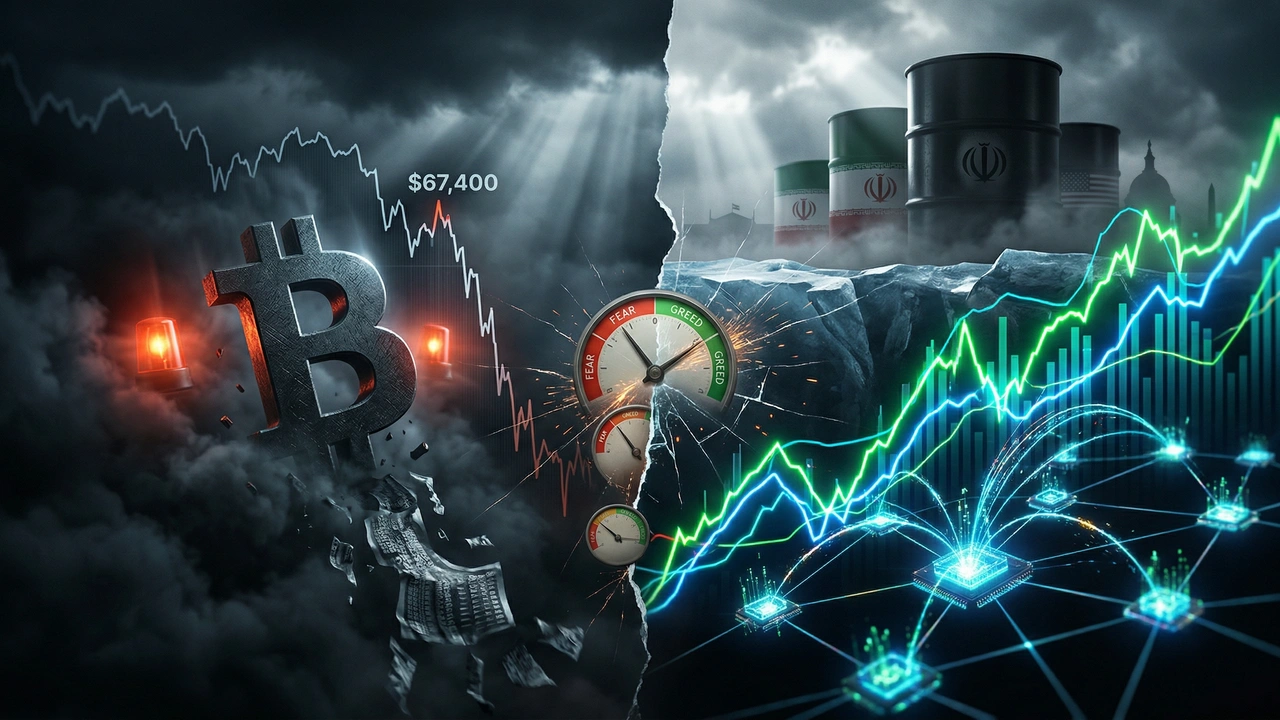
Bitcoin languishes near $67,400 amid extreme fear and macro headwinds, while blockchain-based prediction markets surge 2,838% — together painting a portrait of a market at a critical crossroads.
Key Takeaways
- Bitcoin is in a high-stakes liquidity trap: With over $3 billion in longs below $65,000 and $7.65 billion in shorts above $70,000, the next major price move carries outsized consequences for leveraged traders on both sides [2].
- Extreme Fear (index: 8) is historically rare and warrants attention: Past occurrences near this level have often coincided with market bottoms, but macro conditions — including oil above $110/barrel and Iran conflict — make this cycle uniquely complex [2].
- Prediction markets are a breakout use case for blockchain: A 2,838% year-over-year surge in transactions signals that decentralized platforms are capturing mainstream interest in real-world event speculation, diversifying blockchain's value proposition well beyond crypto trading [1].
- Regulatory risk is rising on multiple fronts: From prediction market legislation in the U.S. to broader macro pressures, the environment for crypto-adjacent innovation is becoming more legally fraught, and participants should monitor legislative developments closely [1].
- The divergence between fear and on-chain activity is a signal: While spot market sentiment is deeply negative, the explosion in prediction market usage suggests that engaged blockchain users remain active and forward-looking — a potential indicator that network fundamentals remain intact even as prices struggle.
When Extreme Fear Meets Explosive Growth: Bitcoin's Contradictory Market Moment
The cryptocurrency market is sending mixed signals. On one hand, Bitcoin investors are gripped by some of the most intense fear readings in recent memory, with the asset struggling to reclaim key psychological levels. On the other hand, a closely related corner of the blockchain ecosystem — prediction markets — is experiencing a historic explosion in activity. Together, these two developments tell a deeper story about how market participants are navigating uncertainty: some are retreating, while others are betting aggressively on the outcome of global events.
This divergence is not merely a curiosity. It reflects a maturing digital asset ecosystem where fear and speculation exist simultaneously, and where on-chain data is becoming an increasingly powerful lens through which to read the pulse of global sentiment.
The Facts
Bitcoin is currently trading at approximately $67,400, sitting meaningfully below the psychologically significant $70,000 threshold and posting only a modest 1% gain on the day [2]. The broader crypto market capitalization stands at roughly $2.4 trillion, with Bitcoin dominance hovering around 58% [2]. Altcoins are offering little relief — Ethereum is barely holding above $2,000, while XRP is up just 1.5% to $1.35 [2].
Perhaps most telling is the Fear & Greed Index, which has collapsed to a deeply alarming score of just 8 out of 100, firmly in "Extreme Fear" territory [2]. This reading reflects just how cautious and risk-averse the market has become. The derivatives landscape compounds this concern: more than $3 billion in long positions are clustered below the $65,000 level, creating a potential liquidation cascade if prices slip further, while approximately $7.65 billion in short positions sit above $70,000, ready to be squeezed if bulls manage a breakout [2]. Bitcoin is effectively trapped between two massive liquidity zones.
Macroeconomic conditions are not helping. An ongoing geopolitical conflict involving Iran, a correction across U.S. equity markets, and oil prices surging well above $110 per barrel are all contributing to elevated risk aversion among investors [2]. In this environment, crypto is being treated as a risk asset first and a store of value second.
Meanwhile, in a striking contrast, blockchain-based prediction markets have reached record-breaking activity levels. Data from Dune Analytics shows that more than 191 million transactions have been recorded on these platforms in March alone — a staggering 2,838% increase compared to the same period last year [1]. According to TRM Labs, this explosion in activity is being driven by improved platform accessibility, favorable regulatory developments in certain jurisdictions, and the integration of prediction markets into mainstream platforms [1]. Notably, the content of these markets has shifted: users are no longer primarily betting on crypto-native topics but are instead focused on geopolitical developments, U.S. political events, and macroeconomic decisions [1].
However, the regulatory picture for prediction markets is growing more complex. In March, both Kalshi and Polymarket announced measures to restrict certain types of trading, and U.S. lawmakers introduced legislation targeting event contracts deemed to have gambling characteristics [1]. TRM Labs has noted that the long-term trajectory of this sector will hinge significantly on how regulators address concerns around market manipulation [1].
Analysis & Context
A Fear & Greed Index reading of 8 is not just a number — it is a historical rarity that demands attention. For context, similarly extreme fear readings have historically emerged at or near major market bottoms, most notably in the aftermath of the FTX collapse in late 2022 and during the COVID-induced crash of March 2020. In both cases, extreme fear ultimately preceded significant recoveries. However, the critical distinction between a capitulation bottom and a prolonged bear phase is that the former is typically accompanied by a surge in spot selling and on-chain distribution — data points that deserve close monitoring in the coming days.
The $65,000-$70,000 range has emerged as a decisive battleground. The concentration of over $10 billion in combined long and short liquidation risk on either side of Bitcoin's current price means that the next significant move — in either direction — could be amplified dramatically by forced liquidations. This is a market structure that rewards patience and punishes overleveraged positions. Historically, when Bitcoin has found itself in a similar liquidity sandwich, the resolution has often been swift and violent, with price action breaking decisively one way or the other rather than grinding sideways indefinitely.
The explosive growth in prediction markets adds a fascinating dimension to this analysis. The 2,838% surge in transactions is not just a headline figure — it signals that on-chain participants are increasingly using decentralized platforms to express views on real-world events, from elections to central bank decisions. This trend suggests that blockchain infrastructure is expanding its utility beyond pure financial speculation, evolving into a genuine information aggregation tool. For Bitcoin specifically, this maturation of the broader ecosystem is a long-term positive: it builds the case for blockchain technology's relevance in a world increasingly defined by information asymmetry and geopolitical uncertainty. Yet the looming regulatory crackdown on prediction markets also serves as a reminder that the industry's growth often outpaces its regulatory framework — a dynamic that can create short-term headwinds even for fundamentally sound innovations.
Sources
- [1]btc-echo.de
- [2]btc-echo.de
AI-Assisted Content
This article was created with AI assistance. All facts are sourced from verified news outlets.