Fear Trades and Financial Myths: Decoding Bitcoin's Macro Moment
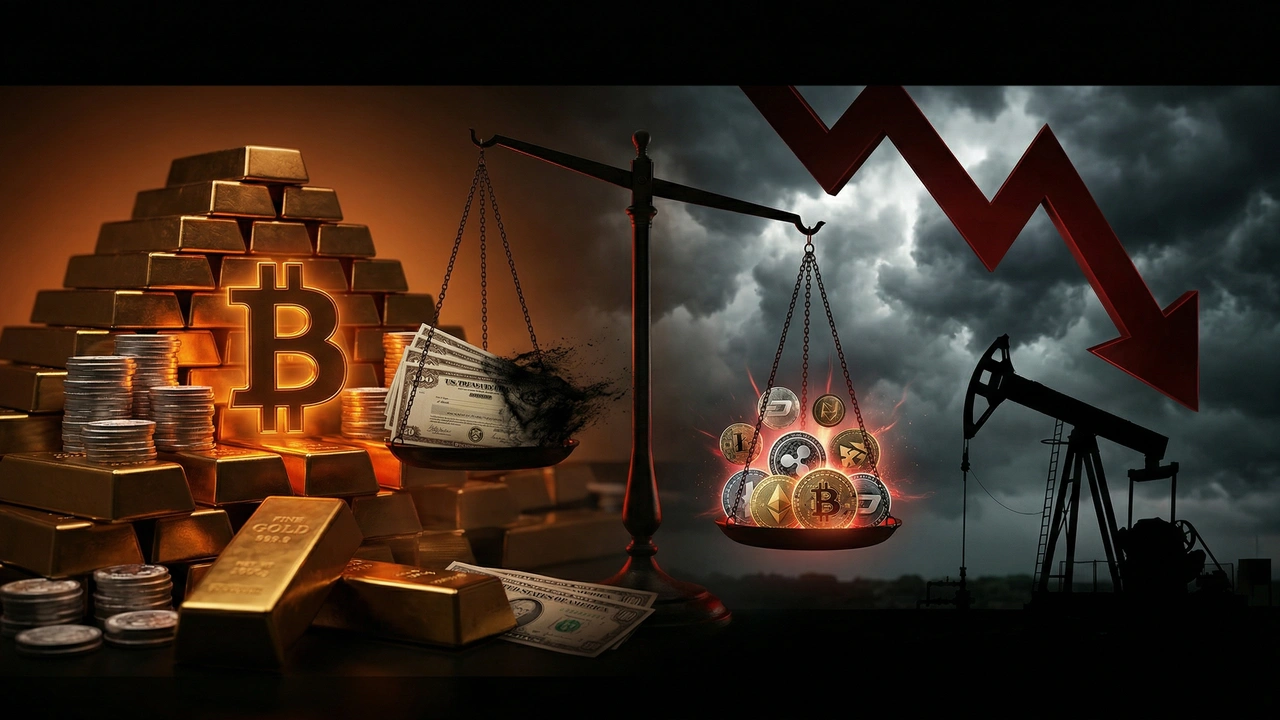
From Robert Kiyosaki's broadside against traditional finance to an $80 million leveraged whale bet against Bitcoin, contrarian signals are multiplying — but reading them correctly is everything.
When Fear Meets Capital: The Macro Storm Shaping Bitcoin's Outlook
Two powerful narratives are colliding in the Bitcoin market right now. On one side, a celebrated financial author is doubling down on his conviction that the global monetary system is structurally broken — and that hard assets like Bitcoin are the only rational refuge. On the other, a deep-pocketed whale is placing an $80 million leveraged bet that Bitcoin is about to fall while oil surges. Both positions reflect the same underlying anxieties about inflation, geopolitical instability, and the reliability of traditional financial instruments. The question is: who is reading the macro environment correctly?
This tension reveals something fundamental about Bitcoin's current moment. It is no longer just a speculative tech asset debated in niche corners of the internet. It is increasingly the lens through which serious — if polarized — financial thinkers are processing questions about war, monetary debasement, and the long-term credibility of sovereign debt. That alone is a significant development worth understanding deeply.
The Facts
Robert Kiyosaki, author of the globally bestselling personal finance book Rich Dad, Poor Dad, has issued another stark warning about the state of conventional investing. In a recent post on X, Kiyosaki argued that predicting the future is currently "unusually easy" due to two converging forces: governments worldwide are continuing to print money, which he characterizes as "counterfeit currency," thereby fueling inflation and eroding purchasing power for savers; and the ongoing Iran conflict shows no sign of resolution, which he believes will keep oil prices elevated and compound inflationary pressures [1].
Kiyosaki singled out what he called "the biggest financial lie" in mainstream advice — the idea that following a conventional path of education, employment, tax-paying, and investing in diversified portfolios of stocks, bonds, mutual funds, and ETFs leads to financial security. Most provocatively, he labeled the notion that U.S. Treasury bonds are a safe investment as the greatest financial falsehood of our era [1]. For 2026, he listed gold, silver, oil, food, Bitcoin, and Ethereum as his preferred asset classes — a lineup that prioritizes hard, government-resistant stores of value over yield-generating instruments [1].
Meanwhile, on the derivatives platform Hyperliquid, a whale wallet identified by the address 0x94d373…c933814 constructed a leveraged position worth nearly $80 million over two trading days [2]. The position consists of a $40 million short on Bitcoin futures entered near $68,760, a $2 million short on synthetic S&P 500 contracts, and a $37 million long on synthetic Brent crude oil contracts — running at 7x aggregate leverage [2]. The Bitcoin position faces forced liquidation if the price rises above $80,083, while the oil long gets wiped out if Brent climbs above $93 [2].
The timing is notable. The trade was built precisely as markets were rallying on optimism that the U.S.-brokered ceasefire in the Iran conflict could materialize, with S&P 500 futures gaining 4% in a single session [2]. President Trump publicly referenced Iran's leadership considering a ceasefire, though Iran's Foreign Minister denied formal talks were underway while acknowledging an intent to end hostilities [2]. This whale appears to be making the opposite bet — that the ceasefire optimism is premature, oil will remain elevated, and Bitcoin will decline in that environment.
Importantly, this is not the whale's first high-stakes foray. The same address lost $37 million in December 2025 during its first month of activity, and suffered a further $40 million loss in early February after flipping from profitable short positions to bullish bets on Ethereum, Bitcoin, Solana, and XRP at an inopportune moment [2]. The wallet appears to execute via automated bots, given the volume and granularity of its order flow [2].
Analysis & Context
Stripping away the noise, both of these stories share a common thread: the macroeconomic backdrop — specifically sovereign debt sustainability, inflation trajectories, and geopolitical instability — is increasingly driving Bitcoin market positioning. This is a meaningful evolution. In Bitcoin's earlier cycles, price action was dominated by retail sentiment, exchange hacks, and halving mechanics. Today, large capital allocators are making nine-figure bets based on their read of oil markets and U.S.-Iran diplomacy. That is institutional-grade macro thinking applied to a crypto native instrument.
Kiyosaki's critique of traditional finance, while frequently dismissed as sensationalist, lands on genuinely contested ground. The U.S. national debt trajectory, persistently elevated inflation in key spending categories, and the erosion of real yields on Treasuries are documented phenomena — not fringe conspiracy theories. The community response he received on X, distinguishing Bitcoin from gold, silver, and even Ethereum on the basis of its fixed supply, censorship resistance, and absence of governing committees, reflects a maturing understanding of what makes Bitcoin structurally unique among hard assets [1]. That argument has only grown stronger as other "stores of value" have shown susceptibility to physical confiscation, price suppression, or protocol-level governance changes.
As for the whale trade, history counsels skepticism. This particular address has demonstrated a pattern of high-conviction, high-leverage, high-loss positioning. Losing $37 million in one month and $40 million in a single position flip suggests that size does not equal insight [2]. The trade structure — short Bitcoin, long oil — is internally coherent as a macro thesis (oil-driven inflation hurts risk assets), but it runs counter to Bitcoin's growing reputation as an inflation hedge in its own right. If a genuine ceasefire in Iran materializes and oil prices soften, the whale's entire thesis unravels simultaneously from both sides. The 7x leverage leaves almost no room for error. Traders watching this position as a directional signal should weigh the source's track record heavily.
Key Takeaways
- Macro is now a dominant Bitcoin driver: Geopolitical signals around the Iran conflict and inflation expectations are visibly moving large capital into and out of Bitcoin positions, signaling Bitcoin's deepening integration into global macro trading strategies.
- Kiyosaki's core argument has structural merit, even if his style invites criticism: The challenge to U.S. Treasury bond "safety" is not fringe thinking — real yield erosion and debt trajectory are legitimate concerns that inform the bull case for hard assets including Bitcoin [1].
- The $80M whale short deserves scrutiny, not automatic credence: This wallet has lost over $77 million across multiple high-leverage positions since December 2025 — its conviction should be weighed against its track record, not taken as a reliable market signal [2].
- Bitcoin's fixed-supply, committee-free architecture remains its key differentiator: Community analysis distinguishing Bitcoin from gold, silver, oil, and Ethereum on structural grounds reflects a maturing investor understanding of what genuine monetary hardness means [1].
- Ceasefire dynamics are the near-term wildcard: A credible Iran ceasefire resolution would likely collapse oil prices, relieve inflationary pressure, and potentially fuel a risk-on rally — directly benefiting Bitcoin and liquidating the whale's entire position simultaneously [2].
Sources
AI-Assisted Content
This article was created with AI assistance. All facts are sourced from verified news outlets.