Geopolitics, Bank Wars, and Market Noise: What Really Drives Crypto
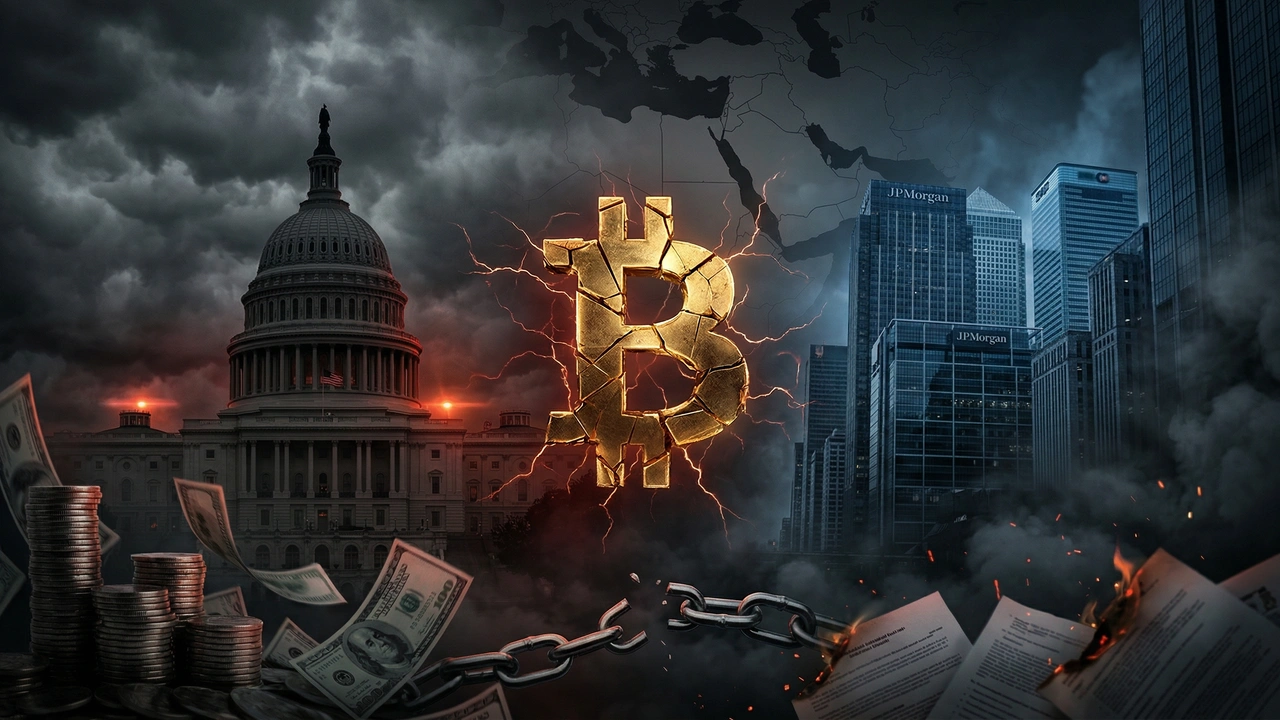
As Middle East tensions dominate headlines and Trump wages war on Wall Street banks over crypto legislation, seasoned analysts warn investors to separate geopolitical noise from the structural signals that actually move markets.
When Wars and Turf Battles Obscure the Signal
Two distinct but thematically linked forces are currently testing crypto investors' focus: a brewing confrontation between the Trump administration and America's most powerful banking institutions over the future of stablecoin regulation, and the ongoing geopolitical turbulence in the Middle East following the US-Israeli strikes on Iran. Together, they represent a defining challenge for the crypto market — the ability to distinguish between short-term noise and long-term structural shifts. For Bitcoin holders and broader crypto investors alike, reading that distinction correctly may be the most important analytical skill of the current cycle.
The convergence of geopolitical drama and domestic regulatory warfare is creating a uniquely volatile information environment. Headlines compete for attention, fear and uncertainty spike, and emotional trading decisions replace disciplined strategy. Understanding what is actually happening beneath the surface — and why it matters — requires stepping back from the daily news cycle.
The Facts
On the domestic front, President Donald Trump has taken a strikingly personal stance in the battle over US crypto legislation. In a post on Truth Social, Trump directly attacked the banking lobby, demanding that banks "stop undermining the GENIUS Act or holding the Clarity Act hostage" [1]. The statement represents an extraordinary moment: a sitting US president explicitly aligning himself with the crypto industry against Wall Street's most entrenched institutions.
The core dispute centers on whether stablecoins should be permitted to pay yields to holders. Banking groups, led by figures such as JPMorgan CEO Jamie Dimon, argue that any entity holding customer deposits and paying interest on them is functionally a bank and should be regulated as one [1]. Their concern is not merely philosophical — Standard Chartered estimates that up to $500 billion could flow out of traditional bank deposits and into yield-bearing stablecoins by 2028, potentially starving regional banks of the liquidity they need to extend loans [1]. For the banking sector, this is an existential competitive threat, not a regulatory nuance.
Trump, however, is pushing back with characteristic force. "The banks are making record profits — we will not allow them to endanger our crypto agenda," he declared [1]. His son Eric Trump amplified the attack, labeling the banks "the biggest hypocrites" and accusing them of exploiting customers for years while now trying to block the crypto industry from offering genuine financial benefits to users [1]. Critics have not missed the obvious conflict of interest: Trump's own family markets USD1, a proprietary stablecoin whose reserves — typically parked in short-term US Treasuries — would grow considerably more valuable as the stablecoin market expands [1].
The political clock is also ticking. With midterm elections approaching in November, Republicans face the prospect of losing their congressional majority, which would likely kill crypto-friendly legislation in its current form [1]. Trump's urgency in pressuring the banks may be as much about political timeline management as genuine ideological commitment to financial innovation.
Meanwhile, in the broader crypto market, the US-Israeli military strikes on Iran have triggered the kind of geopolitical anxiety that typically produces short-term volatility across risk assets [2]. Yet crypto analyst EGRAG Crypto is explicitly warning investors not to let war narratives distract from more meaningful technical signals. His central argument: long-term market cycles consistently outweigh daily geopolitical headlines as drivers of sustained price action [2]. Focusing on XRP as a case study, he identifies a critical support zone between approximately $1.00 and $1.40 that, if reclaimed and held, could set the stage for a multi-year bull phase — irrespective of what is happening in the Middle East [2].
Analysis & Context
The Trump-versus-banks confrontation is not merely a colorful political spectacle — it has direct structural implications for Bitcoin and the broader digital asset ecosystem. Stablecoin regulation is the infrastructure layer upon which much of crypto's integration with traditional finance depends. If the GENIUS Act or Clarity Act stalls or is watered down under banking industry pressure, on-ramps between dollars and crypto could remain fragmented, expensive, and legally ambiguous for years. Historically, regulatory clarity — even when imperfect — has been one of the most reliable catalysts for sustained institutional capital flows into Bitcoin. The absence of clarity, conversely, has consistently delayed institutional adoption cycles.
There is also a deeper pattern worth recognizing here. Throughout Bitcoin's history, the periods of most intense regulatory and geopolitical uncertainty have frequently coincided with the formation of long-term price floors. The 2018-2019 bear market, the COVID crash of March 2020, and the FTX collapse of late 2022 all generated maximum fear — and all preceded significant rallies. EGRAG Crypto's observation that XRP's current support zone traces back to the 2018-2019 bear market lows is a reminder that technical structures built over years carry far more predictive weight than any single news cycle [2]. Bitcoin investors would do well to apply the same framework: geopolitical shocks create noise, but the underlying supply dynamics, adoption curves, and regulatory trajectory remain the dominant variables.
The Trump administration's aggressive posture toward the banking lobby also represents something structurally new. Previous administrations treated the financial sector as a partner in crypto policy discussions. Trump is now treating it as an obstacle to be bulldozed. Whether or not this produces legislative results before the midterms, it signals a lasting shift in the political economy of crypto in Washington — one where the industry has genuine executive-branch advocacy for the first time. That is a meaningful change in the long-term operating environment for Bitcoin and digital assets broadly, regardless of how individual bills fare in the short term.
Key Takeaways
- Trump's direct confrontation with the banking lobby over the GENIUS Act and Clarity Act represents the strongest executive-branch support for crypto legislation in US history, but his personal financial stake in the outcome through the USD1 stablecoin raises legitimate conflict-of-interest concerns that markets should not ignore [1].
- The November midterm deadline creates a narrow legislative window — if crypto-friendly bills do not pass before Republicans potentially lose their congressional majority, the regulatory framework could remain uncertain for years, which historically suppresses sustained institutional inflows [1].
- Standard Chartered's projection of $500 billion migrating from bank deposits to stablecoins by 2028 is the number that explains everything about why banks are fighting so hard — this is a structural threat to their core deposit base, not a peripheral policy disagreement [1].
- Geopolitical events like the Iran conflict generate short-term volatility but have a poor track record as predictors of long-term crypto market direction — experienced analysts consistently advise focusing on on-chain structure and technical levels over war-driven sentiment swings [2].
- For Bitcoin investors, the key insight from both developments is to separate signal from noise: the legislative battle over stablecoin infrastructure is a genuine long-term signal; the daily geopolitical headlines are largely noise that creates entry opportunities for those with disciplined time horizons.
Sources
- [1]btc-echo.de
- [2]btc-echo.de
AI-Assisted Content
This article was created with AI assistance. All facts are sourced from verified news outlets.