Geopolitics, SpaceX, and Sanctions: Bitcoin Caught in Crossfire
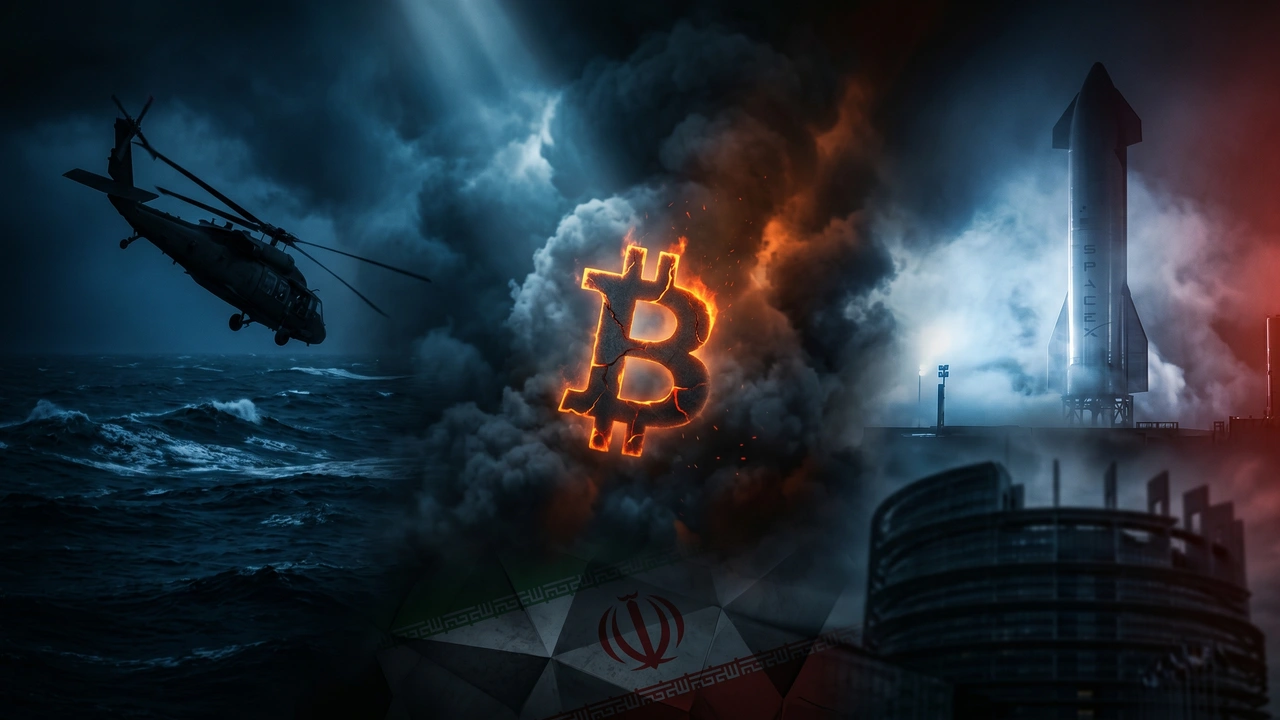
A downed US helicopter in the Strait of Hormuz, a looming SpaceX IPO, and fresh EU sanctions on Russian crypto use have converged into a perfect storm for Bitcoin markets - but a potential US-Iran peace deal could flip the narrative fast.
Key Takeaways
- The Strait of Hormuz blockade has functioned as a sustained macro headwind for Bitcoin for months, but a US-Iran memorandum of understanding - if signed - could remove one of the biggest overhangs currently weighing on sentiment.
- Five consecutive weeks of Bitcoin ETF outflows are being driven primarily by geopolitical uncertainty and its interest rate implications, not by deteriorating Bitcoin fundamentals.
- The SpaceX IPO poses a short-term capital competition risk for crypto, but the post-listing period could see that liquidity rotate toward digital assets if geopolitical conditions improve simultaneously.
- The EU's 21st sanctions package marks the first time Brussels has explicitly targeted third-country crypto platforms for sanctions evasion - a jurisdictional expansion with long-term structural implications for the industry.
- The Humanity Protocol hack, which erased over 80% of the H-Token's value in a single day, underscores that private key security failures remain one of the most acute and preventable risks across the broader digital asset ecosystem.
Geopolitics, SpaceX, and Sanctions: Bitcoin Caught in Crossfire
Rarely does a single week deliver so many distinct macro shocks aimed squarely at crypto markets. Right now, Bitcoin finds itself squeezed between a Middle East conflict that has strangled global energy flows, a trillion-dollar IPO preparing to vacuum up retail capital, and a tightening European regulatory net around Russian crypto activity. Each of these forces, taken alone, would be worth watching. Together, they form a stress test for Bitcoin's resilience - and, paradoxically, a setup for a sharp reversal if any one of them resolves.
The connective tissue across all three developments is the same: geopolitical uncertainty drives capital toward safety and away from risk. Bitcoin, for all its store-of-value credentials, still trades like a risk asset in moments of acute fear. Understanding that dynamic is the key to reading what comes next.
The Facts
The immediate market catalyst came from the Persian Gulf. Reports of a US military helicopter being shot down in the Strait of Hormuz, followed by an American counterstrike, reignited fears about a broader regional escalation [1]. The Strait is the world's most critical energy chokepoint - a naval blockade there has throttled approximately 20% of global oil and liquefied natural gas supply, pushing commodity prices higher and injecting a sustained sentiment shock into financial markets [2]. Bitcoin has absorbed that pressure for months, with the coin trading around $64,491 at the time of reporting, up just 1.5% on the day [2].
Yet a diplomatic off-ramp is taking shape. Pakistan, acting as a mediator between Washington and Tehran, signaled that a memorandum of understanding could be finalized within 24 hours, with Pakistani Prime Minister Shehbaz Sharif stating on X: "We are closer to a peace deal than ever before" [2]. The proposed agreement would extend a ceasefire for 60 days and reopen the Strait. Iran's foreign ministry did not confirm a Sunday signing, with spokesperson Esmaeil Baghaei indicating it would happen "in the coming days" rather than immediately [2]. Crypto analyst Michael van de Poppe argued that once the deal lands, liquidity will rotate back into risk assets - and with the SpaceX IPO likely absorbing its share of capital first, Bitcoin could be next in line [2].
The SpaceX listing adds a separate layer of near-term competition for capital. Market observers warn that the sheer scale of retail enthusiasm for the offering could temporarily redirect investor attention away from digital assets [1]. Bitcoin ETFs have already recorded five straight weeks of net outflows, shedding roughly $315.84 million in the most recent week alone [2]. CoinShares head of research James Butterfill attributed the persistent outflow trend primarily to geopolitical uncertainty and its knock-on effects for interest rate expectations [2]. The SpaceX IPO is not purely a threat, however - analysts note that once the listing excitement fades, the capital it attracted could conceivably migrate toward crypto, particularly if the Iran situation stabilizes simultaneously [1][2].
On the regulatory front, the European Union is preparing its 21st sanctions package against Russia, and crypto infrastructure is now squarely in scope [1]. Investigations have pointed to Moscow's large-scale use of stablecoins and crypto exchanges to sidestep existing Western financial restrictions. The new package would expand the blacklist to include crypto firms and platforms, and for the first time would extend those restrictions to entities operating in third-party countries - a meaningful jurisdictional leap that signals Brussels is done treating offshore platforms as beyond its reach [1].
Separately, a severe security incident at Humanity Protocol shook confidence in decentralized identity projects. Private keys belonging to a member of the Humanity Foundation were compromised, allowing attackers to drain H-Tokens worth at least $30 million [1]. The native token cratered by around 83% within a single trading day, and users were urged to avoid the platform's bridge and connected liquidity pools while external security specialists assist with the investigation [1]. The incident is a reminder that headline-grabbing exploits still carry the power to inflict sector-wide reputational damage, even when the affected project sits outside the Bitcoin ecosystem.
Analysis & Context
The pattern here is familiar to anyone who tracked Bitcoin through the 2019-2020 US-Iran tensions. When a US airstrike killed Iranian General Qasem Soleimani in January 2020, Bitcoin spiked briefly as a perceived safe haven - then sold off hard as broader risk aversion dominated. The lesson from that episode was counterintuitive: in a genuine geopolitical crisis, Bitcoin does not reliably behave as digital gold. It behaves like a high-beta risk asset that gets sold alongside equities when fear peaks. The current dynamic - sustained outflows from ETFs, price suppression despite dollar weakness - fits that same mold.
The more interesting forward implication is what happens at the intersection of a peace deal and post-IPO capital reallocation. Van de Poppe's thesis - that liquidity seeking opportunity will flow toward crypto once the SpaceX listing has cleared - is worth taking seriously, not because it is guaranteed, but because the structural logic holds [2]. Two of the largest near-term headwinds for Bitcoin (geopolitical risk premium and capital tied up in the IPO) could dissolve within a relatively short window. Markets tend to overshoot in both directions around such inflection points. Investors who interpret ongoing ETF outflows as a directional signal rather than a temporary sentiment drain may find themselves on the wrong side of a rapid repositioning.
The EU's expansion of its sanctions architecture into third-country crypto platforms deserves more attention than it has received. This is not incremental enforcement - it represents a structural shift in how Western regulators approach cross-border digital asset flows. If the framework proves enforceable, it sets a precedent for using crypto compliance as an arm of foreign policy, with implications that extend well beyond Russia.
Sources
AI-Assisted Content
This article was created with AI assistance. All facts are sourced from verified news outlets.