Georgia's Hidden Mining Crisis: How Mestia Became a $9.5M Power Drain
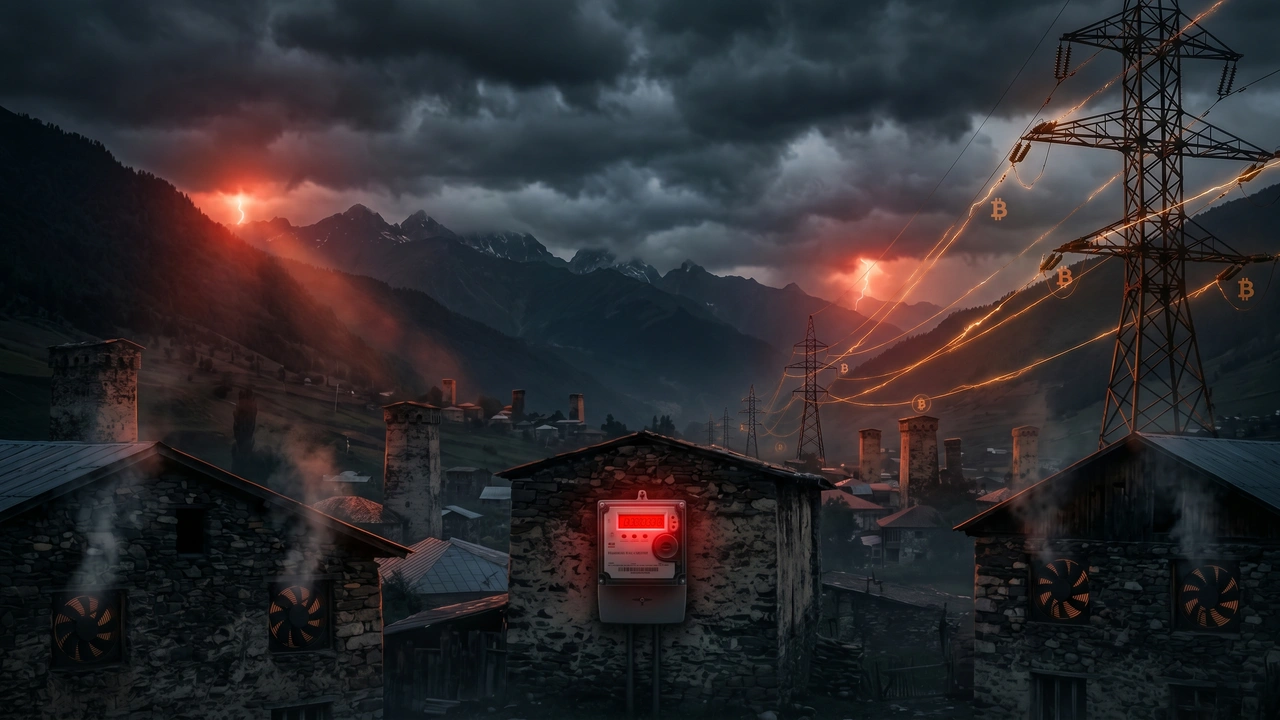
Illegal Bitcoin mining in Georgia's Mestia municipality has pushed regional electricity consumption to nearly 13 times the national average for comparable areas, forcing authorities to deploy smart metering and law enforcement across mountain villages.
Key Takeaways
- Mestia's electricity consumption in 2025 ran at more than ten times the level typical for comparable Georgian municipalities, a discrepancy authorities attribute entirely to illegal mining operations concentrated across the region's villages.
- The annual financial damage from this unauthorized energy use has been placed at up to $9.4 million - a figure that justifies the government's decision to deploy metering infrastructure and direct law enforcement resources toward the problem.
- Georgia's response follows a metering-first strategy: building a data trail of village-level consumption before pursuing enforcement, rather than relying on raids alone.
- Ordinary residential consumers are shielded by a free-electricity threshold that remains intact, meaning the crackdown is calibrated against industrial-scale abuse rather than household usage.
- Georgia's appeal as a mining destination - hydropower, low taxes, and industrial zones - is structural, not accidental; sustainable enforcement will require a legalization pathway alongside suppression, or the same dynamic will reassert itself elsewhere in the country.
Georgia's Hidden Mining Crisis: How Mestia Became a $9.5M Power Drain
Something was quietly draining the power grid in the Svaneti mountains. Residents and tourists visiting Mestia - one of Georgia's most scenic highland destinations - were experiencing repeated blackouts, but the cause had nothing to do with aging infrastructure or seasonal demand. Illegal Bitcoin mining operations had burrowed deep into the region's villages, siphoning electricity on a scale that dwarfs anything a normal community of its size should require. The numbers Georgian officials have now put on the table are staggering, and the government's response signals a turning point in how post-Soviet states reckon with energy theft in the crypto age.
This is not simply a local enforcement story. It is a case study in what happens when cheap, abundant power meets a vacuum of regulatory oversight - and why that combination is increasingly unsustainable.
The Facts
Georgia's Vice Prime Minister Mamuka Mdinaradze went public with the scale of the problem at a press conference, revealing that Mestia municipality's electricity draw in 2025 reached 133 million kilowatt-hours [1][2]. To appreciate just how abnormal that figure is, consider the benchmark: comparable Georgian municipalities typically consume in the vicinity of 10 million kilowatt-hours across an entire year [1][2]. Mestia's grid was absorbing more than a dozen times that volume - a disparity that cannot be explained by population growth, tourism, or industrial development.
Authorities traced the surge directly to large-scale illicit mining activity concentrated across the region's villages and settlements [1]. The financial toll has been calculated at somewhere between 20 and 25 million Georgian lari annually, a figure Mdinaradze translated to roughly $9.4 million in US dollar terms [1][2]. That money represents electricity that was either stolen outright or obtained at subsidized rates never intended to power commercial-grade mining hardware running around the clock.
The government's countermeasure is a metering rollout designed to give authorities granular visibility into consumption patterns at the village level [2]. Rather than trying to catch miners through random inspections, Georgian officials want a data trail - precise, location-specific consumption records that can pinpoint abnormal draws within individual settlements and direct law enforcement to the source [1][2]. Law enforcement agencies have already been formally instructed to identify and shut down illegal operations as this surveillance infrastructure goes into place [1].
Critically, Mdinaradze was careful to frame the crackdown in terms that protect ordinary households. Electricity in Svaneti will continue to be provided free of charge up to a defined usage threshold, meaning the new measures are targeted squarely at commercial-scale abuse rather than residential consumers [1][2]. This political framing matters: it allows the government to pursue enforcement without alienating the rural population whose support it needs.
The broader context is Georgia's long-standing appeal as a mining destination. The country's geography delivers cheap hydroelectric power from the Caucasus mountain systems, keeping industrial energy costs well below what miners would face in Western Europe or North America [1][2]. Favorable tax treatment has reinforced that advantage - free industrial zones and exemptions on various crypto-related commercial activities have drawn mining companies to the country for over a decade [2]. Bitfury, one of the industry's early heavyweight operators, established a 20-megawatt facility near Gori as far back as 2014, making Georgia one of the first countries to host institutional-scale Bitcoin mining infrastructure [2].
Analysis & Context
What is unfolding in Mestia fits a pattern that has repeated itself across multiple jurisdictions where energy is either cheap or poorly metered: Iran, Kosovo, Kazakhstan, and parts of Central Asia have all cycled through versions of the same crisis - subsidized power attracts miners, consumption spikes, grids buckle, and governments eventually respond with either crackdowns or formalization efforts. Georgia is now passing through the enforcement phase of that cycle.
The more instructive question is what comes next. Heavy-handed suppression without a parallel legalization pathway tends to push mining underground rather than eliminate it. Operators willing to absorb the financial and legal risk of running covert farms are exactly the actors least likely to comply with metering mandates or respond to warning letters. If Georgia wants a durable solution rather than a temporary reduction in consumption, it needs a licensing framework that makes above-board mining economically competitive with the illegal alternative - something the country's industrial zone infrastructure could theoretically support. The fact that legitimate mining has thrived there for years suggests regulatory appetite exists; the Mestia situation is evidence that informal tolerance has limits.
For the Bitcoin network itself, the episode is a footnote rather than a structural threat. Georgian hashrate, whether legal or illicit, represents a small fraction of global mining output. But the pattern it exemplifies - cheap renewable energy being tapped without authorization - is worth watching as hydropower-rich nations from Central Asia to Latin America increasingly find themselves in similar positions. The infrastructure investment needed to expand grid capacity rarely keeps pace with the marginal cost of adding mining hardware, and that gap creates ongoing tension between the industry and host governments.
Sources
AI-Assisted Content
This article was created with AI assistance. All facts are sourced from verified news outlets.