Mining's Identity Crisis: Bitcoin's Picks-and-Shovels Industry Finds New Ore
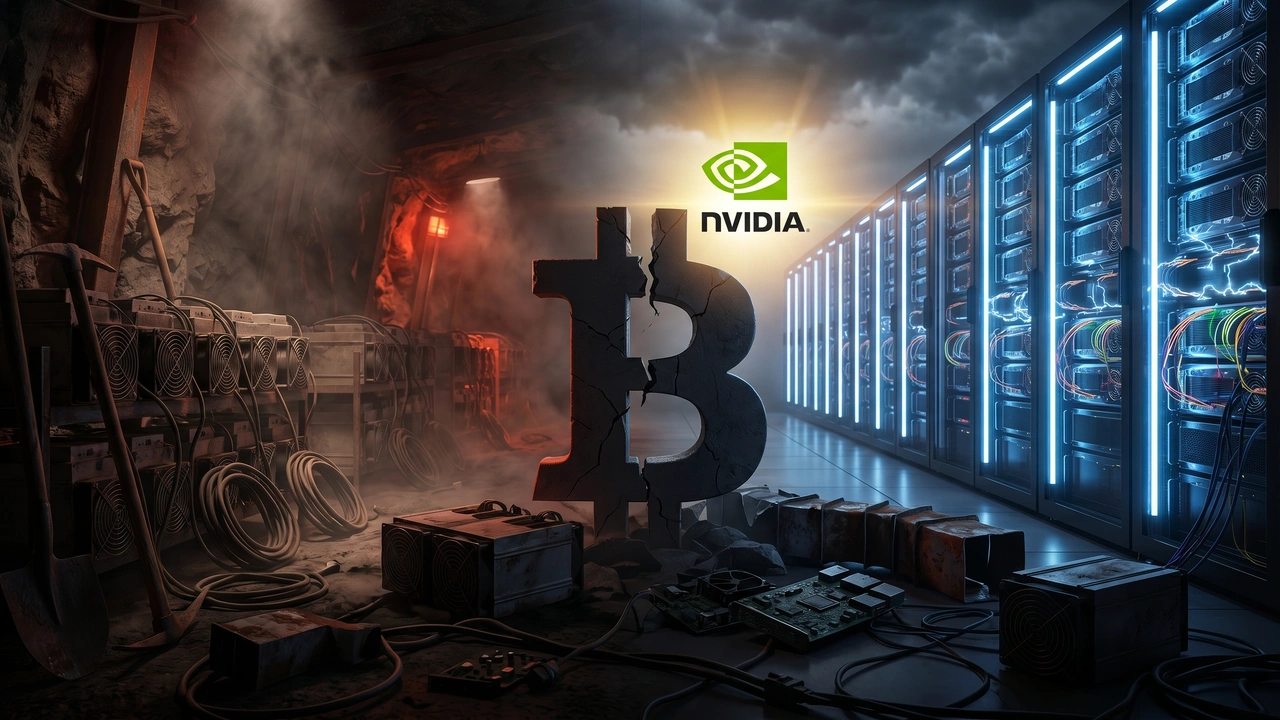
Nvidia's explosive AI revenue surge is lifting Bitcoin miner stock prices even as the mining industry itself confronts a structural reckoning - a collision of shrinking block rewards, record-low hashprice, and the gravitational pull of the AI compute gold rush.
Key Takeaways
- Nvidia's record AI revenue is lifting Bitcoin miner stocks because the market now prices these companies primarily as power and data-center infrastructure plays, not purely as bitcoin producers - a structural rerating with lasting implications.
- Hashprice has collapsed to historic lows and difficulty has posted six consecutive negative adjustments in three months, conditions last seen in 2011, signaling that current mining economics are under severe structural pressure beyond a simple price downturn.
- The AI pivot by large public miners - who collectively control roughly 40 percent of Bitcoin's hashrate - is likely to shrink the megaminer cohort permanently, which, counterintuitively, could benefit smaller independent miners and improve Bitcoin's decentralization.
- The block subsidy math is unforgiving: without either a substantial rise in bitcoin's price or a meaningful revival in transaction fee revenue, the network will increasingly rely on the most energy-cost-efficient operators at the margins to sustain hashrate.
- The current era of publicly listed mega-miners may prove to be a historical anomaly driven by zero-rate financing and post-China mining ban dynamics, rather than the permanent structure of the Bitcoin mining industry.
Mining's Identity Crisis: When Bitcoin's Picks-and-Shovels Industry Finds a New Ore
Two stories are unfolding simultaneously in the Bitcoin mining world, and they point in strikingly different directions. On one hand, Nvidia's blowout quarterly results are sending Bitcoin miner stocks higher, reinforcing the market's conviction that data-center operators - including those that started life mining bitcoin - stand to profit handsomely from the AI infrastructure boom. On the other hand, a more sobering picture is emerging from inside the mining industry itself: one of record revenue compression, a cascade of negative difficulty adjustments not seen since Bitcoin's earliest days, and a structural drift away from hashing blocks entirely. The question is no longer whether Bitcoin mining will change. It is whether it will survive in any recognizable form.
The Facts
Nvidia's first-quarter revenue reached $81.62 billion, a gain of 85 percent year-over-year, with the data-center segment alone generating $75 billion [1]. CFO Colette Kress noted that more than half of that data-center revenue came from large cloud providers, and that AI cloud provider revenue more than tripled compared to the prior year [1]. For the current quarter, Nvidia guided for roughly $91 billion in sales, and the company announced $80 billion in additional share buybacks alongside a higher quarterly dividend [1]. CEO Jensen Huang characterized the AI infrastructure build-out as the single largest such expansion in human history [1].
For Bitcoin miners that have pivoted toward AI and high-performance computing - companies such as Riot, CleanSpark, Core Scientific, IREN, Cipher, Hut 8, and TeraWulf - these numbers are directly relevant [1][2]. Investors increasingly view those companies as proxy plays on power capacity and data-center real estate, regardless of how many ASICs they still operate. Riot and CleanSpark shares each rose around 5 percent on the day of Nvidia's report [1].
The mining economics underlying this pivot are stark. Bitcoin's hashprice - the revenue a miner earns per unit of hashrate - dropped to a record nadir of $28.90 per petahash per day, according to the Hashrate Index platform [2]. That figure means a fleet of roughly five next-generation ASIC machines generates less than $30 per day in gross revenue. In the three months between mid-November 2025 and early February 2026, Bitcoin's network difficulty saw six negative adjustments out of seven total - a string of downward revisions that has no precedent since 2011 [2]. Miners are not just hurting from a softer bitcoin price; they are actively decommissioning ASIC hardware to free up power capacity for GPU-based AI workloads [2].
The publicly traded miners together represent approximately 40 percent of Bitcoin's total hashrate, and a significant portion of that cohort is now steering capital toward AI compute rather than block rewards [2]. The economic logic is straightforward: monetizing a megawatt through GPU rental contracts generates substantially higher returns than mining bitcoin at today's hashprice. The block subsidy itself is on a relentless downward schedule. By 2036 it will have halved again to just 0.78125 BTC per block - to maintain the same nominal dollar payout as the current 3.125 BTC reward, the bitcoin price would need to exceed $272,000 [2]. Transaction fees, which could theoretically compensate, are currently negligible: the mempool is nearly empty and fees have dropped below a single sat per virtual byte, a floor that barely existed two years ago [2].
Analysis & Context
The juxtaposition of a booming Nvidia earnings call and a cratering mining hashprice is not a contradiction - it is the same story told from two vantage points. The AI infrastructure boom requires exactly what Bitcoin miners built over the last decade: cheap, reliable, large-scale power infrastructure paired with high-density computing expertise. The irony is that the very capital and operational discipline miners developed to survive halving cycles has made them attractive candidates to repurpose those facilities for an entirely different workload. History rhymes: after China's 2021 mining ban, the mass migration of hashrate to the United States produced a wave of publicly listed miners who financed aggressive expansion through equity markets, driving hashrate growth far beyond what organic mining economics would have supported [2]. That era may itself be ending, replaced by a new wave of AI-driven repurposing.
Historically, each halving cycle has tested the weakest miners and concentrated hashrate among the best-capitalized. The 2012 halving was survived by hobbyists with GPUs; the 2016 halving filtered out most consumer-grade ASIC operators; the 2020 halving accelerated the transition to industrial-scale mining. What the current cycle adds - and what makes it qualitatively different - is an off-ramp. For the first time, large miners have a capital-intensive alternative business that uses the same assets. That off-ramp is the AI pivot, and it changes the competitive dynamics of mining in ways that previous halvings never did. In prior cycles, stressed miners simply went offline; their hashrate vanished temporarily and difficulty adjusted downward, improving profitability for survivors. This time, a substantial share of hashrate is not just going offline - it is being permanently redirected into AI compute, which means the recovery in mining economics for remaining participants may be faster and more durable than past cycles would suggest.
The implications for Bitcoin's security model are double-edged and worth unpacking carefully. The departure of large public miners removes a genuine centralization risk. As one Bitcoin Magazine analysis points out, firms like Foundry currently mine roughly a third of all Bitcoin blocks [2], creating a single point of potential regulatory capture. A shift toward smaller, more distributed miners - those running on stranded natural gas, co-located with wind farms, or integrated at the power-plant level - would actually strengthen Bitcoin's censorship resistance [2]. That outcome aligns with what decentralization advocates have long argued for. The concern, however, is the transition period: if hashrate drops faster than difficulty adjusts, block times lengthen, confirmation delays mount, and user experience degrades. The six consecutive negative difficulty adjustments already recorded suggest this is not a theoretical risk [2].
The fee market question looms over all of this. The Ordinals and inscriptions wave briefly demonstrated that organic demand for Bitcoin blockspace could meaningfully supplement block subsidies - but that market has since collapsed, and no comparable source of fee pressure has emerged [2]. SegWit and Taproot have improved data efficiency at the cost of reducing on-chain fee density. Layer 2 scaling solutions remain a hope rather than a revenue source for miners. Whether AI-era applications - timestamping, content attestation, identity proofs - generate meaningful on-chain demand by 2036 is genuinely uncertain, but the burden of proof rests with optimists. Miners cannot plan around speculative fee revenue.
Sources
AI-Assisted Content
This article was created with AI assistance. All facts are sourced from verified news outlets.