Institutional Infrastructure Deepens as Major Players Expand Crypto Exposure
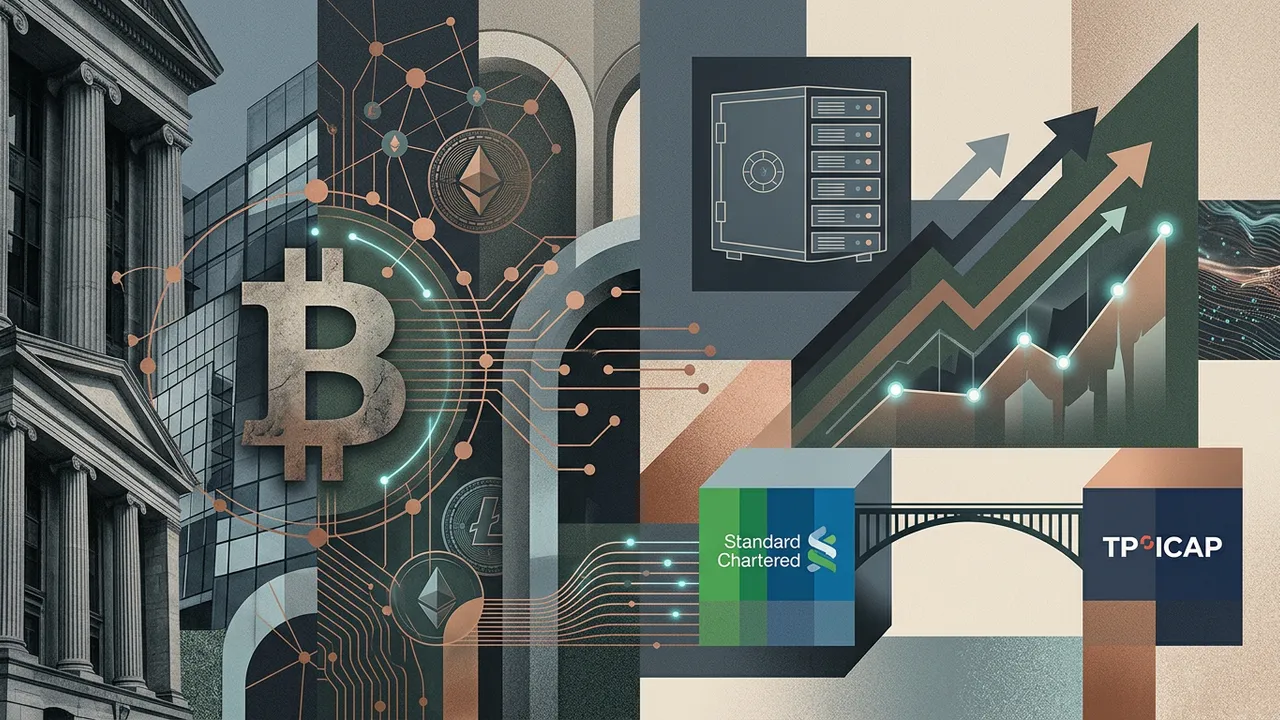
From Cathie Wood's strategic accumulation of Coinbase shares to Standard Chartered's custody partnership with TP ICAP, institutional players are building the infrastructure and positions that signal long-term commitment to digital assets.
Key Takeaways
• Institutional players are accumulating crypto exposure during market volatility rather than retreating, with Ark Invest deploying over $16 million into Coinbase and Robinhood despite geopolitical tensions—a contrarian signal suggesting long-term conviction.
• The Standard Chartered-TP ICAP custody partnership represents critical infrastructure development that addresses the operational and regulatory concerns preventing many traditional institutions from entering digital asset markets at scale.
• The matched-principal trading model with bank-grade custody creates a bridge between traditional finance operational standards and blockchain-based assets, likely accelerating institutional adoption by reducing friction rather than requiring complete operational reimagination.
• The convergence of investment flows (Ark's buying) and infrastructure development (Standard Chartered's custody services) suggests institutional preparation for sustained digital asset market participation rather than speculative trading, fundamentally differentiating current market structure from previous cycles.
• As regulated custody and settlement solutions mature, the remaining barriers to institutional participation shift from "can we operationally handle this?" to "how much should we allocate?"—a profoundly different question that favors increased capital flows over the medium term.
Institutional Infrastructure Deepens as Major Players Expand Crypto Exposure
While retail investors chase price movements, the most sophisticated institutional players are quietly building the foundations of a mature digital asset ecosystem. Recent moves by Ark Invest and Standard Chartered reveal a two-pronged institutional evolution: aggressive accumulation of exposure to crypto-native companies and simultaneous construction of regulated infrastructure that will support the next wave of institutional adoption. These aren't isolated incidents—they represent coordinated preparations for a market transformation that many retail participants have yet to fully appreciate.
The convergence of investment flows and infrastructure development tells us something critical: institutional players are positioning not for a trade, but for a permanent seat at the table in digital asset markets.
The Facts
Cathie Wood's Ark Invest has significantly expanded its positions in crypto-related equities amid broader market volatility. The investment firm purchased $4.1 million worth of Coinbase shares (COIN) across three of its flagship funds: the ARK Innovation ETF, ARK Next Generation Internet ETF, and ARK Fintech Innovation ETF [1]. Simultaneously, Ark deployed an even larger $12 million into Robinhood (HOOD) through the same vehicle structure [1].
This buying spree follows a volatile trading pattern from Ark Invest over recent months. In the previous month, the firm had already acquired approximately $15.2 million in Coinbase shares after a period of net selling [1]. Earlier in February, Ark had liquidated roughly $17.4 million in Coinbase stock, followed by additional sales totaling around $22 million [1]. The recent purchases suggest Wood views current price levels as attractive entry points despite—or perhaps because of—heightened geopolitical tensions involving the United States, Israel, and Iran that have pressured global equity markets [1].
On the infrastructure side, Standard Chartered has been appointed as the digital asset custodian and settlement agent for TP ICAP's Fusion Digital Assets platform, marking a significant operational milestone for both institutions [2]. This partnership, which deepens a collaboration first announced in October 2024, directly supports TP ICAP's expansion into matched-principal trading for spot crypto assets [2].
Fusion Digital Assets, operated by TP ICAP E&C Limited and registered with the UK Financial Conduct Authority for crypto-asset activities, provides institutional clients access to digital asset trading on a regulated UK exchange [2]. Under the matched-principal model, TP ICAP acts as counterparty to both sides of every trade, eliminating prefunding requirements for clients and using multilateral netting to reduce gross settlement volumes [2].
Margaret Harwood-Jones, Global Head of Financing & Securities Services at Standard Chartered, emphasized the strategic nature of the collaboration: "We are pleased to deepen our collaboration with TP ICAP, reinforcing our shared vision of bridging traditional and digital finance. Our custody and settlement solutions will enable TP ICAP to scale its matched principal activity securely and efficiently, meeting growing institutional demand" [2].
Duncan Trenholme, Managing Director and Global Co-Head of Digital Assets at TP ICAP, described the arrangement as enabling the firm "to settle blockchain-based assets through our own accounts for the first time and offer a broader array of on-chain assets and execution services to clients" [2]. The custody arrangement remains agnostic on the client side, allowing counterparties to deliver assets from their preferred custodian rather than mandating Standard Chartered exclusively [2].
This development follows Standard Chartered's earlier 2024 partnership with B2C2 to enhance institutional crypto market access, combining the bank's global infrastructure with B2C2's liquidity across spot and options trading [2]. That collaboration aims to streamline fiat-to-crypto transactions with faster settlement, particularly targeting asset managers, hedge funds, corporates, and family offices [2].
Analysis & Context
These parallel developments reveal the maturation of institutional crypto participation along two critical dimensions: conviction and capability. Ark Invest's accumulation pattern—buying aggressively during market stress caused by geopolitical uncertainty—demonstrates sophisticated contrarian positioning. Wood's firm isn't merely maintaining exposure; it's actively increasing stakes when valuations compress, a classic sign of long-term conviction rather than momentum chasing.
The Coinbase position is particularly telling. As the primary regulated on-ramp for institutional capital in the United States, Coinbase's business performance serves as a proxy for institutional adoption trends. By accumulating shares during volatility, Ark is effectively betting that the current geopolitical turbulence represents noise rather than signal regarding the long-term trajectory of institutional crypto adoption. The even larger Robinhood investment suggests Ark sees retail crypto access as another crucial growth vector, particularly as younger demographics continue entering markets.
The Standard Chartered-TP ICAP partnership addresses what has historically been the primary barrier to institutional participation: the absence of bank-grade custody and settlement infrastructure that meets fiduciary standards. Traditional financial institutions require the same operational safeguards for digital assets that they enjoy in equities and fixed income markets. By providing regulated custody within a matched-principal framework, this partnership eliminates the operational friction that has kept many institutions on the sidelines.
The matched-principal model is especially significant because it shifts counterparty risk management to TP ICAP while maintaining the settlement efficiency advantages of blockchain technology. This hybrid approach—blockchain-based assets operating within traditional market structures—represents the most likely path for mainstream institutional adoption. Rather than forcing institutions to completely reimagine their risk management frameworks, it allows them to extend existing processes to a new asset class.
Historically, every major asset class expansion has required this type of infrastructure buildout before significant institutional capital could flow. The 1970s development of the Depository Trust Company enabled the equity market explosion of subsequent decades. Today's custody and settlement infrastructure for digital assets serves an analogous function, reducing operational barriers that currently constrain allocation decisions at pension funds, endowments, and insurance companies.
Sources
AI-Assisted Content
This article was created with AI assistance. All facts are sourced from verified news outlets.