Iran's Bitcoin Toll and the Ceasefire Rally: What It Means for BTC
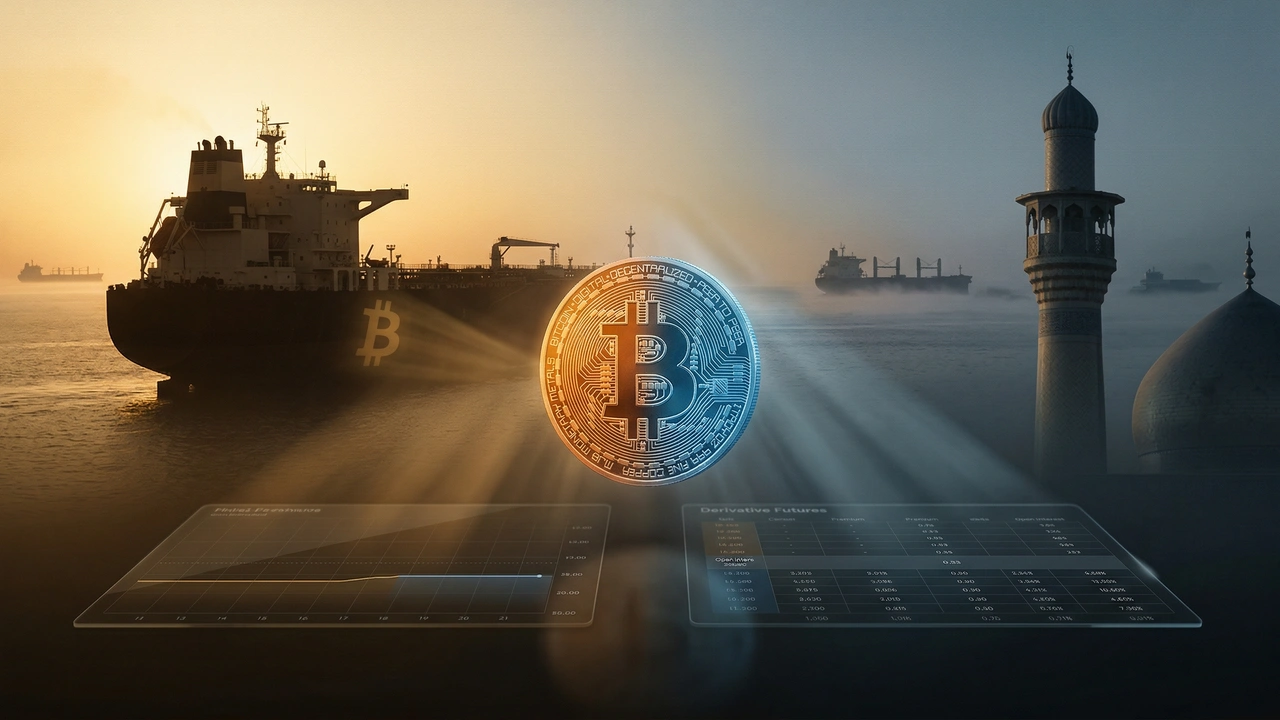
A US-Iran ceasefire sparked a 6% Bitcoin rally and a historic demand for Bitcoin as Strait of Hormuz transit fees — but derivatives data and a 'fragile truce' warn against premature optimism.
Key Takeaways
- Iran's explicit demand for Bitcoin as Strait of Hormuz transit fees is a landmark geopolitical validation of Bitcoin's censorship-resistance properties, representing a qualitatively new sovereign use case beyond speculation or reserves.
- The 6% BTC rally is real but structurally shallow — derivatives metrics including a sub-neutral futures premium, flat open interest growth, and persistent put option demand all indicate that professional traders are not yet positioning for a sustained bull move.
- A two-week ceasefire is not a resolution — elevated oil prices near $95/barrel and JD Vance's own characterization of a "fragile truce" keep the $68,000 correction scenario firmly on the table for investors managing risk.
- US regulatory stagnation compounds the uncertainty — the failure of the PARITY Act to include key Bitcoin-friendly provisions and the loss of the White House's crypto policy lead remove two near-term catalysts that bulls were counting on.
- Watch the Strait of Hormuz negotiations closely — if Iran's Bitcoin toll model survives into any longer-term framework, it could establish a geopolitical precedent that permanently elevates Bitcoin's macro relevance, independent of short-term price action.
When Geopolitics Hands Bitcoin Its Most Consequential Moment Yet
In a single week, Bitcoin has been thrust into the center of two of the most significant geopolitical developments of 2025: a market-moving US-Iran ceasefire and an unprecedented demand by Tehran to accept Bitcoin as payment for passage through one of the world's most critical shipping lanes. Together, these events represent something far larger than a short-term price catalyst — they signal a stress test for Bitcoin's identity as a censorship-resistant, sovereign-grade monetary network. The question now is whether the market truly understands what is unfolding.
For years, Bitcoin proponents have argued that BTC would eventually be called upon precisely when traditional financial rails fail — when sanctions bite, when trust between nations collapses, and when no neutral currency exists. That theoretical argument just met a real-world scenario in the Strait of Hormuz.
The Facts
Bitcoin surged approximately 6% in under four hours following news that the United States and Iran had agreed to a two-week ceasefire deal [1]. The move caught leveraged traders off guard, triggering a $280 million liquidation event predominantly affecting bearish futures positions [1]. The rally closely tracked gains in global equity markets, reflecting Bitcoin's persistent high correlation with S&P 500 futures — a correlation that, in this instance, was driven by the prospect of the Strait of Hormuz reopening to commercial shipping [1].
US President Donald Trump stated that Iran's nuclear program would be wound down in exchange for tariff and sanctions relief, while US Vice President JD Vance tempered expectations by characterizing the arrangement as a "fragile truce" [1]. The geopolitical stakes are enormous: prior to the conflict, roughly 135 ships transited the strait daily, primarily carrying oil, and an estimated 400 vessels are currently waiting to safely exit the Persian Gulf [3].
Perhaps the most structurally significant development came from the Iranian side of the negotiating table. Hamid Hosseini, a spokesperson for Iran's state-affiliated oil exporters' association, confirmed to the Financial Times that ships seeking passage would face weapons inspections and transit fees — and that those fees must be paid in cryptocurrency, with Bitcoin specifically named as the preferred instrument [3]. Under the proposed framework, oil tankers would pay approximately $1 per barrel, with payment windows of only seconds after inspection approval — a design explicitly intended to prevent sanction-related payment reversals or asset freezes [3]. Iran had previously accepted yuan and stablecoins for transit during the conflict, but shifted to Bitcoin due to its superior censorship resistance, since stablecoins and fiat currencies can be frozen by their issuers or governments [3].
Meanwhile, despite the headline-grabbing rally, Bitcoin derivatives markets painted a more cautious picture. The annualized futures premium held flat at roughly 3%, remaining below the neutral 4% threshold it has failed to breach since late January [1]. Open interest in Bitcoin futures rose only marginally to 593,930 BTC, and demand for put options — bearish downside protection — continued to outpace call options over the preceding two weeks [1]. Brent crude oil remained elevated near $95 per barrel, up sharply from $72 per barrel in late February, suggesting inflationary pressure has not meaningfully eased [1].
On the regulatory front, additional headwinds emerged. The latest draft of the PARITY Act failed to include tax exemptions for small Bitcoin payments or deferred capital gains treatment for mining income [1]. David Sacks, the White House's AI and crypto policy coordinator, also departed his role [1], leaving the US Strategic Bitcoin Reserve initiative without its most visible champion and no disclosed mechanism for acquisition.
Analysis & Context
The Iran-Bitcoin toll story deserves to be understood for what it actually represents, stripped of both hype and dismissiveness. Nation-states have historically sought neutral, hard-to-censor monetary instruments during periods of sanctions and conflict — gold being the clearest precedent. Iran's explicit choice of Bitcoin over yuan and dollar-pegged stablecoins is a revealing data point: it acknowledges that only a truly decentralized asset with no issuer can provide the censorship-resistance required in a high-stakes, sanctions-laden environment. If this toll model were to survive beyond the ceasefire period, it would mark the first time Bitcoin functioned as an enforced medium of exchange on a global trade chokepoint — a qualitatively different use case than retail speculation or institutional portfolio allocation.
Historically, Bitcoin has reacted sharply to macro risk-off and risk-on shifts, frequently in lockstep with equities rather than as an independent safe haven. The 6% rally driven by ceasefire news, mirroring S&P 500 gains, is consistent with that pattern. But the derivatives data telling us that open interest barely moved and the futures premium remained below neutral is a critical signal: the market is not yet pricing in a durable geopolitical resolution. Liquidation cascades of $200-$300 million have occurred five other times over the prior 90-day window [1], meaning this event, while significant, does not represent an unusual shift in structural positioning. The last time Bitcoin faced a similar combination of geopolitical-driven rally without underlying derivatives conviction — the early 2024 ETF approval period — the initial spike was followed by weeks of consolidation before the next leg higher materialized.
The regulatory picture in the US adds an important layer of complexity. Without meaningful legislative progress on Bitcoin-friendly tax treatment or a credible Strategic Reserve acquisition plan, domestic institutional demand faces structural friction. The departure of David Sacks removes a key policy advocate at a delicate moment. Bears are not covering aggressively, oil remains elevated, and a two-week ceasefire is, by definition, a temporary arrangement. The path to a sustained break above $80,000 likely requires either a durable geopolitical resolution that genuinely reduces inflationary pressure, a Federal Reserve pivot on interest rates, or a concrete domestic regulatory catalyst — none of which are currently in place [1].
Sources
AI-Assisted Content
This article was created with AI assistance. All facts are sourced from verified news outlets.