Ireland Seizes 500 Lost Bitcoin From Drug Dealer in Landmark Operation
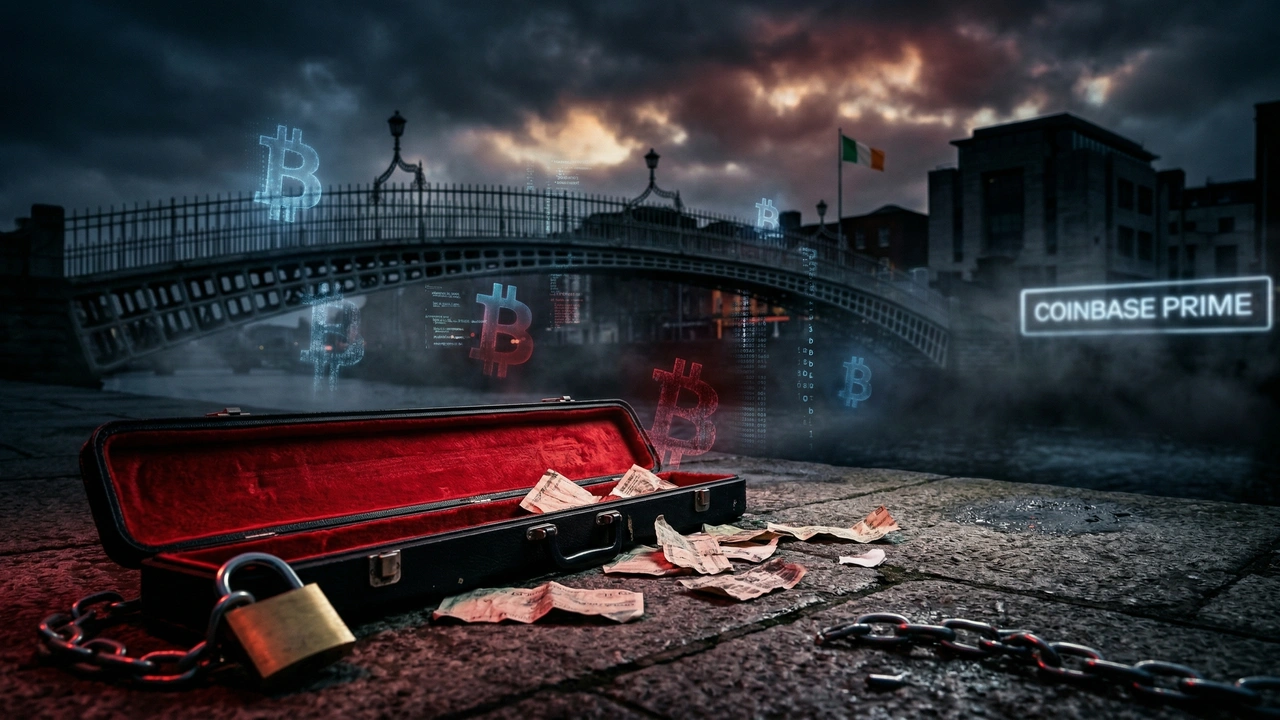
Irish police, working with Europol, have recovered 500 Bitcoin worth ~$35 million from convicted drug dealer Clifton Collins — coins believed lost for a decade — raising critical questions about Bitcoin's cryptographic security and wallet generation practices.
Ireland's Landmark Crypto Seizure Exposes a Hidden Vulnerability in Self-Custody
A Bitcoin wallet dormant for nearly a decade suddenly roared back to life on March 24th — and the story behind that single transaction reveals far more than just a drug dealer's misfortune. The recovery of 500 Bitcoin worth approximately $35 million by Irish law enforcement, in cooperation with Europol, represents one of the most technically intriguing cryptocurrency seizures in European history. It forces a fundamental question: if authorities can crack open a wallet whose private keys were supposedly lost, what does that mean for Bitcoin's foundational promise of absolute ownership?
The case of Clifton Collins — former beekeeper turned cannabis entrepreneur turned accidental Bitcoin billionaire — is equal parts cautionary tale and forensic thriller. And it is far from over.
The Facts
On-chain analysts flagged an unusual transaction on the morning of March 24th, when a wallet linked to convicted Irish drug trafficker Clifton Collins moved 500 BTC — roughly $35 million at the time — after sitting completely dormant since January 2016 [1]. Blockchain intelligence firm Arkham Intelligence had long labeled this wallet cluster under the identifier "Clifton Collins: Lost Keys," reflecting the widespread belief that access to these funds had been permanently severed [2].
According to reporting by the Irish Times and confirmed by a press statement from Ireland's Criminal Assets Bureau (CAB), authorities successfully accessed and seized the wallet contents [1]. The CAB — a specialized unit within the Garda Síochána, Ireland's national police force — confirmed it had gained access to a crypto wallet containing 500 Bitcoin identified as proceeds of criminal activity, with critical support provided by Europol's European Cybercrime Centre [2]. Following the initial movement, the Bitcoin was distributed across dozens of addresses, with approximately $13.5 million ultimately routed to Coinbase Prime — a detail that immediately signaled institutional or law enforcement involvement rather than a criminal actor, since any savvy operator attempting to quietly liquidate funds would avoid a KYC-mandatory exchange [2].
Collins, now 55, began growing and selling cannabis in 2005, using the proceeds to purchase Bitcoin in late 2011 and early 2012 when the price was only a few dollars per coin [1]. His total investment of approximately $30,000 eventually yielded a holding of 6,000 BTC spread across 12 separate wallets — a fortune now valued at over $427 million [1]. Collins printed his private keys on paper and concealed them inside a fishing rod case in a rented property in County Galway. When he was arrested in 2017 and sentenced to five years in prison, the case reportedly disappeared — likely discarded during a clearance of the rental property [2].
While Irish authorities have not officially confirmed the wallet belongs to Collins, nor disclosed precisely how access was restored, their press statement notably cited the use of "highly complex technical expertise and decryption resources" provided by Europol during operational sessions held at its headquarters in The Hague [2]. Crucially, only one of the twelve wallets — 500 BTC out of a total 6,000 BTC — has been emptied, suggesting authorities have not recovered the physical paper keys but may instead be working through wallets one at a time using technical reconstruction methods [2].
Analysis & Context
The technical dimension of this case is where things become genuinely significant for the broader Bitcoin community. The cryptographic security underpinning Bitcoin is, under normal circumstances, computationally impenetrable — brute-forcing a private key is not a realistic attack vector. If it were, Satoshi Nakamoto's estimated 1.1 million unmoved coins would have been plundered long ago [2]. The fact that authorities accessed only one of twelve wallets, combined with Europol's specific reference to "decryption resources," strongly implies that Collins did not use a high-quality hardware wallet with a properly randomized seed generation process. Instead, he likely relied on an early or inferior method of key generation — one that introduced enough predictability or bias to make forensic reconstruction feasible with sufficient computing power and analytical expertise [2].
This is not without precedent. Wallet recovery specialists like ReWallet have built entire businesses around the idea that imperfectly generated seeds can sometimes be reconstructed given enough contextual clues and computational effort [2]. In the early days of Bitcoin, 2011-2012, the tools available to ordinary users were rudimentary, and many people generated keys using methods that would be considered dangerously inadequate today. Collins appears to have been among them — a fact that ultimately cost him (or, depending on one's perspective, returned to the public) tens of millions of dollars.
From a market standpoint, 500 BTC moving to Coinbase Prime signals an imminent or ongoing sale by Irish authorities. Unlike the United States, which under President Trump's executive order on a strategic Bitcoin reserve has adopted a policy of holding seized BTC rather than liquidating it, Ireland has no such framework [2]. The remaining 5,500 BTC — if and when they are recovered through continued technical efforts — would represent a more substantial market event, though still modest in the context of Bitcoin's daily trading volume. The broader implication for investors is not price pressure, but rather a reminder that state-level actors are becoming increasingly sophisticated at tracing, attributing, and recovering on-chain assets. The era of "lost forever" Bitcoin, at least for those who stored keys carelessly, may be drawing to a close.
Key Takeaways
- Self-custody quality is non-negotiable: Collins' apparent use of a weak or non-random key generation method allowed law enforcement to reconstruct access — a stark warning that how you generate your seed phrase matters as much as where you store it.
- Only one of twelve wallets was accessed: Authorities likely do not have the physical paper keys; they appear to be technically reconstructing keys one at a time, meaning the remaining 5,500 BTC (~$427M+) could still be recovered in future operations.
- Europol's cryptographic capabilities are advancing: The agency's explicit reference to "decryption resources" signals that European law enforcement has quietly developed or acquired serious technical capacity for Bitcoin wallet forensics — a development the industry should monitor closely.
- Ireland will likely sell the seized BTC: Without a strategic reserve policy like the U.S., Irish authorities are expected to liquidate the seized coins, consistent with standard asset forfeiture procedures.
- The $30,000 to $427M+ trajectory underscores Bitcoin's long-term value proposition: Collins bought approximately 6,000 BTC for around $30,000 in 2011-2012 — a return that dwarfs virtually any other asset class over the same period, even if the circumstances of this particular holding are extraordinary.
Sources
AI-Assisted Content
This article was created with AI assistance. All facts are sourced from verified news outlets.