JPMorgan, Ripple and the Tokenization Race Leaving Bitcoin Behind
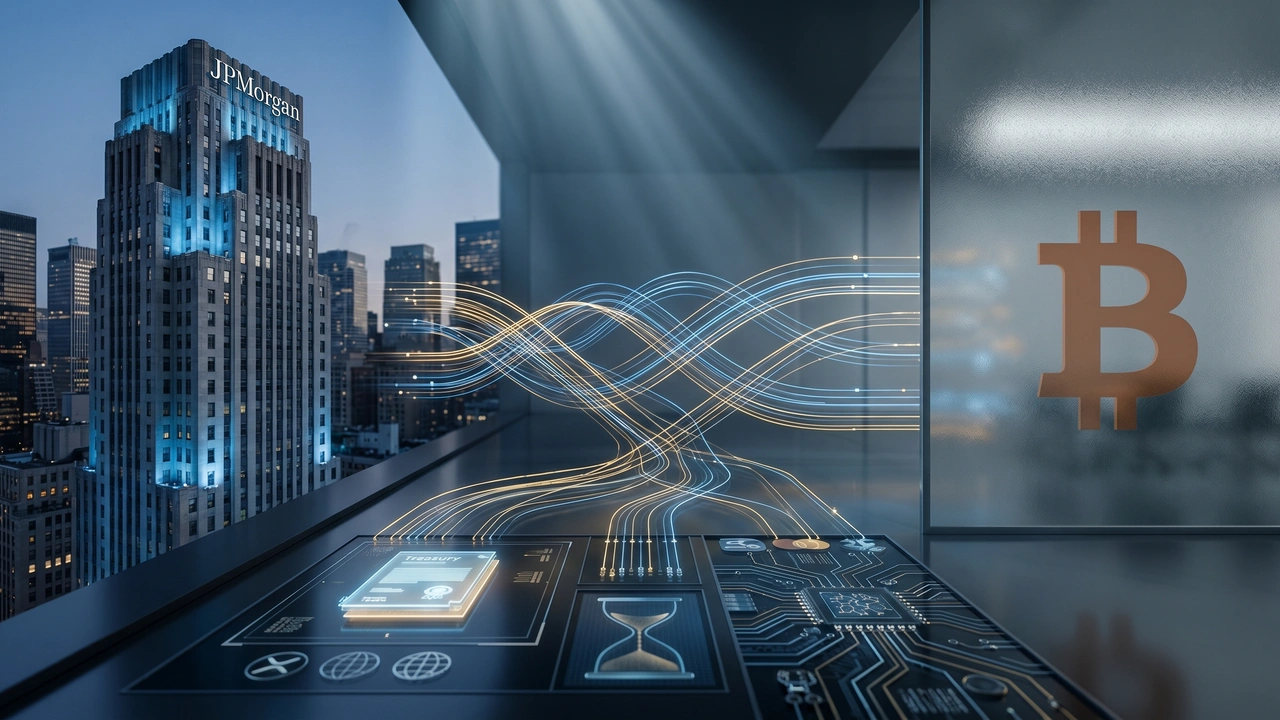
A landmark near-real-time treasury transaction involving JPMorgan, Mastercard, and Ripple signals the accelerating institutional push into tokenized assets - raising pointed questions about where Bitcoin fits in the emerging financial architecture.
Key Takeaways
- The JPMorgan-Ondo-Mastercard-Ripple pilot transaction completed a cross-border tokenized Treasury redemption in under five seconds, representing a genuine infrastructure milestone for institutional finance rather than a consumer-facing breakthrough [2].
- Tokenization of real-world assets is accelerating rapidly, with Kinexys processing over $3 trillion in transactions and the DTCC preparing to launch its own tokenization service this year - this is infrastructure that will reshape settlement, not just experimentation [2].
- Bitcoin's design philosophy stands in deliberate contrast to this trend: while XRP functions as settlement rail for bank-controlled assets, Bitcoin's value lies in being the asset itself, not the pipeline for other people's assets.
- Ripple's equity story reveals a structural tension - retail XRP holders cannot access Ripple corporate upside through conventional equity markets, and even the former CTO discourages secondary market participation, reinforcing the gap between the company's success and the token holder's position [1].
- Investors should distinguish clearly between infrastructure plays in the tokenization space and sovereign, censorship-resistant assets like Bitcoin - these are different bets on different futures, and conflating them carries real analytical risk.
When Wall Street and Crypto Shake Hands: The JPMorgan-Ripple Treasury Test Changes the Conversation
Something significant happened in global finance this week, and it happened in under five seconds. A cross-border redemption of a tokenized U.S. Treasury fund was completed nearly in real time, stitching together a public blockchain, a multinational payments network, and one of the world's most powerful banks. The participants - Ondo Finance, JPMorgan, Mastercard, and Ripple - represent a convergence that would have seemed implausible just a few years ago. What it signals about the direction of institutional finance deserves serious scrutiny, especially from a Bitcoin-first perspective.
At the same time, a separate but related story is unfolding around Ripple's own corporate structure, where the company's former chief technology officer is actively discouraging retail investors from purchasing Ripple equity on secondary markets. Together, these two developments paint a nuanced and sometimes contradictory picture of how the XRP ecosystem is positioning itself in the new financial order.
The Facts
The centerpiece of this week's news is a pilot transaction orchestrated by Ondo Finance, in which the company's tokenized U.S. Treasury product, known as OUSG, was redeemed across borders in less than five seconds [2]. OUSG is designed for accredited investors and qualified buyers seeking exposure to U.S. government debt through blockchain infrastructure.
The mechanics of the transaction are worth unpacking carefully. The redemption was first processed on the XRP Ledger. Mastercard's Multi-Token Network then relayed payment instructions to Kinexys, JPMorgan's dedicated blockchain platform. JPMorgan subsequently transferred U.S. dollars directly to Ripple's bank account in Singapore [2]. The entire sequence occurred outside of conventional banking hours - precisely the scenario where legacy correspondent banking systems fail investors, often stretching settlement windows to one to three business days for cross-border transactions [2].
Ondo President Ian De Bode framed the pilot as a foundational step toward financial markets that operate continuously, describing the combination of public blockchain infrastructure with interbank payment rails as the basis for a truly 24/7 global market [2]. RippleX executive Markus Infanger echoed this view, arguing that institutional players could eventually manage cross-border movements of tokenized assets as a seamless, integrated workflow rather than a fragmented process relying on aging banking infrastructure [2].
The broader context matters here. JPMorgan's Kinexys platform has already processed more than three trillion dollars in transactions by the company's own account [2]. The Depository Trust and Clearing Corporation announced this week that it plans to launch its own tokenization service before year's end [2]. Tokenization of real-world assets is no longer a whitepaper concept - it is becoming operational infrastructure.
Meanwhile, on the equity side of the Ripple story, former Ripple CTO David Schwartz made headlines for candid and somewhat contradictory remarks on X. He acknowledged that cryptocurrencies represent a potentially life-changing wealth opportunity, yet simultaneously advised investors against purchasing Ripple shares on secondary markets such as Forge Global [1]. Schwartz cited legal constraints as the reason Ripple cannot offer public access to its equity, noting that secondary market participation is restricted to investors who meet U.S. accredited investor requirements [1]. Ripple shares reached a high of $243.23 on November 6, 2025 on Forge Global, compared to an initial listing price of $19.74 in January 2023, and are currently trading around $116 [1]. Ripple President Monica Long has stated clearly that the company intends to remain private for the foreseeable future [1].
Analysis & Context
For Bitcoin-focused observers, this week's developments carry a dual message. On one hand, the JPMorgan-Ripple transaction is a genuine technical milestone. Near-instant cross-border settlement of tokenized government securities is a problem worth solving, and the fact that it was achieved using a public blockchain ledger rather than purely private infrastructure is meaningful. It demonstrates that institutional finance is increasingly willing to engage with public blockchain rails - even if the asset being settled is a JPMorgan product moving to a Ripple bank account, rather than a native crypto asset.
On the other hand, Bitcoin maximalists will note what this transaction fundamentally is: a more efficient wrapper around traditional financial instruments. OUSG is a tokenized Treasury fund. It represents the same U.S. government debt that existed before blockchain technology. The innovation is in the plumbing, not the asset. Bitcoin's value proposition rests on the opposite premise - that the asset itself is new, that its scarcity and neutrality are the point, and that dependence on bank accounts in Singapore or JPMorgan's internal platforms reintroduces exactly the counterparty risk that sound money is meant to eliminate.
Historically, every wave of financial innovation has involved incumbent institutions attempting to absorb disruptive technology on their own terms. The introduction of electronic trading, derivatives, and ETFs all followed a similar pattern: first resistance, then co-option, then the creation of new intermediaries. The tokenization push bears the hallmarks of that same dynamic. JPMorgan is not embracing Ripple because it has converted to decentralization ideology - it is using available infrastructure to reduce settlement costs and extend its operating window. The XRP Ledger, in this context, functions as a utility, not a revolution. For Bitcoin, which has resisted being co-opted into this kind of infrastructure role, the contrast is instructive. Bitcoin remains outside the institutional plumbing even as alternatives are absorbed into it.
The Schwartz equity commentary adds another layer of complexity. An insider at one of the most prominent companies in crypto actively steering retail investors away from equity exposure - while acknowledging personally holding stock he finds comfortable - highlights the persistent asymmetry between retail and institutional access in this space. The illiquid secondary market for Ripple shares, available only to accredited investors, is a reminder that the democratization narrative in crypto has real limits.
Sources
- [1]btc-echo.de
- [2]btc-echo.de
AI-Assisted Content
This article was created with AI assistance. All facts are sourced from verified news outlets.