Scarcity Wins: SpaceX Bets and Bitcoin Cards Signal Alt-Asset Shift
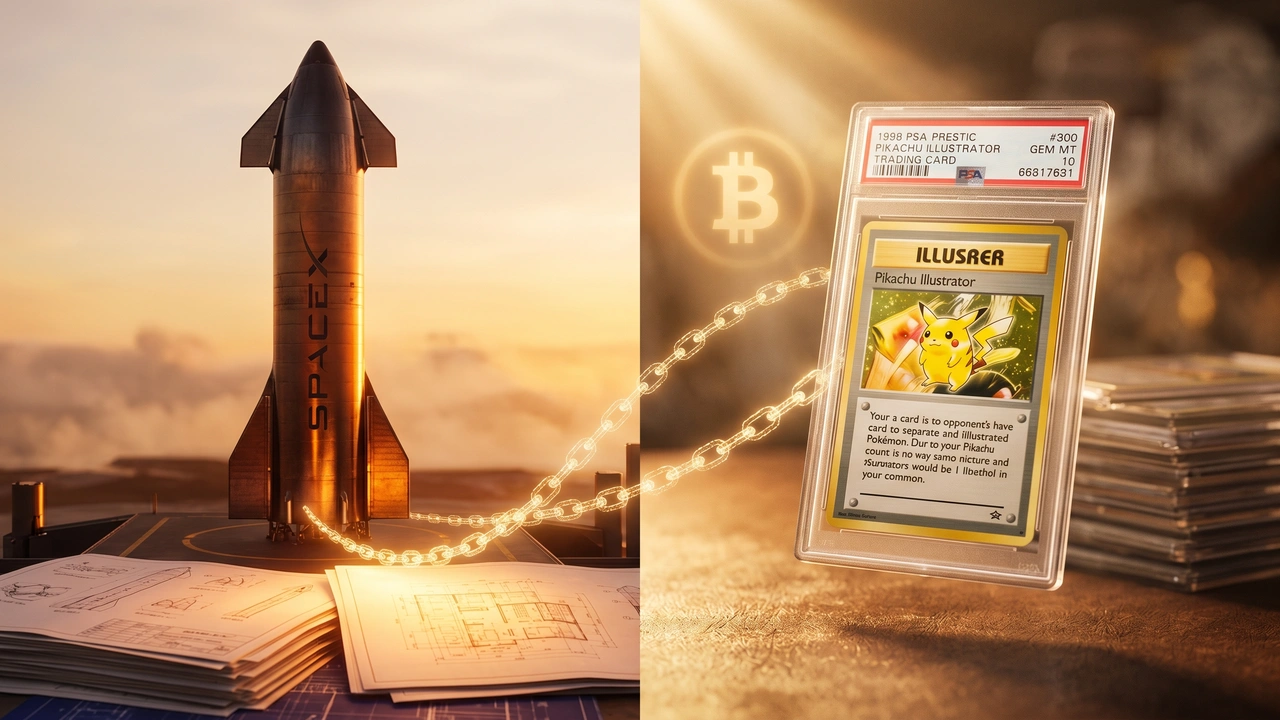
From Ron Baron's billion-dollar SpaceX accumulation to Bitcoin-themed trading cards fetching record prices, a convergent thesis is emerging: verifiable scarcity and long-horizon conviction are reshaping how serious money approaches alternative assets.
Key Takeaways
- Ron Baron's $1 billion SpaceX top-up was a dilution-prevention strategy, not a fresh speculative entry - his conviction at a $2 trillion valuation remains unchanged, with a ten-year target range of $20 trillion to $40 trillion.
- The $16.5 million Pikachu Illustrator sale is not an outlier but a data point confirming that properly authenticated physical scarcity now attracts capital at institutional scale.
- Bitcoin-culture collecting is maturing: Based Trading Cards' approach of explicit consent from featured figures, limited serialization, and long-horizon storytelling mirrors Bitcoin's own low-time-preference ethos.
- Flinn's warning about AI-generated sets and overnight print-on-demand releases as cycle-top indicators deserves attention from collectors, just as on-chain analysts watch leverage metrics for similar signals in crypto markets.
- Across SpaceX equity, premium trading cards, and Bitcoin, the same thesis is compounding: verifiable scarcity plus community conviction is outperforming conventional diversification strategies over multi-year horizons.
Scarcity Wins: SpaceX Bets and Bitcoin Cards Signal Alt-Asset Shift
What do a rocket company valued at two trillion dollars and a cardboard Pikachu have in common? More than the question deserves to be dismissed. Across wildly different asset classes, the same organizing principle is quietly taking over: provable scarcity, authenticated ownership, and communities built around long-term conviction are outcompeting the old logic of liquidity and diversification. The investors and founders who grasped this early are now sitting on returns that make conventional portfolio managers uncomfortable.
This isn't a coincidence of timing. It reflects a deeper anxiety about the purchasing power of fiat currency and a growing appetite for assets whose supply cannot be quietly inflated away. Bitcoin holders recognized this dynamic years before Wall Street did. What's new is how far the vocabulary has spread.
The Facts
The clearest data point comes from Ron Baron, the 83-year-old billionaire who has staked his reputation on Elon Musk's ventures for nearly a decade. Baron Capital recently dropped another $1 billion on SpaceX shares during the company's IPO, not as a fresh bet but as a defensive maneuver to prevent dilution of an existing stake. The firm's total exposure to the space company now sits at roughly $25 billion [1]. Baron first committed capital when SpaceX carried a valuation below $22 billion back in 2017 - meaning his entry price is a fraction of where the company trades today [1].
Even so, Baron sees the current $2 trillion valuation as a floor rather than a ceiling. His projection: SpaceX could be worth somewhere between $20 trillion and $40 trillion within a decade [1]. The arithmetic behind that forecast leans on what Baron views as an insurmountable competitive lead. In his words on CNBC: "What they have done is not achievable for anyone else. Not possible." He argued that Musk remains at least ten years ahead of every competitor on rockets, satellites, and network infrastructure [1]. By late March, SpaceX already represented about a third of the $10.4 billion Baron Partners Fund and roughly a quarter of the Baron Asset Fund, putting nearly half of those portfolios in Musk-linked equities when Tesla holdings are included [1].
On the other end of the asset-size spectrum, the trading card market just delivered its own jaw-dropping proof of concept. In February 2026, a single 1998 Pikachu Illustrator card - the sole PSA 10-graded copy known to exist - sold through Goldin Auctions for $16,492,000, making it the priciest trading card ever to clear at auction [2]. The buyer, A.J. Scaramucci, framed the acquisition as the opening move in a broader pursuit of the globe's most irreplaceable objects [2]. The sale confirmed what collectors had been whispering for years: physical scarcity, properly documented, commands institutional-scale capital.
Aladdan Flinn, founder of Based Trading Cards - launched in late 2022 and also marketed as Bitcoin Trading Cards - built his company precisely at the intersection of these two worlds [2]. Watching NFTs fail to replicate the tactile credibility of physical cards, he developed serialized, limited-edition cards designed to teach sound-money principles through the medium of collecting. The company secures explicit approval from the figures it features - pioneers like Michael Saylor and Adam Back - rather than trading on their likeness opportunistically [2]. Flinn's read on the current market is candid: the collector base is split between veterans who survived previous downturns and newcomers who haven't yet learned to look past hype. He warns that AI-generated artwork, overnight print-on-demand sets, and influencer-driven launches are reliable warning signs of a cycle top [2].
Looking forward, Flinn is skeptical that NFTs will serve as the bridge connecting physical and digital collecting. His bet is on augmented reality instead - a layer that enhances the experience of a physical card without substituting for it or artificially inflating its monetary value [2]. The card's worth, in his framework, remains anchored to the object itself and to the story it preserves.
Analysis & Context
The pattern running through both stories is one Bitcoin analysts will recognize immediately: the market is assigning a growing premium to assets with hard supply limits and transparent provenance. Baron's SpaceX thesis and Flinn's trading card philosophy are structurally analogous to the Bitcoin investment case - buy scarcity early, hold through volatility, trust the long-term trajectory over short-term price noise.
What makes this moment notable is that the thesis is now being expressed simultaneously across multiple asset classes, including aerospace equity, physical collectibles, and digital currency. When previously disconnected communities start converging on the same underlying logic, it usually signals something more durable than a temporary trend. The Bitcoin world spent roughly a decade being treated as a fringe experiment before institutional adoption validated the framework. The trading card market is arguably a few years behind that curve, still navigating its own hype-and-correction cycle. Baron's SpaceX accumulation, by contrast, represents a fully mature expression of the same conviction - an investor so confident in the scarcity of Musk's technical lead that he treats every dilution event as a buying opportunity.
The risk embedded in all three of these assets is also structurally similar: concentration. Baron's funds are heavily exposed to a single founder's execution capacity. Trading cards are vulnerable to authentication fraud and supply manipulation, which Flinn explicitly flags as a present danger [2]. Bitcoin carries its own set of macro and regulatory tail risks. Diversification across these three categories doesn't eliminate concentration risk - it merely relocates it to a shared dependency on the broader thesis that scarcity holds value over time.
Sources
AI-Assisted Content
This article was created with AI assistance. All facts are sourced from verified news outlets.